~/mythology/religion
Dionysus and Heracles: Two Gods at the Gate
Dionysus and Heracles crossed the human–divine boundary through suffering, initiation, and return. Their ancient pairing reveals why gods needed human lives.
TL;DR
- Ancient Greeks repeatedly paired Dionysus and Heracles as sons of Zeus whose lives brought divine power into human suffering.
- Both entered Hades and returned; an ancient text explicitly connects both journeys with initiation.
- Their shared images, civic worship, and royal ancestries made the passage between human and divine life a public concern.
- Heracles’ ascent and Dionysus’s return with his mother offered different versions of the same hope: the boundary around mortal life could be crossed.
Why Dionysus and Heracles guarded the same gate #
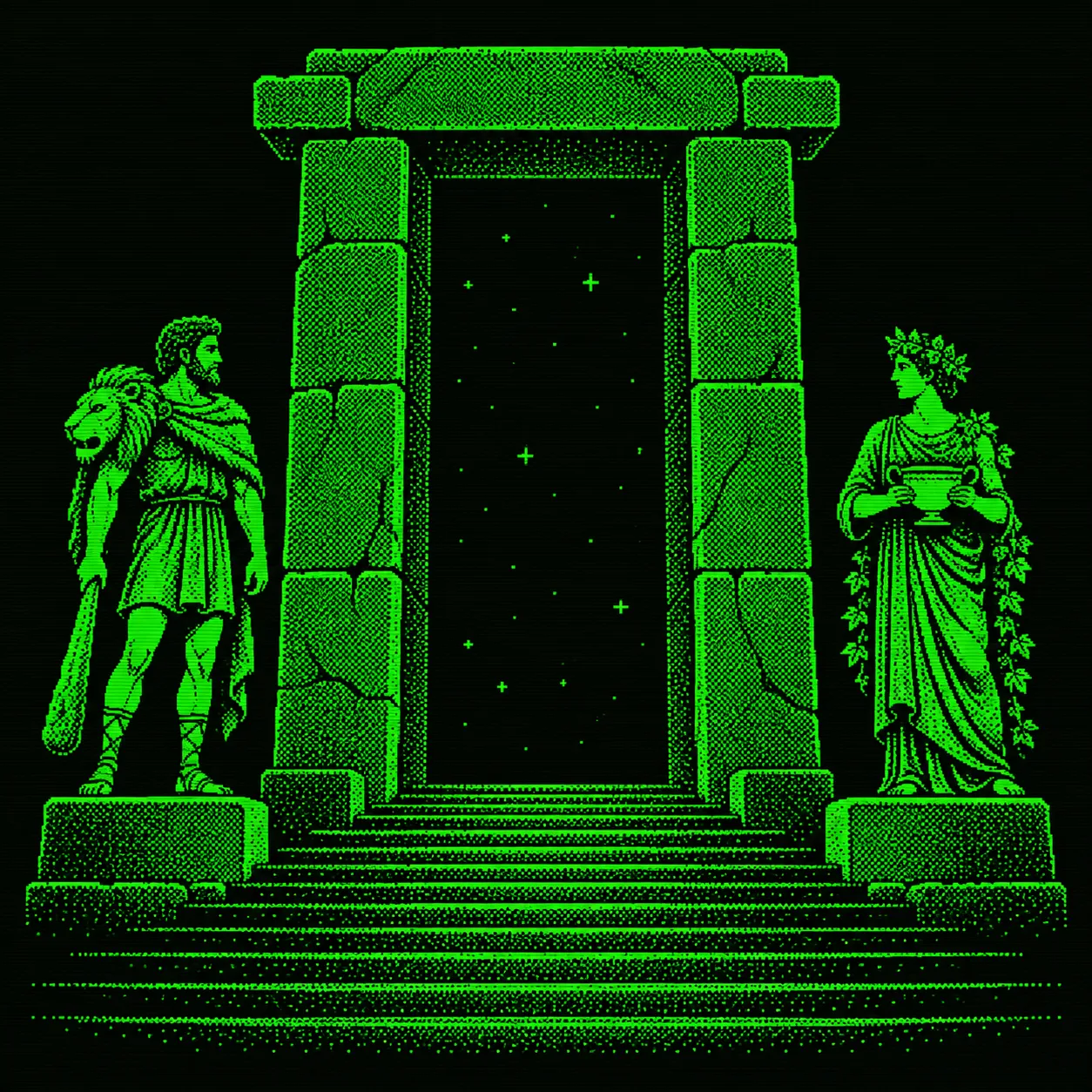
At a gate of ancient Thasos stood two sons of Zeus. One carried the equipment of the strongman. The other belonged to the world of wine. An inscription named their mothers, Semele and Alcmene, and declared their sons the guardians of the city. Around 500 BCE, people entering Thasos passed under the protection of Dionysus and Heracles together. IG XII.8 356.1
The pairing can initially look like an arrangement between opposites: pleasure on one side, effort on the other. Dionysus brings the cup; Heracles brings the club. Yet their lives overlap at places far more consequential than a drinking party. Both belong to Thebes. Both suffer the hostility of Hera. Both enter the country of the dead and return. Both make the distance between a human life and a divine one seem traversable.
That is the deeper logic of the gate. These gods could guard a threshold because their own stories repeatedly crossed one. They joined divine ancestry to human vulnerability, and made that unstable combination a source of religious power.
Centuries later, Thasos put the same pair on its silver coins: the head of Dionysus on one face, Heracles with his club and lion skin on the other. A person could hold their association in one hand. Toledo Museum of Art, 2006.105.
| Dionysus | Heracles |
|---|---|
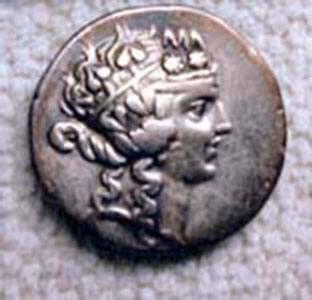 | 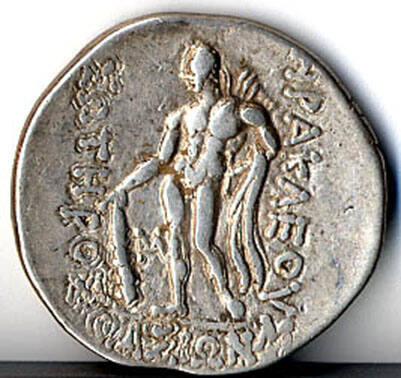 |
Two gods on one coin. Silver tetradrachm of Thasos, after 146 BCE. Toledo Museum of Art, 2006.105, Gift of the Popplestone Family.
The relationship changes as it moves from poetry to comedy, from a sanctuary to a royal inscription. Its persistent concern is access. How does someone born into the human world become fit for the company of gods? What can a god who has lived among suffering people bring back to them?
Divine ancestry did not make either son safe #
Homer places Semele and Alcmene together in Zeus’s catalogue of lovers, naming Dionysus and Heracles as their children. Hesiod likewise puts the two births side by side. The association is already present in archaic poetry, long before later philosophers try to reconcile the gods into a cosmic system. Iliad 14.323–325; Theogony 940–944.
Their parentage gives them a place in two worlds without making that place comfortable. Zeus is their father; mortal women are their mothers. The connection to Olympus brings them into the sphere of Hera’s jealousy. Being born close to divine power means being exposed to its conflicts.
In the Library attributed to Apollodorus, Hera drives Heracles mad, and he kills his children. The same work describes Hera driving Dionysus mad, his wanderings, and his eventual purification and initiation by Rhea. Extraordinary strength and divine parentage leave both vulnerable to the loss of command over themselves. Library 2.4.12; 3.5.1.
This matters because their authority is built from more than invulnerability. They undergo conditions their worshippers can recognize: persecution, dependence, humiliation, and terrifying changes of mind. Their proximity to the gods intensifies those conditions. It does not exempt them from having a biography.
The two biographies also begin from different positions. Hesiod calls Dionysus immortal even as he names his mortal mother. Heracles, in the same poem, reaches his enduring life among the gods after completing his labours. One story asks how a human career can end in heaven. The other brings an immortal into the dangerous circumstances of earthly life. Their meeting makes the boundary visible from both sides. Theogony 940–955.
Our discussion of Heracles’ older Near Eastern inheritance followed the traveling images and adventures that helped form the Greek hero. His relationship with Dionysus reveals what Greek tradition could do with that inheritance: give overwhelming power an intimate human predicament.
Before Hades, initiation #
The clearest meeting place is below the earth.
Heracles descends to bring back Cerberus, the guardian of the dead. Dionysus goes down to retrieve Semele. The first expedition extends the hero’s reach beyond the territory of living opponents. The second makes the journey personal. Dionysus brings his mother out of the condition that separates her from her immortal son. Apollodorus 2.5.12; 3.5.3.
Pausanias records an extraordinary local convergence. In the sanctuary of Artemis Saviour at Troezen, altars to the rulers of the underworld marked the place where Dionysus was said to have brought Semele up and Heracles to have dragged Cerberus out. Two adventures emerged through the same opening in the landscape. Description of Greece 2.31.1–2.
The association was also ritual. The ancient dialogue Axiochus states that Heracles and Dionysus received initiation before their descents, and connects the courage for those journeys with the Eleusinian rites. Its author presents the celebrated travelers as people who had prepared for the encounter with death.2 Axiochus 371e.
That preparation changes the meaning of heroic force. Even the strongest figure in Greek mythology enters a religious relationship before crossing the final boundary. Strength can carry him to the entrance. Initiation gives the journey another kind of order: instruction, purification, and a place within a sacred community.
The example also turns in the other direction. When the gods and heroes receive rites that human beings can receive, their distance from the worshipper becomes imaginable as a path. A participant at Eleusis could recognize a practice shared with the great travelers below the earth. The promise did not require every initiate to drag a monster back into daylight. It placed human preparation for death within the same sacred world as divine success in confronting it.
This is the force of initiation as a transformation of identity. The participant enters a condition that ordinary birth did not supply. Heracles and Dionysus give that possibility memorable bodies and journeys.
At nearby Lerna, Pausanias places the Hydra’s story in the same landscape as the Alcyonian lake, through which Dionysus was said to have descended for Semele. The place held both the hero’s confrontation with a monstrous animal and the god’s passage into the dead. The recurrence gives the landscape depth: beneath the familiar surface lay another territory, and these two knew routes through it. Description of Greece 2.37.4–5.
The god inside the lion skin #
Aristophanes makes that familiarity funny. In Frogs, performed in 405 BCE, Dionysus wants to visit Hades and bring back a great tragic poet. He dresses as Heracles and calls on the hero for directions. Lion skin and club sit awkwardly with the rest of his clothing. Heracles laughs at the combination. Frogs, opening scene.
The joke carries a precise recognition: Heracles has been there before. A god can borrow a hero’s reputation when he needs to enter the underworld. Along the journey, the costume attracts the consequences of Heracles’ earlier behavior, while Dionysus and his slave Xanthias exchange the dangerous privilege of wearing it. Divine status, heroic reputation, and a servant’s body become entangled onstage.
The audience can laugh because the visible signs of identity are so economical. A skin and a club make Heracles recognizable. The comedy then separates those signs from the person they are supposed to identify. The wearer receives fear, anger, or hospitality before anyone discovers who is underneath.
Wine produces another encounter between power and the loss of control. Diodorus tells of a jar Dionysus left with a centaur, reserved for Heracles’ arrival. Four generations later, Pholus opens it for the hero. The scent draws other centaurs to the feast, and hospitality becomes battle. Dionysus has entered the heroic adventure through his gift. Library 4.12.3–5.
Ancient artists also pictured a more intimate encounter. A cup in the British Museum shows Dionysus reclining and offering a drinking vessel to Heracles. Later mosaics turn their shared drinking into competition. In the Worcester mosaic, Dionysus reclines with his emptied cup while Heracles is on his knees. The winner of physical contests meets a power with its own terms of victory. British Museum, B446; Worcester Art Museum, 1933.36.3
These scenes prevent the pair from hardening into an easy moral diagram. Heracles can drink, lose control, and become ridiculous. Dionysus can travel, fight, and prevail. Their shared territory includes pleasure and danger, force and dependence. The human qualities remain visible even when the characters are divine.
How Heracles entered the divine family #
Heracles’ arrival in heaven gives the boundary its starkest form. In Apollodorus, his agony ends on a pyre; a cloud carries him upward with thunder. He becomes immortal, reconciles with Hera, and marries her daughter Hebe. The persecuted son enters the family that had made his earthly life so difficult. Library 2.7.7.
Diodorus adds a striking ceremony. After the apotheosis, Hera lies on a bed, draws Heracles against her body, and lets him pass through her clothing to imitate birth. She adopts him by becoming his mother in a performed second beginning. Diodorus explicitly compares the action with human adoption customs. Library 4.39.2–3.
The ritual makes the destination social. Becoming divine involves recognition, kinship, a marriage, and a place among others. Heracles’ new condition is expressed through acts that human communities also use to make belonging real. The goddess whose hostility shaped his suffering gives him a new relationship to his own past.
Dionysus appears among the gods welcoming Heracles in an Attic vase painting now at the Metropolitan Museum. Nike carries the hero upward in a chariot; Dionysus waits with other Olympians. The god whose own life crossed the human world receives the hero completing his ascent. Metropolitan Museum of Art, 52.11.18.
In the fifth-century CE epic of Nonnus, the resemblance becomes almost an exchange of roles. Hera heals the adult Dionysus with milk from her breast. Looking at his restored strength and beauty, she wishes he could marry Hebe. The narrator reminds us that Zeus has already destined Heracles for that marriage. The same divine mother, the same daughter, and a comparable reconciliation bring the two lives close enough for one to suggest the other. Dionysiaca 35.319–335.
Across these accounts, the boundary is repeatedly crossed through recognizable relationships. A son retrieves a mother. A hostile goddess adopts a son. A marriage admits the exhausted hero into a lasting household. Greek stories give immortality the forms of a life people already understand.
| Threshold | Heracles | Dionysus |
|---|---|---|
| Divine ancestry in the human world | Zeus and Alcmene’s son undergoes a mortal career | Zeus and Semele’s son brings immortal power into earthly life |
| Loss of ordinary control | Hera’s madness overwhelms his strength | Hera’s madness is followed by purification and initiation |
| The country of the dead | Brings Cerberus into daylight | Brings Semele back from Hades |
| Preparation for the crossing | Named as an initiate in Axiochus | Named beside Heracles in the same passage |
| Admission and recognition | Reconciliation, adoption, and marriage to Hebe | Recovery of his mother and, in Nonnus, reconciliation through Hera’s milk |
Why cities and kings wanted both gods #
The religious force of these lives also made them politically useful. Diodorus explicitly pairs Dionysus and Heracles as sons of mortal women whom Zeus judged worthy of the name Olympian. He explains their distinction through their deeds and their benefits to humanity. Divine ancestry begins the account; the use they make of their power completes it. Library 4.15.1.
Here the biography becomes available to kings. Rule can be represented as a difficult career through which an exceptional person brings order and receives exceptional honours. In Arrian’s account, Alexander invokes both Heracles’ labours and Dionysus’s expeditions as precedents for his own advance. He explicitly connects Heracles’ toil with his passage from man to god. Their journeys provide a scale against which a ruler can measure both his achievements and the honours he expects them to earn. Anabasis 5.26.
Ptolemy III goes further. His Adoulis inscription claims descent from Heracles on his father’s side and Dionysus on his mother’s. The royal house gathers both trajectories into its own family tree. The ruler inherits the prestige of the hero who reached heaven and the god who moved through the inhabited earth. OGIS 54, lines 4–5.
Cities could make a related claim without putting one man at the center. At Leptis Magna, an inscription names Hercules and Liber Pater, the Roman god identified with Dionysus, as ancestral gods. The pairing belongs to the community’s account of itself. IRT 289.
The public uses of the pair follow the same movement as their myths. Power crosses from a divine origin into human institutions, then returns as worship and honour. People claim a relationship with the gods through descent, initiation, benefaction, and protection. The boundary remains consequential precisely because there are recognized ways to approach it.
A cup for a robe of stars #
Nonnus offers a final image on a larger scale. Dionysus arrives at Tyre and addresses its Heracles as a solar and cosmic power. This is the Tyrian god, whose identity belongs to the Mediterranean history of Heracles and Melqart. The familiar name has opened onto a divinity extending beyond the biography of Alcmene’s son. Dionysiaca 40.366–429.
The encounter ends in an exchange. Dionysus offers a golden mixing bowl. Heracles clothes him in a robe of stars. Wine’s vessel passes one way; the visible heavens pass the other. The gifts give the meeting a form as intimate as hospitality while enlarging its scale to the cosmos. Dionysiaca 40.574–580.
That movement toward a cosmic Heracles extends the possibilities of the name. Yet the enduring attraction of the pair remains close to the human body: the skin one wears, the cup one drinks, the madness one survives, the mother one wants to bring home.
The gods at the gate of Thasos can now be seen more clearly. They protect a city whose inhabitants must also face losses of control, changes of identity, and the approach of death. Their stories make those experiences part of a world that includes divine life. Heracles reaches its company after a career of suffering. Dionysus crosses back for someone he loves.
Their promise lives in that return. The traveler who has crossed the boundary can become a guide, a protector, a presence at the entrance. At the gate stand two sons of mortal women. They know the way through.
Notes #
Sources #
- Homer. Iliad, book 14, lines 323–325.
- Hesiod. Theogony, lines 940–955.
- Pseudo-Apollodorus. Library, book 2, 2.4.12, 2.5.12, 2.7.7; book 3, 3.5.1 and 3.5.3.
- Pseudo-Plato. Axiochus, 371e.
- Pausanias. Description of Greece, book 2, 2.31.1–2 and 2.37.
- Aristophanes. Frogs, 405 BCE.
- Diodorus Siculus. Library of History 4.12 and 4.15; 4.39.
- Arrian. Anabasis of Alexander 5.26.
- Nonnus. Dionysiaca: 35.319–335, 40.366–429, and 40.574–580.
- IG XII.8 356, Thasos gate inscription; OGIS 54, Ptolemy III’s Adoulis inscription; IRT 289, dedication at Leptis Magna.
- Toledo Museum of Art. Silver tetradrachm of Thasos, 2006.105, after 146 BCE.
- British Museum. Black-figure cup B446, 1864,1007.1686.
- Worcester Art Museum. Drinking Contest of Herakles and Dionysos, 1933.36, early second century CE.
- Metropolitan Museum of Art. Terracotta calyx-krater, 52.11.18, fourth century BCE.
- Huard, Warren. Herakles and Dionysos in Archaic Greece. PhD dissertation, Ohio State University, 2018. A sustained study of the pair’s relationship to the human–divine boundary, epic, and visual art.
- Foucher, Louis. “Concours de boisson entre Dionysos et Héraclès.” Syria 77 (2000): 201–210.
- Stafford, Emma. Herakles. Routledge, 2012, p. 188.
The inscription is dated to the end of the sixth century BCE in the PHI edition. Emma Stafford places it at the Gate of Heracles and Dionysus and dates the gate to the early fifth century (Herakles, 2012, p. 188). “Around 500 BCE” accommodates the two datings. The inscription identifies the gods through their parents. ↩︎
Axiochus is transmitted among Plato’s works but is not considered his composition. The conventional locator is 371e; the online translation groups the surrounding text under a broader paragraph marker. The passage pairs the two initiates without saying they participated in a single ceremony. ↩︎
The shared-drinking scene and the competitive scenes should be distinguished. The drinking contest is securely attested in surviving mosaics; a continuous ancient literary narrative supplying its circumstances was not identified in the research for this essay. Louis Foucher examines the imagery in “Concours de boisson entre Dionysos et Héraclès,” Syria 77 (2000), pp. 201–210. ↩︎