~/consciousness/religion
The Woman Waiting After Death Is Your Own Character
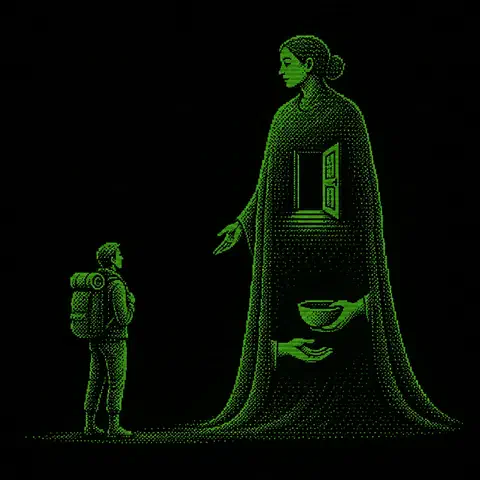
Daēnā makes moral self-recognition a meeting with a woman: the social intelligence used to judge others turns toward one’s own character.
TL;DR
- Daēnā lets a person encounter the moral character formed by a lifetime of action.
- Iranian texts also teach living people to use moral exemplars and religious instruction as mirrors.
- The encounter recruits the ability to recognize, judge, and care about other people for a new object: oneself.
- Its deepest consequence is educational. A person can learn to care now about the character he is becoming.
Three nights after a righteous man dies, a fragrant wind reaches his soul. A beautiful woman approaches. He asks who she is.
“I am thy own conscience!”
That is James Darmesteter’s translation of her answer in the Zoroastrian Hadhokht Nask. She is Daēnā, his moral and religious being encountered in female form. His conduct has helped make her what she is. Hadhokht Nask 2.7–14.
The order of recognition is extraordinary. The man responds to her beauty before he knows who she is. He admires an apparent stranger, then learns that his response concerns his own moral life.
We are used to the idea that death will bring an encounter with a judge. This story introduces a different confrontation. The person under examination meets his own character as someone he can perceive.
The arrangement solves two problems at once. It makes an accumulated life available as a single object of attention. It also puts that object in a form the social mind already knows how to approach: another person.
In Consequences of Conscience, I argued that moral self-awareness grows through our relations with other people. Daēnā gives that proposal an unusually precise mythology. The ability to interpret and evaluate a person returns to the person doing the interpreting.
The Iranian tradition carries the idea much further than an isolated scene after death. It describes moral exemplars as mirrors, prescribes regular examination of one’s conduct, and presents Dēn as a teacher with whom a living person converses. It even records an attempt to preview the encounter while there is still time to respond.
Together these materials describe an education in becoming visible to oneself. The death story supplies its most dramatic moment: a man is introduced to the character his own actions have been forming.
Her beauty was made at the door #
Zoroastrianism emerged in the ancient Iranian world. Its Avestan scriptures and later Middle Persian books preserve several accounts of the meeting. Daēnā’s name spans meanings including vision, inner self, conscience, and religion; the Middle Persian form is Dēn. The figure joins things that modern English tends to keep in separate compartments. Shaki, “Dēn.”
The Book of Arda Viraf makes one part of the identification especially direct. During his journey, Viraf sees a soul meet the woman, who explains: “I am thy actions.” Arda Viraf 4.18–33.
The Mēnōg ī Xrad, or Spirit of Wisdom, provides the everyday substance. The righteous man protected people from oppression, received those needing hospitality, acquired wealth honestly, and refused bribery and false testimony. Worship and care for the religious community belong to the same account. These are among the deeds embodied by the woman. Mēnōg ī Xrad 2.125–139.
Her beauty has a history. Someone arrived at a door. A witness had an opportunity to lie. Money was available on terms that would injure somebody else. The man’s decisions in those situations have become qualities of the figure standing before him.
That transformation is the first intellectual achievement of the story. Events scattered through time become the character of a person.
A deed is something that happened. Character is something we expect to persist across occasions. To call a man honest is to say more than that he once told the truth. It is to organize several possible situations around a common expectation about how he will act.
The leap from deed to character lets us think beyond the scenes we have personally witnessed. A person who refused a profitable lie may also be someone to trust with a promise. The behaviors differ, but a judgment about their author connects them.
Daēnā turns this normally invisible synthesis into an encounter. Her appearance gathers the life that produced it. The soul can perceive a whole where ordinary memory offers a succession of episodes.
The Hadhokht Nask adds a subtle qualification to the causal picture. The woman was already beautiful; the man’s good conduct made her more beautiful. He has cultivated a goodness that precedes his individual contribution. Hadhokht Nask 2.14.
This makes sense of the link between personal character and religion. A person enters a moral world already containing standards, examples, and claims upon him. His life gives those possibilities a particular realization. He participates in forming the character he will encounter.
The wicked soul undergoes the corresponding shock. In the Mēnōg ī Xrad, a repellent female figure identifies herself with his harmful conduct. His deeds have made her condition worse. Mēnōg ī Xrad 2.167–181.
The asymmetry between doing and seeing is the point. A person who accepted his choices while making them recoils from their accumulated form. The reasons that made each action tolerable to its author no longer monopolize his attention. He sees what kind of person those actions compose.
The story gives self-deception a particularly exact defeat. The man encounters his own contribution to the world before he has recognized it as something to defend.
A good person can become your mirror #
The Iranian texts themselves explain how another person can make your character visible.
The sixth book of the Dēnkard advises someone who would instruct a fellow to improve his own character and become a mirror for that person. The following passage explains that another person’s cultivated judgment reveals our defects. A moral exemplar supplies a standard against which we can see ourselves. Dēnkard VI.223–224.1
Consider the mechanism. You watch someone handle a provocation with patience. Your own response to a comparable provocation becomes newly visible. The comparison may reveal something you had failed to notice even though you remember exactly what happened.
The exemplar has supplied a possibility against which your conduct can be measured.
This is one reason instruction by example can reach beyond a verbal rule. Being told to be patient leaves open what patience looks like in a difficult situation. Watching another person carry it through gives the quality a body, a sequence of actions, and an intelligible relation to circumstances.
You can then discover a defect in yourself by recognizing an excellence in someone else. The direction of understanding runs through another person.
A later passage in the same book makes the relation more explicit. Dēn is compared to a mirror in which someone who knows how to look can see himself and distinguish good from evil. Here the term concerns religious teaching or revelation. The tradition offers itself as an instrument of self-recognition. Dēnkard VI.261; modern translation discussed by Azarnouche and Ramble, 2020, p. 359.
The two mirrors belong together. A person exemplifies a moral possibility. A body of teaching makes the possibility available beyond the immediate presence of that person. Both give the observer a way to recognize something about himself.
The image also captures a limit of direct introspection. A face cannot see itself simply by looking harder at the world from its usual position. It needs a relation that returns an image. A moral agent can similarly require a comparison, a standpoint, or an interlocutor through which his own conduct becomes legible.
This is a stronger connection to consciousness than the claim that religion tells people to behave. The instruction concerns how a person comes to understand the being whose behavior is at issue.
The same book prescribes a practice to make that understanding recurrent. After solar prayers, a person should examine what he has consumed, accomplished, and done, and whether his activity has served the divine or the demonic. Dēnkard VI.227.
The cosmic division becomes a question about an ordinary day.
That is a disciplined change of perspective. During an action, attention is directed toward the object one wants, the obstacle one faces, or the person one is trying to persuade. At the appointed interval, the agent becomes the object. What have I been doing? What did my efforts serve?
The practice takes a sequence experienced from within and reviews it as conduct. A repeated occasion for self-examination can make that movement increasingly familiar.
This is where a religious account becomes an intellectual technology. It provides a vocabulary in which actions have moral significance, examples through which qualities become recognizable, and a schedule for turning the resulting understanding back upon the actor.
The mirror does not work by showing a person an entirely unfamiliar object. It shows him something familiar from a position he had not been occupying.
The excuse arrives after the judgment #
Adam Smith describes conscience through a related division of labor. In The Theory of Moral Sentiments, he writes: “I divide myself, as it were, into two persons.” One acts; the other examines the action. Learning to view our conduct from another person’s position supplies the basis for this internal spectator. Part III, chapter I.
Smith’s account has a difficulty built into it. We are exceptionally well informed about our own motives, yet that information does not make us exceptionally fair judges of ourselves.
In his discussion of self-deceit, Smith distinguishes the moments before and after an action. Passion distorts the first; attachment to a favorable view of oneself can distort the second. He even describes reviving old resentments to justify conduct whose injustice has become harder to ignore. Part III, chapter IV.
The grievance has become useful evidence for the defense. Keeping it alive protects an account of the kind of person one is.
This is a familiar trap. A person can spend years rehearsing why a particular cruelty was necessary. Each rehearsal retrieves the insult, the provocation, the unusual pressure, and the reasons an ordinary rule supposedly failed to apply. The explanation preserves the action inside a privileged frame.
Now imagine meeting someone whose defining qualities consist of that cruelty and the other decisions made in its spirit. The privileged frame is harder to maintain. You are being asked to respond to a person.
The narrative makes conduct beautiful or repellent before disclosing whose conduct it is. It supplies in visible form the moral significance that the actor could obscure while considering each deed separately.
My reading is that this arrangement separates the response from the immediate demand for self-defense. The soul has already been drawn toward the figure, or recoiled from her, when the identification makes that response concern his own life.
That is why the identification matters so much. Without it, the scene would remain an encounter with an attractive or frightening stranger. With it, an already intelligible judgment returns to its source. The mind discovers that it can be the object of the response it normally directs outward.
Smith also distinguishes receiving praise from deserving it. The impartial spectator can judge a person favorably despite public condemnation, or unfavorably despite applause. Moral self-assessment can use a social standpoint while reaching beyond the actual opinions of the crowd. Part III, chapter II.
The distinction is essential to the Iranian encounter. A successful reputation on earth cannot determine the woman’s condition. Otherwise the story would teach people to manage appearances, and the most accomplished deceiver would have the finest character waiting for him.
The Mēnōg ī Xrad makes the judicial standard explicit. Rashn’s scales disregard worldly rank. The judgment occurs before the encounter with the embodied deeds. The soul’s response to the woman makes the verdict felt; it does not establish what the verdict should be. Mēnōg ī Xrad 2.120–139.
This gives the story two distinct achievements. Judgment establishes the moral significance of a life. Recognition forces the person who lived it into an intelligible relationship with that significance.
Knowing that a court has condemned you and seeing why your character is repellent are different experiences. Daēnā gives the second experience a form.
A character can answer questions a memory cannot #
The personification does another kind of work. It converts a record of actions into something with a recognizable way of being.
Imagine being given a complete list of someone’s actions over a week. The list would still leave you with the task of understanding its author. Which acts were exceptions? Which expressed a recurring concern? What would this person do if a similar temptation returned with different details?
A character judgment organizes the record around an answer.
My work on the primary factor of personality began from the structure of descriptions of people. Words for different qualities carry relationships to one another, including a strong evaluative dimension. We can recognize qualities as belonging together even when the acts that express them look physically different.
That makes a person model a useful object for moral thought. It gathers information across situations and supports expectations about situations that have not yet occurred.
An experiment by Jenifer Siegel and colleagues illustrates how quickly people form such impressions. Participants observed agents choosing between money for themselves and painful shocks for somebody else. Broad moral impressions emerged before observers had precisely learned the agents’ tradeoffs between profit and harm. Later studies showed substantial revision when initially bad agents improved. Siegel and colleagues, 2018.
The observer is doing more than storing episodes. He is using them to understand somebody, while remaining capable of changing that understanding.
Apply this familiar social activity to oneself. Remembering that I refused a bribe leaves the event in the past. Thinking of myself as someone who refuses bribes gives the memory a claim on future behavior. A later temptation can now present a question about continuity of character.
This is one reason a promise to oneself can matter. The future act becomes related to a person one has undertaken to be. Breaking it can feel like discovering that this person’s supposed qualities were misunderstood.
Daēnā gives that continuity an external presence. Today’s action contributes to someone with whom the actor will eventually have a relationship. A choice that seems isolated in the present is gathered into the character of a recognizable being.
The effect of this representation is to make conduct accumulate in imagination before its consequences arrive. The host opening his door can understand the act as part of the woman he will meet. The witness contemplating a lie can imagine what the lie is doing to the same figure.
This is my extension of the narrative’s logic: a personified character can serve as a model of the kind of agent one’s decisions are producing. It can make the relationship between an action and a life easier to keep in view.
The model need not be frozen. Every new action supplies further material. The very claim that conduct makes Daēnā more beautiful or more repellent gives the actor a continuing role in her formation.
The moral object is under construction while the person who will encounter it is still alive.
Once that model begins to influence a decision, the relation runs both ways. Conduct forms the character one imagines; the imagined character then helps form the next act. The witness refuses a lie partly because he understands what accepting it would make of him. That refusal becomes further evidence about the person he is.
The future figure can therefore enter the process whose result she represents. In the living person’s imagination, she helps organize a decision that will contribute to her own condition. The agent uses a model of his formation to participate in forming himself.
The living priest learns to see with her #
The Dēnkard also describes a living relationship with Dēn. Its third book presents her as an authoritative presence cultivated through recapitulation, instruction, listening, and sacrifice. The text compares her growth to a crop nourished by water.
The person’s vital soul converses with her. She explains sacred words as a priest explains them to a capable pupil. Character, will, and action become aligned with hers. Dēnkard III.225A.2–3, translated by Azarnouche and Ramble, 2020, pp. 337–338.
This encounter has a different structure from the one after death. Dēn is the living priest’s dominant teacher. The postmortem figure embodies the deceased person’s moral life. The distinction matters: an authority can first supply the perspective through which someone learns to understand himself.2
There is an ordinary educational sequence beneath the extraordinary relationship. A pupil begins with a teacher whose understanding exceeds his own. Repetition, listening, and interpretation let the pupil acquire distinctions he could not previously make. Eventually they change what he wants and how he acts.
The religious text places that sequence inside the person. A body of inherited teaching becomes an interlocutor with whom he can consult.
It is easy to underestimate what an imagined interlocutor can contain. A maxim tells you what to do in a class of cases. A teacher can explain a maxim, compare cases, identify a misunderstanding, and recognize what a pupil has failed to grasp. To imagine such a teacher is to organize a richer activity than repeating a prohibition.
The relationship also preserves a difference in authority. The pupil is not free to make every interpretation equally acceptable. The figure with whom he consults represents a standard that can resist his wishes.
This gives a religious dialogue a role in the development of reflective agency. The person can acquire a way to question himself by learning to sustain the questioning associated with a teacher.
Daēnā’s connection to vision sharpens the point. In their reading of the chapter, Samra Azarnouche and Olivia Ramble argue that Dēn’s presence enables the priest to perceive the invisible. The figure is involved both in what he encounters and in the capacity through which he sees. Azarnouche and Ramble, 2020, pp. 358–359.
There is a psychological counterpart to this double role. A moral education changes which features of a situation become salient. A person can learn to notice humiliation in an exchange he previously found amusing, or generosity in an act he previously dismissed as foolish.
His eyes can receive much the same scene while his understanding of it changes. Acquiring the teacher’s distinctions changes what he can recognize.
The mirror and the interlocutor therefore belong to the same education. One supplies an image through which the person becomes visible; the other develops his ability to interpret what he sees.
This also gives a more precise meaning to the internalization of a moral authority. Its intellectual content includes ways of attending, comparing, and explaining. A person inherits a standpoint from which his own conduct can become intelligible.
An inner voice becomes consequential when the person can think with it.
The chapter also describes how the achievement reaches other people. Its account of acquired wisdom includes the earthly community listening to the recitation and teaching. The priest’s relationship with Dēn benefits those who hear him. Dēnkard III.225A.5, p. 339.
An inward authority has a public means of reproduction. One person learns to consult her, then supplies words through which others can approach the same understanding.
The text distinguishes this sustained relationship from another adherent’s occasional return to Dēn during the mental struggle against the Lie. That person has not attained the full vision. III.225B.1, p. 340.
Knowing the doctrine, returning to it under pressure, and sustaining its presence are different accomplishments. Practice becomes consequential because access to a useful perspective can be intermittent.
This gives the proposed history of self-awareness an institution as well as an image. A reflective operation must become available again tomorrow, and available to somebody else. Recitation, instruction, and recurrent examination provide ways of preserving what an isolated revelation could lose.
Kartīr asked to meet his future while he was alive #
The late-third-century priest Kartīr left an unusually concrete record of an attempt to bring the future encounter into the present. His inscriptions survive in southern Iran, centuries before the final compilations of many Middle Persian religious books.
He asked for confirmation of what happens to souls after death, specifically including the female Dēn. If her condition revealed that he was bad, he proposed to strengthen his adherence to the gods. The anticipated revelation was connected to something he could still do. Kartīr’s inscriptions, §§22–24, translated and discussed by Skjærvø.
The account that follows has a striking social structure. Observers report seeing Kartīr’s likeness. A splendid woman approaches along a luminous road. The two greet each other and clasp hands; his likeness then follows her. Scales and a bridge appear later in the journey. §§25–31.
Kartīr receives a report about someone recognizable as himself encountering the person connected with his fate.
The mediation makes the scene more interesting. He is represented from outside, and other people describe what happens to that representation. A prospective condition of his soul becomes a narrated event in which he can recognize a personal stake.
The narrative gives a distant consequence a present address. Kartīr’s stated willingness to respond to an unfavorable revelation exposes the practical purpose of the preview: he is consulting the future while he can still act.
In my reading, this is a rehearsal of moral self-recognition. A narrative normally assigned to the end of life is brought forward and attached to a living person.
The inscription also carries the rehearsal outward. Its account can teach others to imagine the same personal implication: the doctrine concerns the condition they are producing through their own conduct.
The unusual feature here is the scene’s division of roles. The living man, his reported likeness, and the woman can be distinguished from one another while all remain bound to the moral problem of his life.
Reflective unity is being achieved through relationships among representations of the person. The story makes him answerable for all of them.
The future becomes someone worth caring about #
Thinking about a future self is often a surprisingly impersonal activity. The person who will bear the consequence lacks the immediate presence of the person making the decision.
Emily Pronin, Christopher Olivola, and Kathleen Kennedy studied this difference by asking participants to allocate an unpleasant drink to themselves now, themselves in a later semester, or another student. When participants believed the decision would be implemented, they assigned more to their future selves than to their present selves. Decisions for the future self resembled decisions for someone else. Nobody ultimately had to drink it. Pronin, Olivola, and Kennedy, 2008, experiment 1.
That result invites a familiar interpretation: people neglect the future because they care less about other people than about themselves.
The researchers’ third experiment makes the explanation more interesting. Receiving inconvenient emails was presented as helping charity and a needy student. Participants accepted more of the burden for their present selves than for future selves or others. Immediate feeling could support generosity as well as self-protection. Experiment 3.
The problem is partly what can engage us now.
Otherness can make a beneficiary remote. It can also make a beneficiary approachable through social emotion. People sacrifice for children, partners, teachers, friends, and strangers whose circumstances become vivid to them. The capacity to care about someone else is already available.
Daēnā gives the future consequence a face and a voice. The figure can be admired, approached, questioned, and understood. Her condition matters before the soul has fully grasped its relation to his own life.
The Hadhokht Nask links this affection to corresponding qualities: the good man was loved for qualities that also made the woman lovable to him. The encounter joins his capacity to value another person with an account of the goodness cultivated through his own conduct. Hadhokht Nask 2.11–14.
The psychological proposal is specific. A moral tradition can give present social emotion an object whose condition depends on present action. The person cares about what he is making because he can imagine a relationship with its result.
This reaches beyond a calculation about delayed reward. It gives a future condition personal form, making affection or aversion toward it intelligible now.
The experiments do not measure the effect of Daēnā belief. They clarify the problem the narrative addresses: knowing that a future condition concerns you is different from being emotionally engaged by it. The story supplies personal identity, moral causation, and an encounter through which the consequence can matter.
Its apparent stranger is a route into concern for the self.
The woman teaches the dead how to live #
One short passage in the selections of Zādspram supplies the most striking further connection. The saved person enters the spiritual world with the help of a female form. She becomes the newcomer’s nurturer and teaches the language of the spirits. Zādspram 31.5, quoted in Azarnouche and Ramble, 2020, p. 343, note 27.3
The dead person needs a language lesson.
That is a much more specific role than bestowing a prize. The newcomer has entered a world in which he does not yet know how to participate. A woman feeds his development and teaches him the means of communicating with its inhabitants.
The scene repeats the structure of becoming human. A person arrives dependent, surrounded by agents whose actions and utterances exceed his understanding. Someone more competent sustains him and draws him into their shared world.
Placed after death, the familiar relation acquires an extraordinary consequence. The adult must become a pupil again. His new existence begins through a dependence he can recognize from the conditions of his first one.
The hospitality motif also turns back upon itself. The righteous person’s character was formed partly by receiving and protecting others. In this account, the newcomer is himself received and taught. The moral quality expressed in the earthly act returns as a relationship he can inhabit from the other side.
This is where Daēnā becomes particularly interesting for the Eve Theory of Consciousness. EToC proposes that women first discovered reflective self-awareness and helped transmit it through social relationships. A female guide becomes relevant to that proposal through the work she performs: care, instruction, and admission into a world whose meanings the learner must acquire.
The connection is stronger when stated at that level of granularity. Calling any female figure an echo of Eve would explain very little. Here the figure occupies a recognizable educational position at a threshold of transformed existence.
Her sex also cannot be understood simply as a heterosexual reward for men. Antonio Panaino emphasizes that the feminine Daēnā belongs to the postmortem encounter of both male and female souls. The pairing concerns complementary aspects of the person across sexes. Panaino, 2024, p. 9.
Nor does the tradition confine her authority to motherhood. The living Dēn in Dēnkard III.225 is compared to a loving father, a priest, and a ruler. The female presence can carry several kinds of teaching and authority. Her relationship to a learner matters alongside her gender.
For the theory, this suggests a refinement. The important historical inheritance may include a set of social positions from which self-awareness can be taught: someone knows you, cares for you, corrects you, and gives you a language in which to understand what you are doing.
Eventually you can occupy some of those positions toward yourself.
The myth places that acquisition at the boundary between worlds. The person’s character becomes an interlocutor, and the interlocutor becomes a guide to a form of existence he has yet to master.
The mind learns who it is through a relationship with someone who can teach it how to see.
Your conduct becomes the country you enter #
Another Iranian account extends the transformation beyond a human figure.
In the Greater Bundahišn, the righteous soul encounters a well-nourished milk cow, a beautiful maiden, and a productive garden. Each identifies itself with the person’s conduct. The wicked soul encounters depleted and frightening counterparts. These signs appear before judgment. Greater Bundahišn XXX.13–21.
The person’s actions have become a world he can enter.
A garden makes a different aspect of conduct intelligible from the one made intelligible by a person. The woman can speak and be recognized. The garden can sustain or fail to sustain. The cow makes nourishment present as a living condition.
Together they expand what it means to encounter one’s actions. Conduct produces relationships, resources, and surroundings. A life can enrich the world available to others or leave it diminished. The narrative makes the actor experience the condition he has helped produce.
This is a powerful change of position. During life, a person acts upon a world that receives the consequences. In the encounter, he becomes a recipient. His own contribution meets him as something he must inhabit.
The same principle can therefore be expressed through several forms. The woman gives moral history the coherence of a character. The garden gives it the coherence of an environment. Both make the relation between doing and undergoing perceptible.
The larger cosmology also prevents the character from becoming an eternally fixed essence. In the final renewal described by the Greater Bundahišn, humanity undergoes purification. Relatives and friends recognize and reunite with one another after the removal of evil. Personal continuity survives the transformation. Greater Bundahišn XXXIV.18–24.
That distinction is consequential. The evil a person has done is truly his, yet the religious story can preserve the person while removing the evil. Ownership of conduct need not make every present quality an unchangeable definition of the self.
This gives the mirror a purpose beyond condemnation. Recognition can make transformation intelligible. A person has to be able to acknowledge the character his actions express without concluding that no different action could ever belong to him.
The tradition’s final horizon keeps both claims in view: deeds are consequential, and the agent can survive becoming better.
The self becomes a relationship one can practice #
Daēnā is an unusually precise answer to the problem of moral self-recognition. A life is dispersed among actions, excuses, memories, and effects on other people. The story gathers those materials into someone the actor can meet.
The Iranian mirror teachings supply the approach to that encounter. Another person’s character makes a quality visible. Religious instruction gives it a shared language. Regular examination turns the language toward one’s own day. The living dialogue gives the learner a standpoint from which to understand what he finds.
The postmortem scene completes the movement. A person recognizes an intelligible moral character, then discovers his own authorship of it.
The resulting feedback develops the recursive account in Déjà You. A person uses his actions to form a model of his character, then uses that model to shape further actions. The system that understands people participates in making the person it understands itself to be.
The most useful extension to EToC is therefore educational. A reflective self can be cultivated through relationships that a person gradually learns to sustain toward his own activity. The authority, the exemplar, the pupil, the observer, and the person observed can acquire places within one life.
Their coordination gives that life a new kind of unity. Its owner can recognize himself across actions and across time, while judging the direction in which those actions are carrying him.
Daēnā makes the direction matter. She can be admired before she is identified, cared about before she is reached, and cultivated before the encounter occurs. The story gives the future moral self a place in present social feeling.
Her final disclosure returns the entire relationship to the person who has been forming her. The woman he recognizes has been taking shape whenever he opened the door, refused the bribe, or protected someone who needed him.
To imagine meeting her is already to begin treating one’s own character as someone for whom one is responsible.
Sources #
- Hadhokht Nask, chapter 2, especially §§7–14. Translated by James Darmesteter, 1898. Primary text in translation. The encounter, identification, corresponding lovable qualities, and further cultivation of the woman’s beauty are distinct details of this account.
- Mēnōg ī Xrad (Spirit of Wisdom), chapter 2, especially §§120–139 and 167–181. Translated by E. W. West, Sacred Books of the East 24, 1885. Primary text in translation. The scales precede the encounter in this version.
- The Book of Arda Viraf, chapter 4, §§18–33. Translated by Martin Haug and E. W. West, 1872. Primary text in translation. Viraf observes another soul’s encounter.
- Shaki, Mansour. “Dēn.” Encyclopaedia Iranica, 1994, updated 2015. Specialist account of the term and its meanings.
- Dēnkard, book VI, §§223–224, 227, and 261. D. D. P. Sanjana’s translation, 1907, available online, compared with modern translations reproduced in the works cited in the first footnote.
- Azarnouche, Samra, and Olivia Ramble. “La Vision zoroastrienne, les yeux dans les yeux. Commentaire sur la Dēn selon Dēnkard III.225.” Revue de l’histoire des religions 237, no. 3 (2020), pp. 331–395. Article. Full PDF. Critical translation: pp. 336–342; living and postmortem relationships: pp. 343–345; vision and mirror: pp. 358–359. Their comparison with Neoplatonic ideas is not treated here as proof of borrowing.
- Smith, Adam. The Theory of Moral Sentiments. First published 1759; sixth edition, 1790. Part III, chapters I, II, and IV. Primary text. The comparison concerns the structure of moral reflection, not a claim of Iranian influence on Smith.
- Siegel, Jenifer Z., Christoph Mathys, Robb B. Rutledge, and Molly J. Crockett. “Beliefs about Bad People Are Volatile.” Nature Human Behaviour 2 (2018), pp. 750–756. Original article. Full author copy. These experiments concern impressions of others; their application to self-representation is an interpretive extension.
- Skjærvø, Prods Oktor. “Kartīr.” Encyclopaedia Iranica, 2011, updated 2018, particularly “The Journey” within section III. Article and translations of the inscriptions. Readable PDF. The identities of the plural observers and the technique producing the vision remain disputed. The inscription does not establish that Kartīr personally saw the woman or that drugs were used.
- Pronin, Emily, Christopher Y. Olivola, and Kathleen A. Kennedy. “Doing Unto Future Selves As You Would Do Unto Others: Psychological Distance and Decision Making.” Personality and Social Psychology Bulletin 34 (2008), pp. 224–236. Original author-posted paper. Experiments 1 and 3 supply the contrasting decision tasks; neither measures enduring moral development.
- Panaino, Antonio. “The Mazdean Esoteric Dimension between Ritual and Theology.” Religiographies 3, no. 1 (2024), pp. 7–26, especially p. 9. Original paper.
- Greater Bundahišn, chapters XXX.13–21 and XXXIV.18–24. B. T. Anklesaria, ed. and trans., Zand-Ākāsīh: Iranian or Greater Bundahišn, 1956, pp. 259–263 and 289–291. Primary text in translation. These passages supply the moral landscape and final purification, respectively.
Dēnkard VI.223–224 is available in D. D. P. Sanjana’s 1907 translation. The modern translation of VI.223 by Shaul Shaked, The Wisdom of the Sasanian Sages (1979), pp. 86–87, is reproduced in Touraj Daryaee’s The Games of Chess and Backgammon in Sasanian Persia, p. 8. Shaked’s VI.261, pp. 100–101, is quoted in Azarnouche and Ramble, p. 359, note 78. The mirror in VI.261 concerns Dēn as religious revelation; connecting it to the female encounter is the synthesis advanced here. ↩︎
Azarnouche and Ramble distinguish the living gyān, or vital soul, from the postmortem ruwān. Dēn is an authoritative teacher rather than an alter ego in III.225. Their critical translation is used here; Sanjana’s older translation independently preserves the conversation and instruction. The final editor of Dēnkard III belongs to the tenth century; its older materials should not make every passage automatically Sasanian. ↩︎
The female form is not named Dēn in Zādspram 31.5. Its identification with her is the scholarly interpretation followed by Azarnouche and Ramble. They reproduce the passage from Philippe Gignoux and Ahmad Tafazzoli’s critical edition, Anthologie de Zādspram (1993), pp. 112–113. That quotation, rather than direct inspection of the complete critical edition, supplies the text used here. ↩︎