~/sacred-objects/mystery-cults
Cybele — Rhea’s Whirling Voice and the Birth of Civilized Life
How the Mother of the Gods, her roaring rhombos, and a dying youth became the soundtrack and syllabus of Greek, Phrygian, and Roman civilization.
TL;DR
- A whirled rhombos and the drum are paired with Rhea/Cybele already in Apollonius (3rd c. BCE): line 1.1139 reads ῥόμβῳ καὶ τυπάνῳ Ῥείην Φρύγες ἱλάσκονται — “with the rhombos and the drum the Phrygians propitiate Rhea.” (Seaton’s Loeb renders rhombos as “wheel”; the word literally means “a whirled thing.”) 1
- The word rhombos is secure here; the object is not — rhombos can mean a bullroarer, a spun wheel/disk, or a magician’s iynx-wheel, so reading it specifically as a bullroarer is reasonable but inferential. 1
- Other witnesses — Clement’s initiatory password 2 and Firmicus’s “the god is saved” consolation 3 — attest the cult’s ecstatic music and its dying-and-returning youth, but neither names a rhombos.
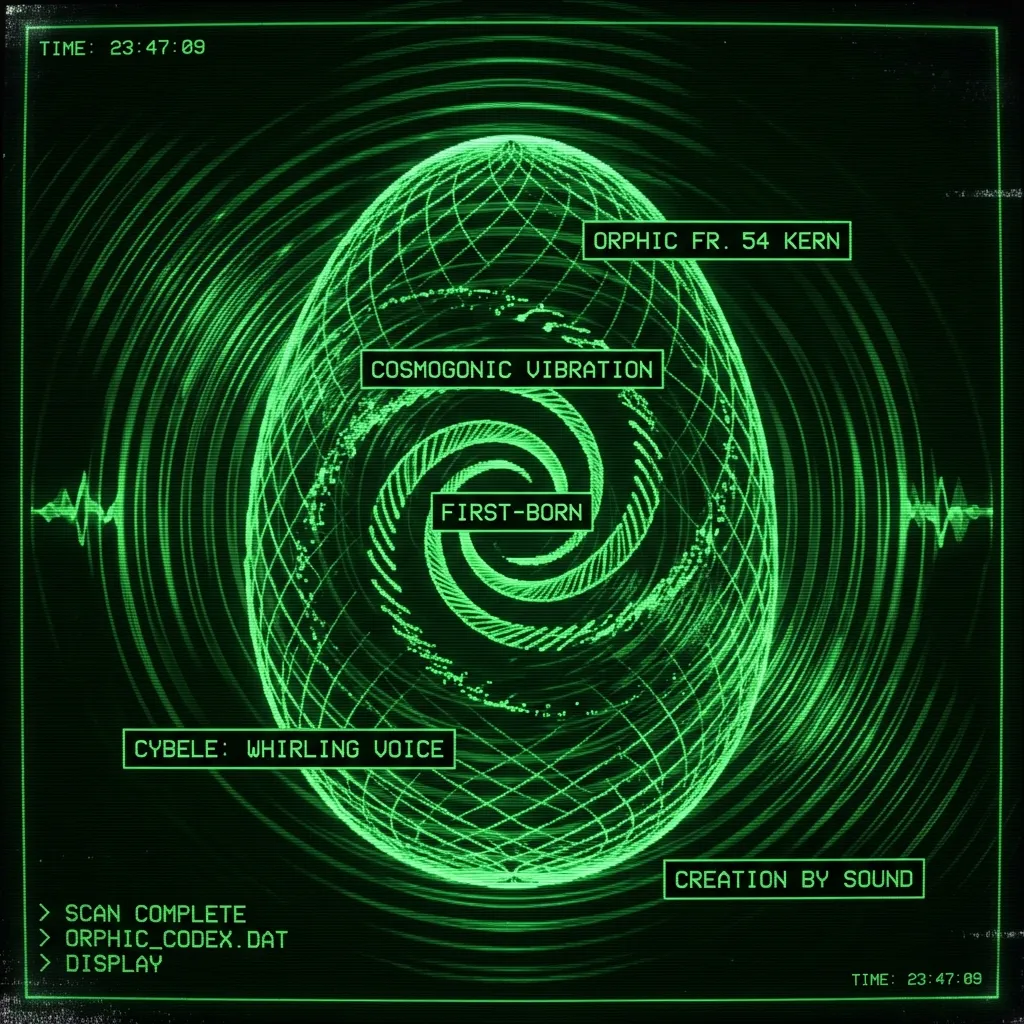
- Orphic lore has creation begin with a whirling egg, inviting a (modern, speculative) analogy between that cosmic “whirling” and the rhombos’s drone. 4
- Late-antique scholia fold the Mother into the Bacchic and Eleusinian mystery family, treating her as the elder of Demeter and Dionysus.
- The cult’s curriculum—acoustic shock, gender inversion, agrarian charter—became the template for mystery performance across the Mediterranean.
1 The Whirring Voice of the Mother #
“Hence from that time forward the Phrygians propitiate Rhea with the wheel and the drum.” — Apollonius Rhodius, Argonautica 1.1138–1139 (Seaton’s Loeb) 1
Seaton’s Loeb renders the instrument “wheel,” but the Greek of line 1139 is in fact ῥόμβῳ (dative of rhombos): ῥόμβῳ καὶ τυπάνῳ Ῥείην Φρύγες ἱλάσκονται. So the word rhombos is bound to Rhea’s rites already in a primary text of the 3rd century BCE (Bullroarer Atlas: Phrygian Cybele / Mt Dindymon) — this is not a late or loose association. What is not settled is the object behind the word: rhombos can denote a bullroarer, a spun wheel or disk, or a magician’s iynx-wheel. Calling it “a flat slat swung on a cord” (a bullroarer) is a defensible reading, but it is an inference, not something Apollonius states.
At Orpheus’ command the youths dance in armor and clash their shields; the goddess answers with favourable omens and calm winds. Apollonius then anchors the aetiology: ever after, the Phrygians propitiate Rhea with rhombos and drum.
1.1 Textual Testimonies #
- Clement of Alexandria, Protrepticus 2.15: “I ate from the drum, I drank from the cymbal, I carried the sacred dish, I slipped into the bridal-chamber.” This initiatory password preserves the cult’s signature instruments — drum and cymbal — but, tellingly, names no rhombos. 2
- Firmicus Maternus, De errore 22.1: the priest’s whispered consolation, “Be of good cheer, initiates: the god is saved!” Firmicus reads it as a dying-and-returning god’s announcement, but the cult it belongs to is disputed (Attis or Osiris), the “resurrection” framing is contested (J. Z. Smith), and Firmicus names no rhombos. 3
1.2 Ritual Technology (three moves) #
| Phase | Sound-device | Dramatic Action |
|---|---|---|
| Epiphany | Rhombos + drum (Apollonius) — low whirring roar | Galli process into the metroön; the uninitiated scatter. |
| Ekstasis | Tympanum & cymbala | Priests dance, bleed, or simulate death for neophytes. |
| Return | Aulos & hymn | Dawn proclamation “the god is saved”; the youth reborn, grain cycle renewed. |
The phase-by-phase scheme above is a modern reconstruction: the ancient sources give us the instruments (rhombos, drum, cymbal, pipe) and the myth, not a documented stage-by-stage program.
2 Cosmogony and Syncretism #
2.1 · Phrygian Mountain Myth #
- Agdistis, born of Zeus and Earth, is unbounded nature.
- After self-castration her blood sprouts the almond that fathers Attis.
- Attis’ infidelity → frenzy → death beneath a pine; his blood fertilises the first grain; the bullroarer’s roar marks the moment.
2.2 · Orphic Egg Lore #
Orphic fr. 54 (Kern) describes Chronos fashioning a silver egg, from which the First-Born springs amid whirling, the aether resounding. The parallel between this cosmic “whirling” and the rhombos’s drone is evocative, but the equation is a modern interpretive move — not a claim the Orphic text or its priests make. 4
2.3 · Why Bacchus and Demeter Join the Party #
- Shared props: ecstatic music, pine/ivy/wheat, torches.
- Narrative homology: dying-returning youth (Attis, Dionysus, Persephone).
- Scholia on Aristophanes, Frogs 323: “Brimo (Demeter) and Rhea are one; their child is both Kore and Dionysus.” Thus a late-antique pilgrim could plausibly tour Eleusis, Dionysian teletai, and Cybele’s March festival as one graded syllabus on how civilisation survives winter. The same whirled-rhombos sound-technology recurs across the wider Greek mystery-cult world, from Athens’ Sabazios rites to the Dionysiac Toys and the Orphic ritual list preserved on the Gurob papyrus (Bullroarer Atlas: Athenian Sabazios mysteries; Ancient Greek Dionysiac rhombos; Gurob papyrus Orphic rhombos).
FAQ #
Q 1. Did women ever handle the rhombos? No extant source shows women spinning the instrument; Roman terracottas give women drums and cymbals, never rhomboi. Mythic aetiology blames an early theft of the “voice,” legitimising male (and eunuch) monopoly. (Bullroarer Atlas: Women and the bullroarer)
Q 2. Is the bullroarer purely Phrygian? The slat-aerophone is worldwide, but the Greek name rhombos and its ritual tie to Cybele/Attis are distinctly Phrygian-Hellenic; Greek colonies spread it westward. 5
Q 3. How long did the cult stay active? Inscriptions for the Galli and the March Hilaria continue into the fourth century CE; Theodosius’ edicts (391 CE) end public rites.
Q 4. What became of the cosmogony after Christianity? Christian polemic recasts Cybele as a demon; the rhombos’ epiphany becomes evidence of possession. The doctrine of creation-by-sound survives only in Neoplatonic commentaries on the Orphic Rhapsodies.
Footnotes #
Sources #
- Roller 1999; 2. Vermaseren 1977; 3. Vian 2003; 4. Lightfoot 2003; 5. Hardie 2016; 6. Burkert 1987; 7. Vine 2017; 8. Macrobius Saturnalia I-III; 9. Firmicus Maternus 2018; 10. Nonnus Dionysiaca 25-27.
- The Bullroarer: An Interactive World Atlas. Relevant records: Phrygian Cybele / Mt Dindymon, Athenian Sabazios mysteries, Ancient Greek Dionysiac rhombos, and Gurob papyrus Orphic rhombos; and the essay Women and the Bullroarer.
Apollonius Rhodius, Argonautica 1.1138–1139; Greek text Perseus/Vian: ῥόμβῳ καὶ τυπάνῳ Ῥείην Φρύγες ἱλάσκονται — the instrument is ῥόμβος (rhombos), which Seaton’s Loeb translates “wheel.” Whether the object is a bullroarer, a spun wheel/disk, or an iynx is debated. ↩︎ ↩︎ ↩︎
Clement of Alexandria, Protrepticus 2.15, trans. Butterworth (Loeb, 1919). The password names drum, cymbal, kernos, and bridal chamber — not a rhombos. ↩︎ ↩︎
Firmicus Maternus, De errore profanarum religionum 22.1. The cult-attribution (Attis or Osiris) is disputed; on the contested “resurrection,” see J. Z. Smith, “Dying and Rising Gods” (1987) and Drudgery Divine (1990). ↩︎ ↩︎
Orphic fr. 54 Kern. The analogy to the rhombos is editorial/modern, not ancient. ↩︎ ↩︎