~/bullroarer/paleolithic
Mas d’Azil Painted Pebbles and the Ice Age Bullroarer
In 1903 A. B. Cook printed Andrew Lang’s verdict on a Magdalenian bone pendant from Saint-Marcel: clearly a bull-roarer. The whole French article, in English for the first time.
TL;DR
- In 1903 the Cambridge classicist A. B. Cook argued in French that the painted pebbles of Mas-d’Azil were churinga, like the sacred stones of the Arunta of central Australia.
- To prove it he needed an Ice Age bullroarer. Andrew Lang gave him one in a letter of 9 December 1902: a bone pendant from the Magdalenian layer of Saint-Marcel (Indre), « nettement un bull-roarer ».
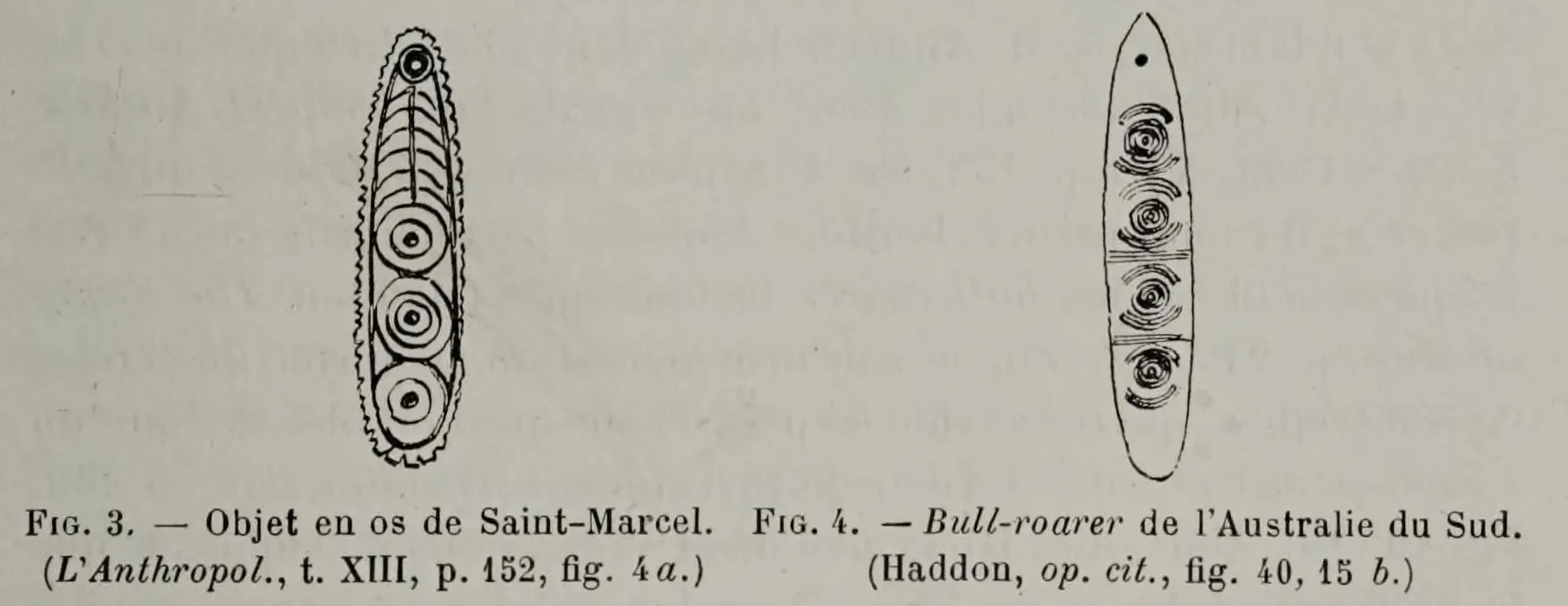
- Cook printed the pendant beside a South Australian bullroarer: the same outline and the same concentric circles.
- His conclusion: Palaeolithic people believed in spirits that outlived the body and could “make their voice heard by means of a bull-roarer”.
- This is the whole article, pp. 655–660, with page markers. I found no earlier English translation.
M. Andrew Lang, dans une lettre qu’il m’écrivit, à la date du 9 décembre 1902, me signala l’un d’eux […] comme étant « nettement un bull-roarer ». “Mr. Andrew Lang, in a letter he wrote to me dated 9 December 1902, pointed out one of them to me […] as being ‘clearly a bull-roarer’.” — A. B. Cook, L’Anthropologie 14 (1903), p. 658
Why does Cook’s 1903 article matter? #
It is the first printed claim that a bullroarer survives from the Ice Age. Arthur Bernard Cook (1868–1952), later the author of Zeus, lectured at Bedford College, London, in November 1902 on the painted pebbles that Édouard Piette had dug from the cave of Mas-d’Azil in the Pyrenees. His argument appeared the next year in French as “Les galets peints du Mas-d’Azil”, L’Anthropologie 14 (1903), pp. 655–660.
Cook’s case for the pebbles has not lasted, and Lang himself doubted it. The part that lasted is on p. 658. Spencer and Gillen had reported that the wooden churinga cannot be told apart from the bullroarer, whose sound women and children are taught is a spirit’s voice. So Cook wanted a bullroarer in the French caves, and Lang supplied it: a bone pendant from the deepest layer at Saint-Marcel, toothed along the edge like British bullroarers and cut with concentric circles like one from South Australia. On the same page Cook names the other two ends of the chain: the bullroarer as a toy and thunder charm in modern Europe, and the rhombos of the Dionysiac mysteries, which Lang had identified in Custom and Myth.
Lang answered in English the next year, in “The Problem of the Painted Pebbles of Mas d’Azil”, Man 4 (1904), no. 22, pp. 37–38. He thought the pebbles were more likely game pieces. The bullroarer he kept: “It may be inferred from these examples and from others in amber from the Baltic coasts, published by Klebs, that palaeolithic and neolithic men had bullroarers, and probably had such religious ideas as among savages are attached to bullroarers, as uttering the Voice (or ‘Word’) of some supernormal being.”
That is the claim this site argues at length: the instrument and its ideas are old enough to have spread with the first modern humans (the bullroarer and the sapient paradox). The next Ice Age specimen came in 1930, from La Roche near Lalinde (Peyrony’s report, also translated here). For the god of the rhombos as the enemy of women’s rule, see Bachofen’s preface to Das Mutterrecht.
“The painted pebbles of Mas-d’Azil”, by Arthur Bernard Cook #
Piette’s pebbles and the readings so far #
[p. 655] For a dozen years now the painted pebbles found by M. Piette in the Mesolithic layer of Mas-d’Azil have been under the examination of archaeologists.1 Received at first with a certain reserve and even, by some, with undisguised scepticism, they have ended by fully establishing their claim to authenticity; everyone today sees in them a discovery of capital importance. There is disagreement, however, about how they should be interpreted. In his first publication M. Piette did not hesitate to class the designs seen on the pebbles as numerals, symbols, pictographs and even alphabetic characters. “The cave of Mas-d’Azil,” he declared, “appears to us as a vast school, where people learned to read, to count, to write and to know the religious symbols of the solar god.”2
But conclusions of this kind, natural enough in the first joy of discovery, must inevitably give way to later and more considered judgements. When we recall the very limited power of counting that all primitive races possess (Tylor, Primitive Culture, I, p. 240: “The art of counting”), it becomes improbable that these pebbles are the slates on which Mesolithic schoolchildren wrote out sums of 510, 640, 920, etc. It is a very risky thing to identify the signs these pebbles bear with symbols, pictographs or letters known from elsewhere, first because we do not know which way up the pebbles should be held to examine them, and then because we cannot compare any two series of simple combinations of lines without [p. 656] noting many cases of purely accidental resemblance.
It is plain to see, however, that the painted pebbles must have meant something; and if M. Piette’s opinion cannot convince us, what have we to offer in its place? Several ideas have been put forward one after another. Some, for example, see in the pebbles the counters of a game; others regard them as the archives of the tribe, others as the equipment of a prehistoric diviner; others again think they see in them the cult objects of a primitive fetishism. Quot capita, tot sententiae (as many opinions as heads). These explanations are for the most part mere conjectures supported by no evidence; it is therefore useless to dwell on them.
The Arunta churinga #
Direct evidence being lacking, the problem can be solved only by the comparative method. The best course is to approach our task from the opposite end, I mean by examining first not the particular resemblances but the general analogies. From the outset we are struck by the singular character of the fact in itself: that a considerable deposit of painted pebbles should have been carefully put aside by primitive man under a rock shelter. Let us look, then, for a parallel fact. In the course of a lecture on this subject at Bedford College (London), in November 1902, I pointed out that the Australian aborigines practise a curiously similar custom.3
Fig. 1. Painted pebble from Mas-d’Azil. (L’Anthropologie, vol. VII, Atlas, I, 7.) Fig. 2. Churinga of the Arunta tribe. (Spencer and Gillen, fig. 21, 5.)4
Messrs. Spencer and Gillen, in their valuable work on The Native Tribes of Central Australia, state that among the Arunta each local totemic [p. 657] centre has its storehouse or depot of churinga, that is to say a cave or a hole in the hills where, for safety, one churinga is kept for each member of the totemic group, man or woman (p. 133). The same authors (p. 131, fig. 21) reproduce a collection of stone churinga from various Australian tribes: their shape comes very close to that of the pebbles of Mas-d’Azil; the design of one of them (no. 5, a churinga of the Hakea tree totem, Arunta tribe) is identical with a whole series of our pebbles.5
The Australian Black of the Arunta tribe sees in his churinga the representation of one of his ancestors whose spirit has passed into him (p. 123) and with whose qualities he is endowed (p. 135). The general belief is that the Blacks of today are reincarnated ancestors (p. 126), the ancestral spirit having entered some woman who was passing by and so been born again (p. 124).
The bull-roarer #
On the other hand, the churinga are often of wood as well as of stone (pp. 132, 140) and cannot be distinguished from the bull-roarer (p. 123, n. 1). The women and children, for whom the churinga are taboo on pain of the most terrible punishments (p. 129), are taught to believe that the sound of the bull-roarer is the voice of a bogeyman called Twanyirika by the Arunta, Tundun and Daramulun by other tribes (p. 246, n. 1); but there is evidence that the Kurnai tribe, for example, associates the bull-roarer with the spirit of a great ancestor (p. 137). In short, it seems legitimate to suppose that the string attached to the bull-roarer is nothing but a mechanical device for making an ancestral spirit speak. However that may be, it is clear that the bull-roarer belongs to the same circle of ideas as the churinga.6
If, then, we can find any reason to think that the Mesolithic inhabitants [p. 658] of Mas-d’Azil or their Palaeolithic ancestors used a bull-roarer, we shall to some extent have confirmed our hypothesis that the coloured pebbles of the cave are of the same nature as the churinga. Now the bull-roarer, which still survives among us as a toy or at most as a charm against thunder (Haddon, The Study of Man, p. 277), was found again by Mr. Andrew Lang in ancient Greece (Custom and Myth, 2nd ed., 1885, p. 39), where it seems to have been a sacred instrument used in the Dionysiac mysteries (Lobeck, Aglaophamus, p. 699).7
Lang’s letter: the Saint-Marcel pendant #
No more distant traces of it had been discovered on the soil of Europe when, in the spring of last year, the abbé Breuil published the discoveries made by M. Benoist at Saint-Marcel. There, in the deepest layer (“the level of engravings with cut-out outlines and in champlevé”), two bone pendants were found. Mr. Andrew Lang, in a letter he wrote to me dated 9 December 1902, pointed out one of them to me (L’Anthropologie, 1902, XIII, p. 152, fig. 4) as being “clearly a bull-roarer”; he remarked on its toothed border, a feature often seen on British bull-roarers (Haddon, The Study of Man, p. 279, fig. 38), and its ornament of concentric circles, which closely resembles that seen on a specimen from South Australia (Haddon, ibid., p. 309, fig. 40, 15).8
But, it will be said, what right have we to suppose that the Palaeolithic race of Saint-Marcel had beliefs and customs like those of the Mesolithic Azilians? Happily this same site of Saint-Marcel supplies the answer and lets us take this dangerous step. A layer somewhat higher, but still of the Reindeer Age (“the level of simple engravings with harpoons”), has yielded what we cannot help regarding as the prototype of the painted pebbles, namely a similar object on which a broad circle and a central hollow are deeply engraved (L’Anthropologie, 1902, XIII, p. 158, fig. 7). The same design is painted, not engraved, on several pebbles from Mas-d’Azil (for example L’Anthropologie, 1896, VII, p. 402, figures 36, 37), where some specimens are still decorated with engraved lines (ibid., Atlas, pl. VI, 18; pl. X, 6; pl. XI, 1, 4, etc.).
Spirits with a voice #
Given the striking analogy that exists between the Palaeolithic and Mesolithic remains of the French caves on the one hand and the existing customs of the Australian aborigines on the other, we may provisionally accept that the pebbles of Saint-Marcel and of [p. 659] Mas-d’Azil really are churinga, bearing witness to a belief in spirits that survived the death of the body and that could perhaps even make their voice heard by means of a bull-roarer. We have thus found what has long been sought: proof that Palaeolithic man himself was not wholly without some belief in spirits and in another life.9 All this, of course, does not amount to a religion, because it does not yet imply a cult; but it is at least what the Romans would have called a religio.10
Reinach, and what the signs depict #
I hardly need point out how well my attempt at interpreting the painted pebbles agrees with the interpretation M. Salomon Reinach has proposed for the paintings of the caves of Altamira, La Mouthe, etc. Writing in La Chronique des Arts et de la Curiosité, 1903, p. 47, M. Reinach puts it thus: “For my part, I do not hesitate to recognize, in this singular school of animal painters, adherents of primitive totemism… The clan lived on flesh; by depicting the animals on which it fed, it believed it was increasing their number and furthering their multiplication, as the savages of Australia believe they further that of the kangaroos by giving themselves up to the kangaroo dance.”11
I come at last, and to speak of it very briefly, to the point treated first and in most detail by M. Piette, that is, the meaning of the lines and combinations of lines found on the pebbles of Mas-d’Azil. The evidence gathered by Dr. E. Grosse, The Beginnings of Art, p. 115, tends to establish that most of the designs on the decorated objects of Australia, though at first sight they may seem purely geometric, are in reality zoomorphic, that is, conventional representations of animals or parts of animals. Messrs. Spencer and Gillen also think that the geometric rock paintings and the decorations of the churinga of central Australia are totemic designs of a zoomorphic or phytomorphic character (op. cit., pp. 618, 634).
I should therefore be disposed to regard the greater part of the designs of Mas-d’Azil as animal [p. 660] and plant forms rendered in the same conventional manner. M. Piette has seen in some of them snakes, eyes, trees, flowers, etc. But, as with Australian art, it is dangerous to try to pin down the details. Dr. Grosse, as Professor Haddon says (Evolution in Art, p. 258), “has been able to do no more than state general principles, owing to the absence of authoritative information from the natives”. We too must resign ourselves to a partial ignorance. It seems, however, that the designs drawn on the pebbles of Mas-d’Azil may well be biomorphic, and it is quite possible that they represent the totem of the man whose churinga they adorn.12
If it is objected that the remarkable artists of the Reindeer Age could have produced, and would have produced, far better likenesses of the animals in question, I shall reply that the painted pebbles of Mas-d’Azil belong to a period when artistic talent had died out: the superb carvings and engravings of the Magdalenian, the paintings full of life of the same period on the rocks, even the admirably worked flints of Solutré, all had by then disappeared. Are not conventional daubs in red paint exactly what we should expect to find in such an age of artistic decadence?
Sources #
- Cook, Arthur Bernard. “Les galets peints du Mas-d’Azil.” L’Anthropologie 14 (1903): 655–660.
- Lang, Andrew. “The Problem of the Painted Pebbles of Mas d’Azil.” Man 4 (1904), no. 22: 37–38.
- Lang, Andrew. Custom and Myth. London: Longmans, Green, 1884. “The Bull-Roarer”, pp. 29–44.
- Spencer, Baldwin, and F. J. Gillen. The Native Tribes of Central Australia. London: Macmillan, 1899.
- Haddon, Alfred C. The Study of Man. London: Bliss, Sands, 1898.
- Breuil, Henri. “Station de l’âge du renne de Saint-Marcel (Indre), d’après les fouilles de M. Benoist.” L’Anthropologie 13 (1902): 145–165.

Cook’s note: L’Anthropologie, 1891, II, p. 141; 1895, VI, p. 276; 1896, VII, 1, 385, 633 and Atlas. ↩︎
Translator’s note: Mas-d’Azil is a cave on the river Arize in the Ariège, in the French Pyrenees. Édouard Piette dug there from 1887 and found river pebbles painted with red dots, bars and signs in the layer now called Azilian, after the site. ↩︎
Cook’s note: Mr. Andrew Lang, in his book Magic and Religion, 1901, p. 244 and following, had already compared with the Australian churinga certain portable cup-marked stones found in a tumulus at Slieve-na-Calliaghe in Ireland (Proceedings of the Soc. of Antiquaries of Scotland, 1893, XXVII, p. 299, figs. 6, 7), in a circular fort on Dunbuie Hill, in Scotland (ibid., 1896, XXX, 291), and on the shore at Dumbuck near Dumbarton; but he had said nothing about the find at Mas-d’Azil. My comparison of M. Piette’s pebbles with the churinga of the Arunta tribe was first published by my friend Dr. P. Giles, who put it into his excellent article on “writing” in the Encyclopædia Britannica, 10th ed., p. 889 b. ↩︎
Translator’s note: Both figures are ovals crossed by a row of upright bars. The Arunta are the Arrernte of central Australia; a churinga (tjurunga) is one of their sacred stone or wooden objects. ↩︎
Translator’s note: The page numbers in brackets here and below are those of Baldwin Spencer and F. J. Gillen, The Native Tribes of Central Australia (London, 1899). ↩︎
Translator’s note: Cook leaves the English word bull-roarer in his French throughout, in italics. The Kurnai are the Gunaikurnai of Gippsland, Victoria. ↩︎
Translator’s note: Lang’s page 39 identifies the Greek ῥόμβος (rhombos), which Clement of Alexandria lists among the toys of the child Dionysus in the mysteries (Protrepticus 2.17–18), with the bullroarer. ↩︎
Translator’s note: The French: « nettement un bull-roarer ». The letter itself is not printed and Cook gives only these words in French, so “clearly a bull-roarer” translates the French and is not a quotation of Lang’s own words. Saint-Marcel (Indre) is the cave of La Garenne in central France; Henri Breuil’s report on the finds of Benoist is in L’Anthropologie 13 (1902). The layer is Magdalenian. ↩︎
Cook’s note: It should be noted that the evidence supplied by the Palaeolithic tomb of Roussillon (L’Anthropologie, 1895, VI, p. 316, pace De Mortillet, Le Préhist., 3rd ed., p. 312) and the pre-Neolithic or proto-Neolithic tombs of Menton (A. Evans, in the Journ. of the Anthropological Institute, 1893, XXII, p. 287) inclines us to the same conclusion. Why bury a man’s knives and ornaments with him if one does not believe in a life after death? ↩︎
Translator’s note: Latin religio here in its older sense: a scruple or awe before unseen powers, short of organized worship. ↩︎
Translator’s note: The italics on « comme les sauvages de l’Australie » are in Cook’s print. ↩︎
Translator’s note: The words given to Haddon translate Cook’s French; they are not Haddon’s English text. ↩︎