Snake Cult / Origins in dispute
Contra d’Huy on the African Root of World Mythology
A global myth is not an African fossil. Start with the bone. Make the root earn its place.
Enter the argument
TL;DR
- A global distribution does not date a myth to humanity’s departure from Africa.
- D’Huy repeatedly supplies African roots, then interprets the resulting reconstructions as African prehistory.
- His population-loss explanation supplies no test connecting Eurasian demographic changes to the disappearance of particular myths.
- Ice Age Europe offers material anchors: elaborate symbolic networks, musical instruments, and a published corpus of bullroarers.
- For the bullroarer-linked complex, Europe is a better starting hypothesis than an African ancestor manufactured by the rooting rule.
The oldest thing in Julien d’Huy’s reconstruction of world mythology is not necessarily the myth. Sometimes it is the assumption.
In his 2017 study of primordial matriarchy, d’Huy explains that modern humans originated in Africa; that some myths might have accompanied their departure; and that, accordingly, his tree “was rooted in East Africa.” He then reconstructs the mythology before the departure from Africa. The computer has successfully remembered its instructions. D’Huy, 2017, p. 161.
That little maneuver carries an enormous historical payload. Stories about women owning sacred instruments, the acquisition of fire, serpents, and the organization of the world become remnants of humanity’s African childhood. Similarities across continents acquire the age of the people who first crossed them. A distribution map becomes a time machine.
There is a much better place to look for the bullroarer-linked ritual complex: Ice Age Europe, with its extraordinary conjunction of figurative art, specialized technology, musical instruments, ornament systems, and long-distance connections. There, at least, the argument begins with things people actually made.
The Eve Theory of Consciousness (EToC) puts the stakes higher still. In its account, the bullroarer cult carries the emergence of humanitas: the reflective, initiated sapience that makes Homo human. The ritual world belongs to the story of becoming human itself. Its birthplace has to be investigated through the cult and its transmission. D’Huy instead supplies the much older geographical origin of anatomically modern humans as the origin of their ritual and mental world.
The origin of humanitas is a cultural question. The bullroarer cult belongs at its center.
Taxonomy is doing the work of cultural history. Bootstrap values do not fix the substitution.
An African root goes in; African prehistory comes out #
A myth tree groups traditions by their similarities and differences. A root tells you which direction to read it: which branches separate first, and which hypothetical ancestor precedes the rest. These are distinct operations. Finding a pattern of relationships does not automatically reveal where that pattern began.
Imagine drawing a road network without arrows. You have shown which towns connect. You have not identified the town from which the first traveler departed.
01 / The hidden instruction
Move the root. Rewrite the past.
Assumed root
A splits first. The remaining traditions descend along the other branch.
D’Huy’s 2017 choice is explicit. He uses the accepted African origin of modern humans, together with the hypothesis that the mythology spread during Out-of-Africa, to place the root. The migration hypothesis therefore helps construct the historical reading that the tree is subsequently said to support.
The problem is broader than one software setting. Standard stationary, reversible models of binary character change cannot distinguish different roots of the same unrooted tree. Even allowing motifs to be gained and lost at different rates does not fix that. Additional assumptions must supply direction. A branch can be well supported while its supposedly ancestral end remains undecided. Klopfstein et al., 2015.
Our earlier reanalysis makes the practical consequence unusually clear. We recovered d’Huy’s printed 13-region, 28-column matriarchy matrix and compared all available root edges under an explicitly directional model. The Balkan branch fits better than his East African reference in all three treatments of motif selection:
| Treatment of the recorded motifs | Balkan advantage over East Africa* | Balkan rank among 23 root edges |
|---|---|---|
| All printed traits | +3.26 | 1 |
| Correct for selecting variable traits | +3.26 | 3 |
| Condition on a motif being recorded somewhere | +2.91 | 3 |
Differences in fitted log likelihood; higher is better within each row. These are our model comparisons, not d’Huy’s reported results. Scores and calculation notes.
This is enough to puncture the claimed inevitability. The African root is not something the matrix forces upon a reluctant investigator. A European alternative competes successfully even on the author’s own material.1
I made the related argument in my earlier critique of d’Huy’s snake trees. The trouble is not that a computer has chosen the wrong continent. It is that a continent has been chosen before the computer is asked to reconstruct its past.
The recurring move, paper by paper #
The African ancestor appears in several related analyses. The procedures differ; the historical assumption keeps returning.
| Paper or analysis | What supplies the African direction |
|---|---|
| Dragon motifs, 2013, pp. 199–206 | South Africa is supplied as the global root/outgroup; ancestral serpent traits are then assigned to pre-Out-of-Africa mythology. |
| Saharan serpents, 2014, pp. 95–104 | The same dragon matrix is reordered and clustered; Africa’s central placement is interpreted through outward migrations. This is reused evidence, not a new independent corpus. |
| Paleolithic dragon ritual, 2016 | A midpoint root falls between African samples in one tree; another method places the root at a Eurasian group. The parsimony tree receives the African orientation. |
| Pleiades and Orion, 2017, with Berezkin, pp. 106–118 | Pleiades reconstructions use chosen East African or Bantu roots; Orion trees receive southwestern or eastern African roots. |
| Matriarchy and fire, 2017, pp. 161–165 | East Africa roots the sex-opposition and first fire tree; Africa roots the second fire tree. The resulting ancestral motifs receive an Out-of-Africa interpretation. |
| Lalinde bullroarer methods, 2025, pp. 1–4 | Midpoint rooting places Africa–Australia at the base; ancestral traits are reconstructed under African and Africa–Australia roots. Europe is not a sampled branch. |
Midpoint rooting supplies a different shortcut: its historical meaning depends on assumptions about rates of change. A mathematically central point supplies neither a date nor a demonstration that the deepest-looking modern sample occupied the birthplace of the tradition.
The repeated confirmation is also less independent than it looks. In the matriarchy paper, seven traits selected from the ancestral reconstruction are used to make a second, more tree-like dataset. A cleaner fit after retaining features selected by the first analysis is not an independent validation. Several papers also reuse Berezkin’s catalogue, geographical pooling, and migration framework. Changing the statistical tool does not make a shared premise into a new observation.
D’Huy’s own exceptions expose the weakness of the shortcut. His Cosmic Hunt study discusses an Asian prototype and postglacial spread from the Franco-Cantabrian refuge; his flood synthesis places the main flood complex in Southeast Asia. He already has a vocabulary for later invention and diffusion. There is no reason to suspend it when an African root makes an attractive deep-time story.
Global is a distribution, not a date #
The underlying historical syllogism goes like this: the motif occurs among widely separated peoples; their ancestors separated during ancient migrations; therefore the motif accompanied those migrations.
The missing premise is that the story could not have traveled afterward.
People trade. They intermarry. They adopt prestigious ceremonies, frightening gods, useful tools, and excellent stories. A successful initiation system can cross a language boundary without bringing an entire population behind it. You do not have to replace someone’s ancestors to teach him a song.
A global motif might be old. It might also have spread surprisingly far after its invention. A broad resemblance might reflect repeated invention; a more peculiar bundle of details might favor historical transmission. Neither observation, by itself, decides the century, millennium, or continent of origin.
This matters especially when a catalogue compresses an elaborate narrative into a broad feature. F38 is not the motif “bullroarer invented in Africa.” It concerns women possessing—or attempting to acquire—sacred knowledge, sanctuaries, or ritual objects subsequently forbidden to them. The bullroarer can occupy that role, but so can another sacred object. Collapsing these stories into one column creates a useful comparison. It also discards information needed to distinguish their histories. Berezkin and Duvakin, F38.
There are at least three different things to date: the instrument, the story about women owning it, and the institution that tells that story. An old instrument does not automatically date its latest explanation. A widespread explanation does not automatically identify the instrument’s inventor. A database cell cannot do all three jobs just because it is very small.
Oral memory has no demonstrated 100,000-year warranty #
The most instructive comparison is Indo-European mythology. Here we possess something much better than “both cultures have a snake”: related languages, regular sound correspondences, early texts, and independently constrained population histories.
The connection between Vedic Dyaus, Greek Zeus, and Latin Jupiter rests on linguistic correspondences as well as a shared sky-father conception. We can reconstruct a relationship with actual historical structure. Even then, reconstructing the ancestor’s entire mythology is much harder than recognizing the inherited divine name. West, 2007, chapter 4.
The relevant chronology is measured in several millennia. A major 2025 ancient-DNA study places the final unity of its proposed Proto-Indo-Anatolian population around 4400–4000 BCE. That is a model of a particular prehistoric language community, with archaeological and genomic constraints—not a date borrowed from the origin of our species. Lazaridis et al., 2025.
One of the oldest and best-supported Indo-European folktale reconstructions is The Smith and the Devil, ATU 330. Sara Graça da Silva and Jamshid Tehrani examined 275 folktales; 76 passed their initial screening for ancestral reconstruction. Of four tales proposed at the Proto-Indo-European node, The Smith and the Devil alone received support in their further Bayesian test. Its basic plot is widely attested, from India to Scandinavia: a smith obtains a supernatural power and turns it against the being who supplied it. Graça da Silva and Tehrani, 2016, results, table 2 and discussion.
That makes it a particularly useful companion to The God the Smith Made, the Bullroarer Atlas essay on smiths, sacred instruments, and the manufacture of divine presence. Technical mastery and mastery over a supernatural being belong together in a tale reconstructed to the Indo-European ancestral horizon. The smith has excellent credentials for deep history.
Even with a much firmer family history, the recoverable ancestral repertoire becomes thin. Extrapolating from a few reconstructed survivors to a detailed mythology 50,000 or 100,000 years old is not a small extension. It is a different evidentiary universe.
Some of the strongest arguments for longer memory have an external clock. Patrick Nunn and Nicholas Reid compared coastal inundation traditions from 21 Australian locations with reconstructed sea levels. They inferred memories of landscapes submerged roughly 7,250–13,070 years ago. The dated coastline constrains the proposed memory. It does not directly date every character and episode in the surviving story. Nunn and Reid, 2016.
These are serious reasons to investigate the flood traditions collected in the Bullroarer Atlas’s Myths of the Great Deluge series. They are not a license to multiply every oral chronology by ten. Nor does every flood story describe the end of the Ice Age: rivers have continued to flood with regrettable enthusiasm ever since.
What is missing from the African-root argument is an independently calibrated demonstration that its particular narrative package survived the required tens of thousands of years. The alleged age helps explain the distribution; the distribution then certifies the age. Two unsupported propositions are holding hands and calling it a bridge.
The Ice Age did not selectively delete the inconvenient stories #
D’Huy encounters an awkward geography. The supposedly ancestral complex is poorly represented in several continental Eurasian samples. He offers an explanation:
“The African mythology was largely lost in Continental Eurasia (in the tree: Balkans, Southern Asia, Northeastern India), likely because the decrease of population density during or soon after the Late Glacial Maximum.”
— D’Huy, 2017, p. 162
This is a substantial historical claim. It needs a demonstrated demographic event, the right geographical coverage, and a reason that this event erased these particular traditions. The tree supplies none of those things.
The timing is especially awkward. In the very period after the glacial maximum that he invokes to explain the loss, Europe gives us dozens of bullroarers and an extraordinary flowering of art and ritual technology. At least 41 specimens in the Atlas’s European Ice Age corpus fall in date ranges from the end of the glacial maximum onward. Decorated bone and antler preserve the instruments inside a culture producing cave images, portable art, and elaborate symbolic equipment. An explanation built around disappearing mythology has to reckon with people busily manufacturing its supposed ritual equipment. Europe did not get the memo. Corpus count and chronology; Barandiarán, 2012.
The genetic chronology does not provide the convenient continental wipeout. Schiffels and Durbin’s multiple-genome analysis distinguishes an older non-African bottleneck associated with Out-of-Africa from later expansion between roughly 30,000 and 10,000 years ago in its northern-European, Italian, Gujarati-ancestry, and Chinese samples. That interval spans the glacial maximum and its aftermath. Schiffels and Durbin, 2014, figure 3 and accompanying text.
Effective population size is not population density: it reflects ancestry and reproduction, and population structure can produce misleading rises and falls. Those curves cannot be relabeled “people per square kilometer in northeastern India.” But they certainly do not supply d’Huy’s missing evidence for a common Eurasian demographic collapse. Mazet et al., 2016.
Ancient DNA makes the geography more concrete. Posth and colleagues find continuity through the glacial maximum in western and southwestern refugia, alongside replacement elsewhere. Later Magdalenian-associated populations expanded northward and northeastward; genomes from France to Poland document that expansion around 18,000–15,000 years ago. The record contains survival, movement, mixture, and replacement. It does not contain a readout of which myths people forgot. Posth et al., 2023.
That last distinction matters. A population can lose a story while growing. It can preserve one while shrinking. Its neighbors can adopt its ritual after most of its genetic ancestry disappears. To connect demography to the selective loss of F38 and its companions requires an actual transmission argument.
Instead, missing motifs become evidence of a catastrophe invoked to explain the missing motifs. The Ice Age has been appointed mythology’s unpaid IT department: anything absent from the expected folder must have been deleted in the crash.
The European alternative has objects in it #
Look at what Upper Paleolithic Europe was doing.
People shaped mammoth ivory into bodies and animals. They made complex flutes from bird bone and ivory. They developed distinctive systems of personal ornaments, transmitted recognizable styles, and moved materials across substantial distances. The Swabian record places art, ornament, and instruments together near the beginning of the European Upper Paleolithic; revised dating at Geißenklösterle puts the early Aurignacian there around 42,000–43,000 years ago. Higham et al., 2012; Conard, Malina, and Münzel, 2009.
This was a sustained cultural flowering, with technological skill serving an elaborate symbolic life. By the Magdalenian, the surviving repertoire joins monumental cave images to miniature engravings, decorated weapons, worked bone and antler, and sound-producing devices. The people who made these things were not passive custodians waiting for the next installment of ancestral mythology to arrive.
A 2025 study counted 215 distinct ornament types at 202 European sites in its Aurignacian–Gravettian dataset. Their distributions reveal regional identities and wider connections; the Gravettian pattern suggests more extensive symbolic networks. That is a material record of people making distinctions, recognizing one another, and sharing conventions. D’Errico et al., 2025.
A center capable of generating and exporting compelling ritual culture ought to leave exactly this sort of conjunction: technical specialization, repeated imagery, portable symbols, performance, and connections between communities. Europe supplies it in abundance. It is one of archaeology’s most conspicuous cultural florescences.
For the complex under discussion, the European case is stronger because it begins where the relevant material evidence becomes substantial. It asks how a flourishing regional tradition could spread and acquire new forms. The African-root reconstruction instead asks us to supply an immensely older ancestor and then explain away the gaps between that ancestor and the objects.
An Ice Age full of bullroarers #
The bullroarer is especially troublesome for an automatic African origin.
It is an elegantly simple sound machine: a flattened blade on a cord, rotating as it swings. In documented ritual settings, its noise can become the voice of a dangerous being, an ancestor, or a secret that initiates must learn. The Bullroarer Atlas assembles the geographically scattered objects and source records; the associated initiation complex is considerably more interesting than the bare fact that a spinning board makes a noise.
The Atlas’s European Ice Age corpus now contains at least 45 specimens across 24 records. That count includes the objects grouped within a site record and merges duplicate reports of the same object. It adds eleven specimens beyond Barandiarán’s familiar Franco-Cantabrian inventory, including examples from Stellmoor in northern Germany and Cuina Turcului in Romania, as well as further French and Spanish finds. This is a European archaeological corpus, not one famous blade asked to carry a continent. Record-by-record count, dated 19 September 2026.
Ignacio Barandiarán’s broad comparison inventory brings together 34 objects from 13 Franco-Cantabrian sites: bullroarers alongside pendants, fragments, and disputed comparanda. Counting his itemized descriptions, the sites retained in his concluding bullroarer category yield 19 specimens at six sites: Lalinde, El Pendo, Aitzbitarte IV, Isturitz, Bourrouilla, and Bolinkoba. This geographically repeated form, examined through its material, suspension features, and decoration, is substantial archaeological evidence. Barandiarán, 2012, pp. 307–334, especially p. 331; 2015, pp. 149–158.
02 / The material record
The places the tree left out
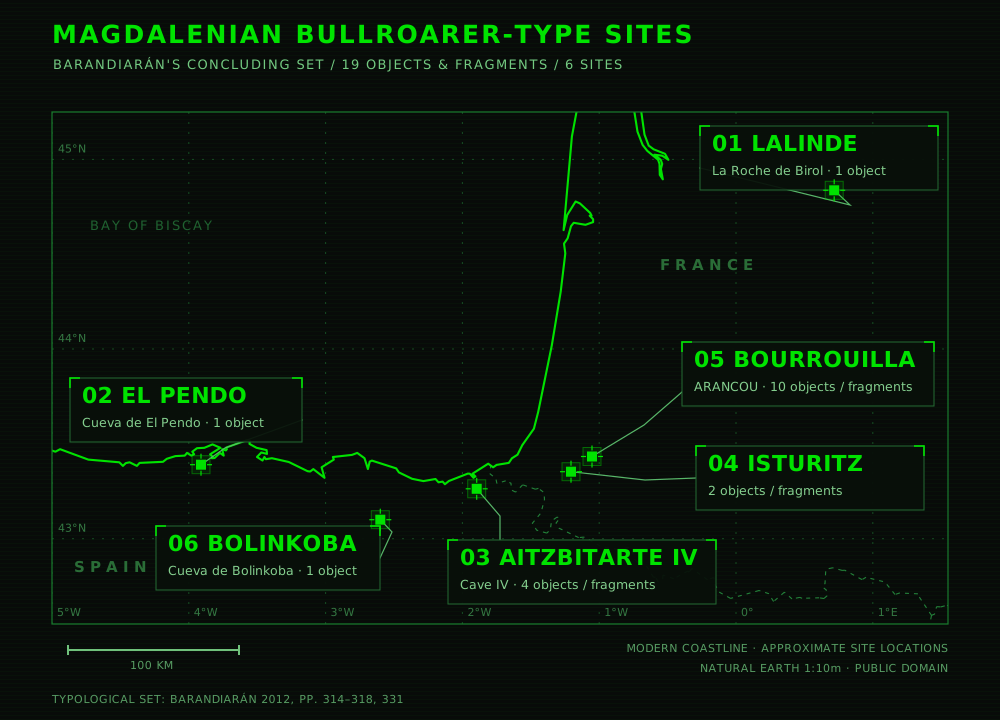
The clearest anchor is the Lalinde blade from La Roche de Birol: an elongated piece of reindeer antler, pierced at one end, ochred, and incised. Its associated assemblage supports a Final Magdalenian attribution, roughly 15,000–13,000 years ago. A replica produces the characteristic rotating sound. Lalinde object record and primary-source trail; Dauvois, 2005, pp. 232–233.
D’Huy’s 2025 Lalinde methods annex adds a remarkable wrinkle. Its tree compares six broad regions and contains no European branch. The midpoint root falls on the Africa–Australia side, and ancestral traits are reconstructed using that grouping and Africa alone. Such a tree can compare those sampled traditions. It cannot defeat a European alternative it never admitted to the contest. Europe has supplied the object and been left off the guest list. Published methods annex, figures 1–2 and table 1.
That is a far more concrete starting point than a pre-Out-of-Africa reconstruction. We have an object, a place, a cultural horizon, a plausible mechanism, and a family of comparable objects. The African ancestor proposed for the story is tens of thousands of years older and lacks an equivalent dated bullroarer anchor in the argument.
At Raymonden, near Chancelade, the conjunction becomes more provocative. A perforated bone object depicts a bison with its vertebral column exposed, accompanied by small human figures. Barandiarán includes the piece in the wider bullroarer corpus; the Jean Clottes database describes it as a pendant showing a dismembered bison. Here are skeletal imagery, a human gathering, and an object with a possible sound-producing form in the same artifact, stylistically assigned to the Upper Magdalenian. Jean Clottes database, item 6241.
I discuss its x-ray-like appearance in the Bullroarer Atlas essay on internal imagery. That comparison proposes a line of investigation into the conjunction of sound, bodies, and hidden interiors. The important point here is simpler: Europe already supplies the material ingredients for the hypothesis. We are not obliged to begin the search 50,000 years earlier on another continent.
The dog that crossed the family tree #
Dogs provide an unusually good test of the assumption that shared culture must follow the deepest branches of human ancestry.
In 2026, ancient genomes identified dogs at Pınarbaşı in Anatolia about 15,800 years ago and Gough’s Cave in Britain about 14,300 years ago. Related dogs circulated among culturally and genetically distinct western Eurasian hunter-gatherers. At Gough’s Cave, the human population retained Magdalenian-associated ancestry without the Epigravettian contribution that might otherwise have explained the connection. Dogs had crossed a boundary that the human genetic record had not crossed in the same way. Marsh et al., 2026.
A dog is a rather demanding item of transmitted culture. It eats. It bites. It needs a place in human life. A story can travel with substantially less luggage.
Here is the mechanism the myth argument needs to take seriously: late Ice Age exchange could move valued things between distinct populations without wholesale population replacement. Earlier genomic work already found at least five major dog ancestry lineages by about 11,000 years ago, demonstrating how much differentiation and movement had occurred by the opening of the Holocene. Bergström et al., 2020.
Europe was part of that connected world. A ritual could spread eastward, change hands, move through later networks, and eventually become associated with populations whose ancestors had left Africa long before the ritual existed. Tracing the ritual back to the departure of those ancestors would confuse the age of the carrier’s family with the age of his cargo.
Nor was first settlement the last opportunity for a tradition to arrive. “People were already there” is not an argument against later cultural transmission. People are usually already there when they hear a new story.
Where is the ancestral reservoir of motifs? #
The diversity argument also deserves better than a hand wave.
A plausible old homeland is often expected to preserve deep internal differentiation: branches have had time to separate there. Linguistic homeland arguments have long used that kind of reasoning. Sapir, 1916, discussion of linguistic differentiation and geographical distribution.
Even the simpler question of recorded motif richness is awkward for the proposed African storehouse. In the pinned 2023 Berezkin catalogue used for our checks, the 117 sub-Saharan traditions have a median of 35 recorded motifs. The other 809 traditions have a median of 61. The corresponding means are approximately 40 and 79. Pinned source catalogue; reproducible calculation.
The sub-Saharan catalogue sample is markedly thinner. It is not the great surviving warehouse of global motifs that a casual appeal to the oldest homeland might lead a reader to expect.
If the thinness partly reflects what collectors failed to record, the problem changes direction: those zeros cannot serve as reliable absences when reconstructing a 65,000-year-old repertoire.2
More fundamentally, a sparse modern tradition is not a fossil. A community can retain few of the selected motifs because it never acquired them, because it lost them, because its repertoire developed along other lines, or because its ethnographers recorded different things. “Has fewer of our coded features” does not mean “resembles humanity before those features were invented.”
A short row in a spreadsheet is not an early chapter in human history.
Follow the cult #
The European hypothesis has a straightforward historical shape. An exceptionally productive Upper Paleolithic cultural world develops and recombines rituals, sound technologies, images, and stories. Networks carry those packages between communities. Later migrations and exchanges move them farther; local institutions change their meanings. The result can be a wide distribution without requiring a complete narrative to survive from before Out-of-Africa.
That account starts with demonstrable capacities and dated objects. The geographical reach of each particular tradition remains a research problem, but the mechanism is already visible. The alternative begins by assigning a remote African ancestor and repeatedly asks absence, survival, and demography to cooperate with the assignment.
For the bullroarer-linked complex, Ice Age Europe is the better bet. It gives us the instruments, the artistic and technical flowering, the networks, and a much shorter distance between material evidence and proposed tradition. It deserves to be treated as a serious source of cultural invention and export, rather than as the place that obligingly forgot the stories the theory needs it to have forgotten.
D’Huy’s matrices can help us study relationships. They do not confer an African passport on every traveling myth. In EToC’s account, the bullroarer cult carries the emergence of humanitas. We need the cultural history of that transformation, not a geographical answer borrowed from anatomy.
Start with the bone. Make the root earn its place.
Sources #
- D’Huy, Julien. “Matriarchy and prehistory: a statistical method for testing an old theory.” Les Cahiers de l’AARS 19 (2017): 159–170. Rooting p. 161; population-loss interpretation p. 162; ancestral motifs p. 163.
- Klopfstein, Seraina, et al. “A Nonstationary Markov Model Detects Directional Evolution in Hymenopteran Morphology.” Systematic Biology 64 (2015): 1089–1103.
- West, M. L. Indo-European Poetry and Myth, chapter 4, “Sky and Earth.” Oxford University Press, 2007.
- Lazaridis, Iosif, et al. “The genetic origin of the Indo-Europeans.” Nature 639 (2025): 132–142.
- Graça da Silva, Sara, and Jamshid J. Tehrani. “Comparative phylogenetic analyses uncover the ancient roots of Indo-European folktales.” Royal Society Open Science 3 (2016): 150645.
- Nunn, Patrick D., and Nicholas J. Reid. “Aboriginal Memories of Inundation of the Australian Coast Dating from More than 7000 Years Ago.” Australian Geographer 47 (2016): 11–47.
- Schiffels, Stephan, and Richard Durbin. “Inferring human population size and separation history from multiple genome sequences.” Nature Genetics 46 (2014): 919–925.
- Mazet, Olivier, et al. “On the importance of being structured: instantaneous coalescence rates and human evolution—lessons for ancestral population size inference?” Heredity 116 (2016): 362–371.
- Posth, Cosimo, et al. “Palaeogenomics of Upper Palaeolithic to Neolithic European hunter-gatherers.” Nature 615 (2023): 117–126.
- Higham, Thomas, et al. “Testing models for the beginnings of the Aurignacian and the advent of figurative art and music.” Journal of Human Evolution 62 (2012): 664–676.
- Conard, Nicholas J., Maria Malina, and Susanne C. Münzel. “New flutes document the earliest musical tradition in southwestern Germany.” Nature 460 (2009): 737–740.
- D’Errico, Francesco, et al. “Multivariate analyses of Aurignacian and Gravettian personal ornaments support cultural continuity in the Early Upper Palaeolithic.” PLOS ONE 20 (2025): e0323148.
- Barandiarán Maestu, Ignacio. “Forma vs. función en tipología prehistórica: el caso de las bramaderas óseas magdalenienses.” Veleia 29 (2012): 307–334. See also the Bolinkoba monograph, pp. 149–158, Kobie, Anejo 6 (2015).
- Dauvois, Michel. “Homo musicus palaeolithicus et Palaeoacustica.” Munibe 57 (2005): 225–241, especially pp. 232–233.
- Bullroarer Atlas. Lalinde object dossier and “X-Ray Style.” Object-level sources and the author’s comparative interpretation.
- Base Jean Clottes. Raymonden/Chancelade, item 6241. Archaeological object and iconography record.
- Marsh, William A., et al. “Dogs were widely distributed across western Eurasia during the Palaeolithic.” Nature 651 (2026): 995–1003.
- Bergström, Anders, et al. “Origins and genetic legacy of prehistoric dogs.” Science 370 (2020): 557–564.
- Sapir, Edward. Time Perspective in Aboriginal American Culture: A Study in Method. Geological Survey of Canada, Memoir 90, 1916.
- Berezkin, Yuri E. “Folklore and Mythology Catalogue: Its Lay-Out and Potential for Research.” RMN Newsletter 10 (2015): 34–46. Pinned query-engine data, 2023-05-16.
- Berezkin, Yuri E., and Evgeny N. Duvakin. Analytical catalogue, motif F38.
- D’Huy, Julien. “Le motif du dragon serait paléolithique : mythologie et archéologie.” Préhistoire du Sud-Ouest 21 (2013): 195–215.
- D’Huy, Julien. “Une méthode simple pour reconstruire une mythologie préhistorique (à propos de serpents mythiques sahariens).” Les Cahiers de l’AARS 17 (2014): 95–104.
- D’Huy, Julien. “Première reconstruction statistique d’un rituel paléolithique : autour du motif du dragon.” Nouvelle Mythologie Comparée 3 (2016): 15–47.
- D’Huy, Julien, and Yuri E. Berezkin. “How Did the First Humans Perceive the Starry Night? – On the Pleiades.” RMN Newsletter 12–13 (2016–2017): 100–122.
- D’Huy, Julien. “Le rhombe de La Roche à Lalinde. L’apport de l’approche phylomythologique”: methods annex. Bulletin de la Société historique et archéologique du Périgord CLII, second installment (2025).
- D’Huy, Julien. “A Cosmic Hunt in the Berber Sky: A Phylogenetic Reconstruction of Palaeolithic Mythology.” Les Cahiers de l’AARS (2013): 93–106.
- D’Huy, Julien. “At the Origin of Flood Mythologies: Synthesis of Three Papers.” RMN Newsletter 15–16 (2020–2021): 70–76.
- Bullroarer Atlas. “The God the Smith Made.” 6 September 2026. Smiths, sacred iron, and manufactured divine presence.
- Bullroarer Atlas. European Ice Age corpus: 24 records, at least 45 specimens. Count of the 19 September 2026 catalogue snapshot, with individual record links and machine-readable data.
Notes #
These are fixed-topology, nonstationary binary gain–loss fits, with ancestral motif frequency estimated separately from its equilibrium frequency. Each of the 23 canonical edges received the same 122-start budget. The unrooted connections match d’Huy’s Figure 1. The Balkan edge ranks first using all 28 printed columns and third under both selection corrections; East Africa ranks last in all three. Several parameters approach imposed bounds; best edges are close; these are neither homeland probabilities nor dates. The printed Appendix A also contains a conflict between its motif-removal prose and its 28-column block, so the audited transcription retains positional columns. The methods and score packet records those limits. Other recovered matrices often favor American edges under the same model family: the exercise challenges the supplied African roots, not a statistical proof that every myth began in Europe. ↩︎
The snapshot contains 926 traditions and 2,138 binary motif columns. “Sub-Saharan” uses the source’s
areas1=1grouping; the comparator includes all other rows, including North Africa and Madagascar. These are unweighted descriptive counts; they do not control for documentation, corpus selection, population size, or varying aggregation of traditions. Richness within a row is different from phylogenetic diversity between traditions. Berezkin explains the selection of recurrent motifs and uneven geographical units in his 2015 catalogue description, especially pp. 37–39. The script and full summary expose the calculation and all 16 source-area summaries. ↩︎