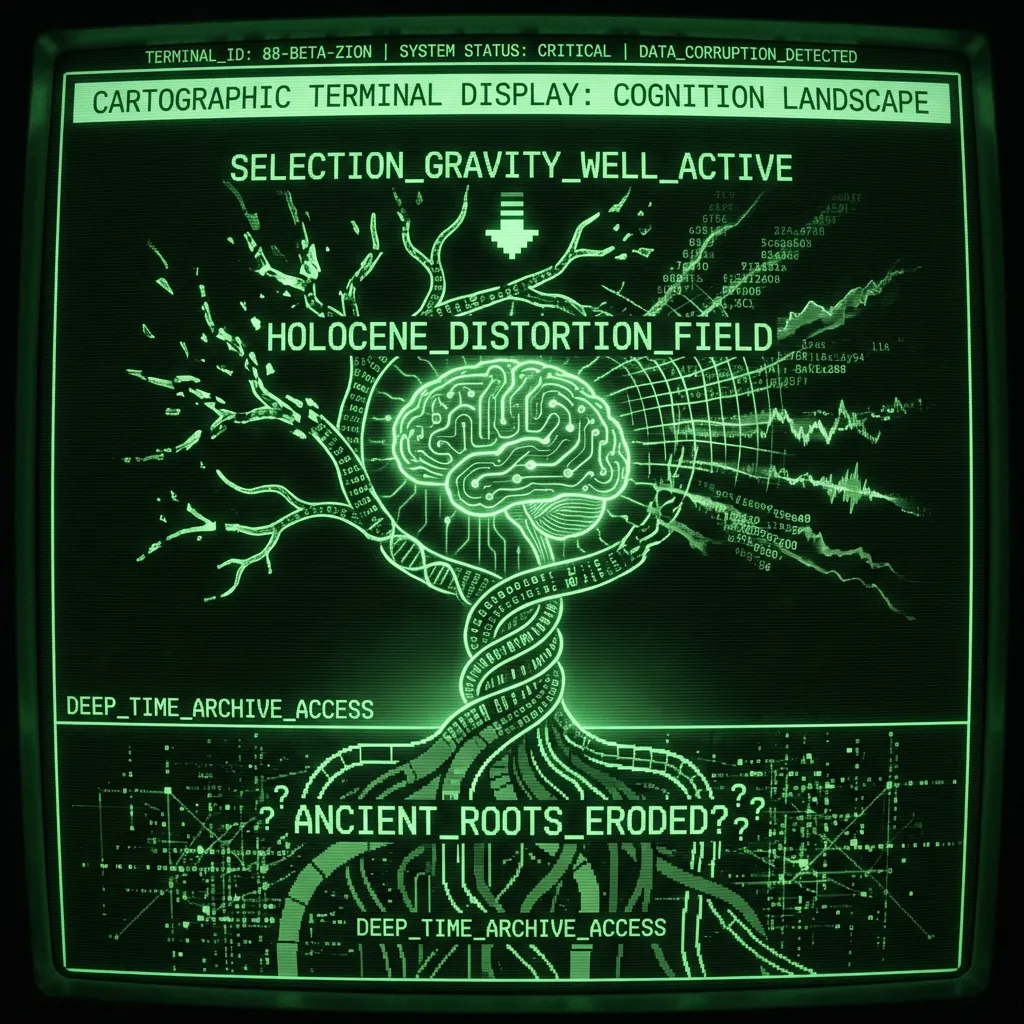
TL;DR
- Population “trees” are already graphs; add strong recent selection for cognition and many standard time-depth inferences become systematically biased, not just noisy (e.g., TreeMix-style drift lengths can inflate as selection shrinks local effective size) (Pickrell & Pritchard 2012).
- Deep splits (e.g., Khoe-San vs. others) can remain real while also being overstated by selection-linked distortions in coalescent histories and locus choice (Schlebusch et al. 2017).
- “Basal Eurasian” could partly be a selection artifact (differential retention/purging of introgressed or deleterious ancestry) layered atop real structure (Lazaridis et al. 2016).
- Australia/Sahul’s archaeology–genetics tension becomes easier to explain if late selection + demographic turnover erased early lineages without erasing early presence (Clarkson et al. 2017; Malaspinas et al. 2016).
- The right response is not “ignore trees,” but “treat tree outputs as mixtures of time, drift, gene flow, and selection,” and re-fit using selection-aware partitions and time-anchored ancient genomes (Li & Durbin 2011; Jakobsson et al. 2025).
“In our model, the sampled populations in a species are related to their common ancestor through a graph of ancestral populations.”
— Pickrell & Pritchard, PLOS Genetics (2012)
Trees are hypotheses about genealogies—not the genealogies#
Let’s start from first principles and keep the metaphysics minimal.
The “true” object in population genetics is not a tree of populations. It’s a forest of genealogies: every locus has its own ancestral recombination graph (ARG), and recombination stitches these into a genome-wide mosaic.1 Any population “tree” is a summary statistic: a lossy compression of covariance patterns in allele frequencies or haplotypes.
Now insert your hypothetical: direct selection on consciousness-related capacities (self-reflection, language, theory of mind, executive control) acting strongly in the last ~50,000 years—especially the last ~15,000 years, where agriculture, dense settlement, prestige-biased transmission, and stratified reproduction explode the selective “surface area.” This premise is compatible with the broad claim that human adaptive evolution accelerated in the Holocene as population size and cultural novelty increased (Hawks et al. 2007). It’s also compatible with the observation that uniparental lineages (Y in particular) can experience dramatic recent bottlenecks plausibly driven by cultural structure (Karmin et al. 2015).
The question becomes: if cognition was under direct and recent selection, what would it do to the inferences we keep making from “trees”?
Answer: it would make a nontrivial fraction of famous “tree-based” time depths look older than they are, while simultaneously making some episodes of admixture look smaller than they were, and making some genuine deep structure harder to place on a calendar.
That sounds like a contradiction until you separate three things that trees conflate:
- calendar time (years),
- genetic drift (variance from finite sampling of parents; effectively ∝ time / Ne),
- selection-linked coalescent distortions (which change local Ne, and can also change which ancestry survives).
The core mechanism: selection changes the conversion rate between “drift units” and years#
Many tree and graph methods infer branch lengths in something like “drift units” (often proportional to (t / 2N_e)). If you then translate drift into years, you need (N_e) and a mutation clock. But selection alters the effective (N_e)—often in a locus-dependent way—without necessarily reflecting a true demographic bottleneck.
Linked selection is the quiet villain#
Even if selection targets only a subset of sites, recombination links neutral sites to selected ones. The net effect:
- diversity drops in low-recombination regions,
- coalescences happen “too fast” compared to a neutral model,
- and any inference that mistakes this for demography can hallucinate population size changes or exaggerated divergence.
This is exactly why single-genome and multi-genome coalescent reconstructions must be interpreted cautiously in recent time slices (Li & Durbin 2011) and why selection can “write” demographic-looking signatures into genomes even when census size is stable.
Your consciousness-selection world is basically: make linked selection stronger and more geographically structured in the late Pleistocene/Holocene, because the targets (cognition-related traits) are highly polygenic and culturally mediated.
Admixture + selection is not additive; it’s adversarial#
Admixture makes the history reticulate (graph-shaped). Selection then acts on the mixture, often preferentially keeping or deleting specific ancestry segments. That means:
- some ancestries are under-retained (purged) even if admixture was substantial,
- other ancestries are over-retained (adaptive introgression) even if admixture was small,
- and the resulting genome can look “less admixed” or “more basal” than the population history really was.
This matters directly for famous claims like “Basal Eurasian” (Lazaridis et al. 2016) and for interpreting why different methods disagree about Sahul structure and dates (Malaspinas et al. 2016).
Famous tree/graph papers, reinterpreted in the cognition-selection universe#
Below I’m going to do what you asked: pick specific studies that build trees/graphs (or derive deep split times from genome-wide genealogical summaries), and then ask: if strong recent selection for cognition were real, which inferred time depths drift, and in what direction?
A quick map of the inference pipeline#
| Step | Typical input | Typical assumption | What cognition-selection breaks |
|---|---|---|---|
| Build covariance / drift tree | allele frequencies across pops | changes ≈ neutral drift | selection induces correlated frequency shifts that mimic drift |
| Add migration edges | residual covariance | “extra” covariance = gene flow | selection can create/erase covariance, faking or hiding edges |
| Convert drift to years | mutation rate + Ne | Ne reflects demography | selection shifts Ne locally & recently, biasing year conversion |
| Calibrate with ancient DNA | dated genomes | time anchors are neutral | selection acts between anchors, biasing interpolation |
(Methods exemplar: TreeMix framework in Pickrell & Pritchard 2012.)
1) SGDP: “population tree” as if drift were neutral#
The Simons Genome Diversity Project paper gives you a canonical global variation set and (as expected) a clean hierarchical structure when you build trees or TreeMix-like graphs (Mallick et al. 2016).
In our cognition-selection world, what changes?
Terminal branch inflation: if selection for cognition is stronger in some Holocene social ecologies (state societies, schooling, high-density markets, prestige hierarchies), then many loci shift in parallel. Tree algorithms interpret parallel shifts as extra drift on those terminal branches. That can make some groups appear “more diverged” than their true neutral separation time would imply.
Effect on time-depth: tends to overestimate divergence times if you back-calculate years from drift without selection-aware Ne.False “deep” splits from recent structure: extremely strong, structured selection can create tree-like separations that are genuinely recent but look old in drift units. You don’t get a fake million-year split genome-wide—physics forbids it—but you can get “this branch is surprisingly long” in a way that seduces people into ancient narratives.
Locus choice becomes destiny: if your filtered “neutral” set still contains many linked-to-selection regions (especially near genes, low recombination), your inferred tree is partially a map of selection landscapes, not just ancestry. In a cognition-selected world, that bias grows because the trait’s architecture is distributed across the genome.
Concrete “what would we do differently?”: re-run tree inference on partitions stratified by recombination rate and distance to functional elements, then compare topologies/branch lengths. If the topology is stable but branch lengths change dramatically, you’ve diagnosed selection-linked Ne distortion rather than genuine deep time.
2) Southern Africa deep splits: real structure, but the clock is fragile#
You specifically asked about Khoe-San deep divergence claims (200–300k years, sometimes even wilder in secondary tellings). A flagship anchor is Schlebusch et al. estimating the first modern human population divergence to ~350k–260k years using southern African ancient genomes and coalescent-based approaches (Schlebusch et al. 2017).
Then, very recently, Jakobsson and colleagues published 28 ancient southern African genomes (10,200–150 calibrated years BP), finding an “extreme end” of variation and long regional isolation signals, while also emphasizing Homo sapiens–specific variants (Jakobsson et al. 2025).
In our cognition-selection world, what changes?
Two things at once—this is the subtle part:
The existence of deep structure is not threatened. Strong selection in the last 15k years cannot conjure genome-wide coalescent depths of 300k years out of nothing. Deep splits in Africa are plausibly real given long-standing population structure, and the ancient-genome evidence strengthens the case that modern variation undersamples the ancient African “state space” (Schlebusch et al. 2017; Jakobsson et al. 2025).
But the translation from genealogical depth to a clean divergence event becomes less trustworthy. If cognition selection is recent and structured, it can create:
- basal erasure: late expansions that overwrite intermediate lineages, making the remaining lineages look like they split “cleanly” and “long ago,” because the middle branches got bulldozed by Holocene demography + selection.
- clock heterogeneity: if selection changes which regions you treat as neutral (or changes mutation-rate proxies indirectly via life history), then time estimates become more method-dependent.
So what would we reinterpret?
Some “deep split” claims might shift from “a clean bifurcation at X years” to “long-standing structure + pulses of gene flow + recent replacement,” with X becoming a range that depends on neutral partitioning. The split could remain deep, but the story form changes: less “tree,” more “braided river.”
Claims of very ancient divergence maxima (the “million-year” vibes) become more obviously artifacts of model mismatch or local genealogies being mistaken for population splits, especially when selection makes genealogies more heterogeneous across the genome.
3) Basal Eurasian: selection could fake “basalness” by editing introgression signals#
“Basal Eurasian” arises in admixture graphs fit to ancient Near Eastern genomes, partly to explain allele-sharing patterns and reduced Neanderthal ancestry in early Near Easterners (Lazaridis et al. 2016).
In our cognition-selection world, what changes?
Basal Eurasian as a purely demographic lineage becomes less uniquely compelling because selection offers an alternative lever:
If some populations experience stronger selection against introgressed (or simply deleterious) variants, they will show reduced archaic ancestry even if their demographic split wasn’t especially “basal.” In other words, “less Neanderthal” can be partly an outcome of post-admixture selection, not only an indicator of admixture dilution by a deeply diverged lineage.
Cognition-selection makes this more plausible because:
(a) targets may be enriched in neural development pathways where introgressed variants might be more often deleterious (not guaranteed, but plausible), and
(b) culturally driven selection can be intense and geographically structured in the Holocene, exactly when Near East populations are undergoing explosive demographic and cultural transitions.
Net effect on inferred time depth: If basal Eurasian is partly a selection-shaped signal, then the calendar-time separation implied by graph fitting could be overstated—the model uses “deep split” to explain a pattern that selection could also explain.
What would we do differently?
Fit the graph on putatively neutral, high-recombination regions, then separately test whether the residual “basal” signal is enriched in functional/low-recombination regions. If yes, you’ve got a selection scent.
Use time series (ancient genomes through the Neolithic/Bronze Age) to observe whether “basalness” changes in ways consistent with selection dynamics rather than stable ancestry proportions.
4) Sahul (Australia–New Guinea): archaeology says “earlier,” genomes often say “structured later”#
The Madjedbebe site pushes occupation of northern Australia to about 65,000 years ago (Clarkson et al. 2017). Genomic work on Aboriginal Australians and Papuans finds deep non-African splits but also estimates Papuan–Aboriginal diversification around 25–40 kya (thousand years ago), implying substantial structure within Sahul after initial arrival (Malaspinas et al. 2016).
That mismatch—early presence vs. later inferred splits—has been a recurring irritant.
In our cognition-selection world, what changes?
This is where “basal erasure” becomes a power tool.
If selection for cognition (plus its cultural scaffolding) is strong and recent, you can get:
Late, selection-amplified demographic turnover that replaces much of the genome while leaving archaeological continuity (people remain; genes shift). You don’t need a sci-fi replacement; you need repeated pulses of gene flow + social selection + drift under high variance reproductive success (plausibly visible in uniparental lineages; see the global Y bottleneck pattern as an existence proof of cultural structure’s genetic impact: Karmin et al. 2015).
Apparent “younger” genetic splits: if early lineages are largely overwritten, coalescent-based “diversification” dates reflect the surviving ancestry’s branching, not the first arrival. That pushes inferred splits toward the period of later expansions—potentially Holocene or late Pleistocene—without contradicting a 65k presence.
So the reinterpretation is:
Archaeology dates presence. Genomes date the surviving ancestry graph. Under strong recent selection, “surviving ancestry” can be much younger than “first presence.”
That doesn’t prove the hypothesis, but it makes the tension less paradoxical.
A more explicit “what shifts earlier vs. later?” table#
Here’s the calibration you wanted: pick famous model outputs, then ask how strong recent cognition selection would bias the implied time depths.
| Inference target | Representative analysis / paper | Usual reading | Cognition-selection world: likely bias |
|---|---|---|---|
| Deepest modern-human split (often Khoe-San related) | Schlebusch et al. 2017 | Very deep divergence (350–260 kya) | Split still deep, but “clean bifurcation” becomes less defensible; selection + later replacements can exaggerate branch-length contrast |
| “Ancient southern African ancestry component” | Jakobsson et al. 2025 | Vast variation, long isolation, human-specific variants | Strengthens idea that modern sampling misses key variation; also warns that modern-only trees can mislead via erasure |
| Basal Eurasian | Lazaridis et al. 2016 | Deep non-African lineage with low Neanderthal ancestry | Some “basalness” could be selection-shaped (differential purging/retention), making divergence time look older than demography alone |
| Sahul internal diversification | Malaspinas et al. 2016 vs. Clarkson et al. 2017 | Genetics implies later structuring than earliest archaeology | Selection-amplified turnover can make genetic splits look younger than first presence; archaeology–genetics tension becomes expected, not weird |
| Recent population size histories | Li & Durbin 2011 | PSMC curves interpreted demographically | Recent cognition selection + linked selection inflates “bottleneck/expansion” illusions unless restricted to neutral partitions |
Where the “trees lie” most: specific model failure modes
TreeMix and drift-graph inference#
TreeMix formalizes what everyone informally knows: a bifurcating tree doesn’t fit, so you add migration edges to a drift backbone (Pickrell & Pritchard 2012).
In the cognition-selection universe, the failure mode is sharper:
- Selection produces covariance residuals that can be misread as admixture edges (or can mask real edges by pushing frequencies around in the opposite direction).
- Branch lengths inflate where selection reduces local Ne or drives correlated allele shifts.
So TreeMix edges become a mixture of:
- real gene flow,
- unmodeled structure,
- and selection-induced covariance.
This is not a complaint about TreeMix; it’s a reminder that it’s optimizing a model class that assumes “most of the genome is drift.” In your world, “most of the genome” is still mostly drift, but the parts that matter for consciousness could be distributed widely enough to distort summaries.
f-statistics / admixture graphs (qpGraph logic)#
Ancient DNA graph-fitting (as in the Near East work) rests on allele-frequency correlation constraints; the “Basal Eurasian” move is one such constraint-satisfying solution (Lazaridis et al. 2016).
In cognition-selection world, the hazard is: if selected alleles are correlated with geography/culture, they can bend f-statistics slightly but systematically—especially when you’re fitting fine residuals.
Best practice response: run the graph on multiple partitions (high recomb vs low; genic vs intergenic; conserved vs unconserved) and see whether the inferred basal component is stable.
PSMC/MSMC-style coalescent curves#
PSMC infers population size histories using a sequentially Markovian coalescent approximation from whole genomes (Li & Durbin 2011). These curves are often treated as “demography.”
In cognition-selection world:
- the last ~20k years are precisely where selection and cultural structure are likely strongest, so the most “interesting” part of the curve is also the most confounded.
- cross-population comparisons (“they were similar until 10–20kya”) become ambiguous: is that demography, or shared selection regimes and linked selection distortions?
So: PSMC becomes a good prior generator and a bad witness.
What does this do to “Out of Africa” style narratives?#
Not much at the 30,000-foot level. Stringer’s “recent African origin” view has already absorbed admixture and complexity; the disagreement is mostly about the structure of the process, not whether Africa matters (Stringer 2014).
What cognition-selection changes is how confident you should be about crisp branching times and clean replacement stories once you get inside the last ~50k years and start using trees as chronometers.
In particular, it makes the following rhetorical move less safe:
“This branch is long, therefore this population has been separate for a very long time.”
In your world, the correct move becomes:
“This branch is long; now show me the neutral partitions, recombination-stratified robustness, and whether selection could plausibly create this drift length in the relevant window.”
A selection-aware workflow for the cognition-selection hypothesis#
If you wanted to treat “direct selection for consciousness” as a scientific program rather than a vibe, the modeling shift is concrete:
Define a priori gene sets and polygenic scores cautiously.
Cognition is polygenic and confounded by stratification; many naive “selection on intelligence” claims have been inflated by population structure artifacts. This forces methodological austerity.Partition the genome by selection sensitivity.
Re-fit trees/graphs on:- high recombination, far from genes (most neutral-ish),
- low recombination / genic regions (selection-sensitive), then compare differences as the signal.
Use ancient DNA as time anchors, not just ancestry labels.
The strongest evidence that selection is acting is frequency change through time in situ, not cross-sectional differences. The newer ancient southern African dataset is a gift here because it highlights unappreciated variation and potential Homo sapiens–specific variants (Jakobsson et al. 2025).Treat “basal erasure” as a formal alternative, not a handwave.
Model scenarios where early presence is real but most ancestry is overwritten. Australia is a natural testbed because archaeology is comparatively crisp on early presence (Clarkson et al. 2017).
FAQ#
Q 1. Could strong selection in the last 15,000 years really make a population look “200,000 years diverged”? A. Not genome-wide from scratch—deep coalescences require deep history—but selection can inflate drift-based branch lengths and erase intermediates, making an already-structured deep history look cleaner and older when converted into years without selection-aware calibration (Schlebusch et al. 2017).
Q 2. Does the cognition-selection hypothesis “explain” Basal Eurasian without a deep split? A. It can reduce the uniqueness of the deep-split explanation by allowing differential retention/purging to mimic “basalness,” but it doesn’t eliminate demographic structure; it mostly says the inferred split time is more model-dependent than we like to admit (Lazaridis et al. 2016).
Q 3. Why does Sahul matter so much for this argument? A. Because it cleanly separates “first presence” (archaeology) from “surviving ancestry graph” (genetics), and strong recent selection plus turnover predicts exactly that those two clocks need not agree (Clarkson et al. 2017; Malaspinas et al. 2016).
Q 4. What’s the simplest empirical check for “trees are partly selection maps”? A. Recompute the same trees/graphs on recombination- and function-stratified partitions; if branch lengths and some edges move systematically with selection sensitivity, you’re seeing selection-linked Ne distortion rather than purely demographic drift (Li & Durbin 2011; Pickrell & Pritchard 2012).
Footnotes#
Sources#
- Hawks, J., Wang, E. T., Cochran, G. M., Harpending, H. C., & Moyzis, R. K. “Recent acceleration of human adaptive evolution.” PNAS (2007). doi:10.1073/pnas.0707650104
- Pickrell, J. K., & Pritchard, J. K. “Inference of Population Splits and Mixtures from Genome-Wide Allele Frequency Data.” PLOS Genetics (2012). doi:10.1371/journal.pgen.1002967
- Mallick, S., et al. “The Simons Genome Diversity Project: 300 genomes from 142 diverse populations.” Nature (2016). doi:10.1038/nature18964
- Schlebusch, C. M., et al. “Southern African ancient genomes estimate modern human divergence to 350,000 to 260,000 years ago.” Science (2017). doi:10.1126/science.aao6266
- Jakobsson, M., et al. “Homo sapiens-specific evolution unveiled by ancient southern African genomes.” Nature (2025). doi:10.1038/s41586-025-09811-4
- Lazaridis, I., et al. “Genomic insights into the origin of farming in the ancient Near East.” Nature (2016). doi:10.1038/nature19310
- Li, H., & Durbin, R. “Inference of human population history from individual whole-genome sequences.” Nature (2011). doi:10.1038/nature10231
- Malaspinas, A.-S., et al. “A genomic history of Aboriginal Australia.” Nature (2016). doi:10.1038/nature18299
- Clarkson, C., et al. “Human occupation of northern Australia by 65,000 years ago.” Nature (2017). doi:10.1038/nature22968
- Karmin, M., et al. “A recent bottleneck of Y chromosome diversity coincides with a global change in culture.” Genome Research (2015). doi:10.1101/gr.186684.114
- Stringer, C. “Why we are not all multiregionalists now.” Trends in Ecology & Evolution (2014). doi:10.1016/j.tree.2014.03.001
The ARG is the object that encodes genealogies along the genome under recombination; most “tree” methods infer summaries of this, not the ARG itself. ↩︎