~/etoc/consciousness
The Chinese Fall: Huainanzi on the Dawn of Knowing
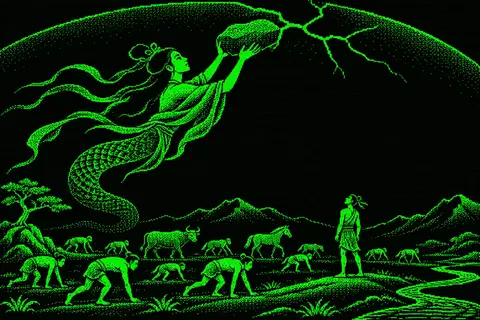
The Huainanzi’s history of mankind: after Nüwa people took themselves for oxen, under Fuxi knowing dawned, and grain made men wise but short-lived.
TL;DR
- The Huainanzi, compiled at the court of Liu An and presented to the Han emperor in 139 BCE, tells the history of mankind as a Fall from a self-less first age into knowing, and the stages are the Eve Theory of Consciousness’s.
- After Nüwa mended the sky, her people “took themselves for horses and oxen” and “none knew where he had come from”. The vipers “sheathed their venom” (Huainanzi 6).
- Under Fuxi, the snake-bodied first king, “knowing first began”, and all “woke up to look about between heaven and earth”. Then the culture-kings “split apart the great ancestor” and “bored openings into heaven and earth” (Huainanzi 2).
- “Those who eat grain are knowing and wise, but die young” (Huainanzi 4). Sowing, wells and penned livestock throw yin and yang into disorder; the sexes “mixed without distinction”, so rites were invented; Cangjie made writing “and the ghosts wailed at night” (Huainanzi 8).
- The book counts all this a loss and prescribes its undoing: become “blank as if one had no hun or po souls”.
- The order of events is strikingly close to Genesis 2–3: a garden of peace with the serpent, eyes opened, bread in the sweat of the face, and death.
精神入其門,而骨骸反其根,我尚何存?
“When the spirit goes in at its gate and the bones return to their root, what of me still remains?”
— Huainanzi 7, “Jingshen” (CText §1)
What is the Huainanzi’s history of mankind? #
The Huainanzi 淮南子 is a compendium in twenty-one chapters, written by the scholars whom Liu An, king of Huainan, kept at his court at Shouchun (present-day Shou County, Anhui, China). He presented it to his nephew, Emperor Wu of Han, in 139 BCE. It is a handbook for rulers, built on the Laozi and Zhuangzi, and it uses myth the way a lawyer uses precedent: in passing, as proof.
Because the myths come in passing, nobody reads them as a single story. They are one. Four chapters, “Surveying Obscurities” (覽冥, 6), “Activating the Genuine” (俶真, 2), “Terrestrial Forms” (墬形, 4) and “The Basic Warp” (本經, 8), each tell a stretch of the same history, and the stretches fit end to end. Laid out in order, the Han court’s account of where humans came from runs like this:
| Stage | What the Huainanzi says | Where |
|---|---|---|
| The first people | After Nüwa mends the sky, people do not know if they are horses or oxen; “none knew where he had come from” | 6 §9 |
| The serpent at peace | Vipers “sheathed their venom”; in Rongcheng’s age “vipers could be trodden on” | 6 §9; 8 §6 |
| Waking | Under Fuxi “knowing first began”; all “woke up to look” | 2 §15 |
| The openings | Shennong and the Yellow Emperor “bored openings into heaven and earth”; the people “stood up straight to listen and look” | 2 §15 |
| Grain and death | “Those who eat grain are knowing and wise, but die young”; sowing and wells throw the seasons out of order | 4 §12; 8 §2 |
| The serpent at war | Yi “cut the Long Snake in two at Dongting” | 8 §6 |
| Rites and writing | The sexes “mixed without distinction”, so rites were prized; Cangjie made writing “and the ghosts wailed at night” | 8 §3–4 |
| The cure | “Blank as if one had no hun or po souls”: “the tracks of Fuxi” | 6 §11 |
That sequence, a first humanity without a self, a waking under a serpent, then farming, mortality and law, is the sequence the Eve Theory of Consciousness reconstructs from the other side, out of psychology and prehistory. The Han scholars wrote it down as their own past, two thousand years before anyone proposed the theory.
What were people like after Nüwa mended the sky? #
Everyone knows the repair. In the far past “the four poles collapsed and the nine provinces split”; fire blazed and water flooded; “fierce beasts ate the simple people”. Nüwa “smelted stones of five colours to patch the blue sky, cut off the legs of the great turtle to set up the four poles, killed the black dragon to save Jizhou, and piled up reed ash to stop the overflowing waters”. Nüwa Theory of Consciousness reads that repair as a memory of the floods at the end of the Ice Age.
What nobody quotes is the next sentence. The same paragraph goes straight on to describe the people Nüwa saved (Huainanzi 6, CText §9):
當此之時,臥倨倨,興眄眄,一自以為馬,一自以為牛,其行蹎蹎,其視瞑瞑,侗然皆得其和,莫知所由生,浮游不知所求,魍魎不知所往。
“At that time they lay down at ease and rose up dazed. One took himself for a horse, another took himself for an ox. They walked with a stumbling gait and looked out with a dim gaze. Artless, they all had their harmony. None knew where he had come from. They drifted about not knowing what they sought, aimless as goblins, not knowing where they went.”
This is a humanity with bodies, harmony and no self. They cannot tell themselves from their beasts. They have no origin story, because “none knew where he had come from”. They have no aims, because they “drifted about not knowing what they sought”. The text does not call them stupid. It calls them 侗, “artless”, and says they “all had their harmony”. They lack only the thing that knows it is a someone.
Then the serpent:
當此之時,禽獸蝮蛇,無不匿其爪牙,藏其螫毒,無有攫噬之心。
“At that time the birds, the beasts and the vipers all hid their claws and fangs and sheathed their venom, and had no heart to seize or bite.”
蝮蛇 is the pit-viper, and 藏其螫毒 says the venom was put away, kept in the sheath. In the first age the serpent has its poison and does not use it. Virgil and Josephus say the same thing from the other end of Eurasia: the snakes of the first age had no venom until the god who sharpened human minds gave it to them (The Ages of Man). The Huainanzi puts it in the gentlest form: the venom exists, and nobody is awake to be bitten.
Nüwa herself is a serpent in every early description of her body. Guo Pu’s note on the Shanhaijing, around 300 CE, calls her “an ancient goddess who ruled as emperor, with a human face and a serpent’s body”, and the Liezi gives Fuxi, Nüwa and Shennong “snake bodies and human faces … shapes that were not human, and the virtue of great sages” (Liezi 2, CText §18). Han tomb reliefs show the pair with their tails knotted together, as Nüwa, Fuxi and the Eve Theory describes. The Huainanzi never draws her body, but it gives her a serpent escort. When her work is done she rides off in a thunder-chariot drawn by dragons, with “white dragons before her and running serpents behind” (前白螭,後奔蛇). And she leaves without a trace: she “hid the Way of the True Man”, because “the Way and its virtue reached up, and cleverness and contrivance were extinguished” (道德上通,而智故消滅也).
One more line in the same paragraph deserves notice. Among her repairs, where “yin and yang were blocked and could not pass, she bored channels through them and put them in order” (陰陽之所壅沈不通者,竅理之). The verb is 竅, “to bore an opening”. Nüwa opens the world’s passages. She does not open the people. That job falls to the kings who come after.
When did knowing begin? #
Chapter 2 picks up the story. It opens with the age of perfect virtue, when people “slept sweetly in a realm of undifferentiated murk” and “the uncarved simplicity was not yet broken up; all was one mass” (純樸未散,旁薄為一). There was knowing of a kind, the text admits, but it lay idle: “though they had the knowing of Yi, they had no use for it” (雖有羿之知而無所用之). Then comes the turn (Huainanzi 2, CText §15):
及世之衰也,至伏羲氏,其道昧昧芒芒然,吟德懷和,被施頗烈,而知乃始,昧昧晽晽,皆欲離其童蒙之心,而覺視於天地之間。是故其德煩而不能一。
“When the age declined and came to Fuxi, his Way was dim and vague. He hummed of virtue and held to harmony, and his bounty spread widely. And knowing first began. Dimly, dawning, all of them wanted to leave their childlike, unopened minds, and woke up to look about between heaven and earth. So their virtue grew troubled and could no longer be one.”
Read it word by word, because each word carries weight. 知乃始: “knowing then began”, the first appearance of 知 in the history. 昧昧晽晽: the doubled characters picture the grey before sunrise, light coming into the dark. 童蒙之心: the mind of a child, 蒙 being the covered, unopened state of the fourth hexagram of the Changes. 覺視: “woke and looked”. And the cost: 不能一, “could no longer be one”. A single undivided mind becomes many minds, each of which “wanted” something.
The first king under whom this happens is Fuxi, the serpent-bodied husband of Nüwa. Chapter 6 makes the same Fuxi the high-water mark: the Yellow Emperor’s rule, for all its order, “still did not reach the Way of Fuxi” (然猶未及虙戲氏之道也, CText §8), and “Fuxi and Nüwa set up no laws and standards, yet left perfect virtue to later ages” (CText §12). The two chapters do not contradict each other. They put Fuxi exactly at the hinge. He is the last ruler of the one mind and the first under whom the eyes open. The Zhuangzi’s chapter “Mending Nature” dates the decline from the same king, as Before the First Smile shows. The serpent stands at the door between the two ages, as it stands at the tree in Eden.
What did the culture-kings bore open? #
The paragraph goes on, and the waking becomes an operation:
乃至神農、黃帝,剖判大宗,竅領天地,襲九窾,重九𤍂……于此萬民睢睢盱盱然,莫不竦身而載聽視。是故治而不能和下。
“Then came Shennong and the Yellow Emperor. They split apart the great ancestor and bored openings into heaven and earth, matched the nine apertures and doubled the nine hollows … At this the myriad people all stared wide-eyed, and every one stood up straight to listen and look. So there was government, but it could not bring harmony below.”
The “great ancestor” (大宗) is the undivided whole, the one mass of the age before. Shennong, the Divine Farmer, and the Yellow Emperor cut it apart, as Enlil’s hoe and Marduk’s blade cut heaven from earth in Severing Heaven and Earth. Then they bore holes in it, and the verb is 竅 again. The result is a population of watchers: 睢睢盱盱, eyes wide open, bodies held upright “to listen and look”. The Huainanzi is describing the arrival of attention.
The people did not get better for it. By the ages of Kunwu and the Xia, “desire was tied to things, keen hearing and sight were lured outward, and nature and life lost what they had had” (嗜欲連于物,聰明誘於外,而性命失其得). By the decline of Zhou the uncarved block had been “watered down and scattered” (澆淳散樸) and “the people for the first time … each wanted to practise his own knowing and falsehood” (各欲行其知偽). The paragraph ends: “the reason the world has lost its nature and life is a gradual decline, and it has been coming for a long time”.
Chapter 7 says what the openings are for. “The openings are the doors and windows of the spirit” (夫孔竅者,精神之戶牖也, Huainanzi 7, CText §4). Bore them, and the spirit can look out, and once it looks out it can be lured out.
The Zhuangzi had told the same event as a fable a century or two earlier. Hundun, the Emperor of the Centre, had no openings; two well-meaning friends bored him seven, “to see, hear, eat and breathe”, one a day, “and on the seventh day Hundun died” (Zhuangzi 7, CText §13). The Han court turned the fable into history and gave the boring to named kings. Hundun’s story, and the sealed first humans of Australia, Egypt and the Mandaeans who are opened in the same way, have their own essays: The First Man Was Sealed and Before the First Smile.
Why does grain bring early death? #
Chapter 4, on the shape of the earth, contains a list of what each diet makes of the eater (Huainanzi 4, CText §12):
食肉者勇敢而悍,食氣者神明而壽,食穀者知慧而夭。不食者不死而神。
“Those who eat flesh are brave and fierce. Those who eat breath are spirit-bright and long-lived. Those who eat grain are knowing and wise, but die young. Those who do not eat at all do not die, and are gods.”
Here the whole of Genesis 2–3 fits in one sentence of four characters: 知慧而夭, “knowing and wise, and short-lived”. The food gives the knowing and the death together. The tree of the knowledge of good and evil was a food too, with the same warning: “in the day that thou eatest thereof thou shalt surely die”. And the curse that follows it is a farmer’s curse: “in the sweat of thy face shalt thou eat bread, till thou return unto the ground” (Genesis 2:17, 3:19, KJV).
Chapter 8 tells the same thing as a story (Huainanzi 8, CText §2). In the declining age people “cut into mountain stone … ripped open the womb and killed the young … made fire with the drill”, and then:
積壤而丘處,糞田而種穀,掘地而井飲,疏川而為利,築城而為固,拘獸以為畜,則陰陽繆戾,四時失敘,雷霆毀折,雹霰降虐,氛霧霜雪不霽,而萬物燋夭。
“They piled up soil and lived on mounds, manured the fields and sowed grain, dug the ground and drank from wells, channelled rivers for profit, built walls for defence, penned beasts as livestock. Then yin and yang went awry, the four seasons lost their order, thunder smashed and broke, hail and sleet fell cruelly, mist, frost and snow did not clear, and the ten thousand things withered and died young.”
The same 夭 again: early death, now for everything that lives. The paragraph ends with the last step of the farming life, boundaries. “They divided the mountains, rivers and valleys so that there were borders, counted the people so that there were shares … set apart noble and base”, and so “weapons and armour arose and strife was born”, and the people were “massacred though innocent and executed though guiltless”.
Field crops, wells, herds, property, war: the Huainanzi lists the Neolithic package item by item and calls it the Fall. A court that lived on taxed grain still remembered that the grain came after the garden.
Why did the ghosts wail at night? #
Chapter 8 marks the change in the serpent too (Huainanzi 8, CText §6). It begins with the age of Rongcheng, one of the rulers of high antiquity:
昔容成氏之時,道路雁行列處,托嬰兒于巢上,置餘糧於畮首,虎豹可尾,虺蛇可蹍,而不知其所由然。
“In the time of Rongcheng, people walked the roads in file like wild geese. They left their babies in nests and put spare grain at the head of the field. Tigers and leopards could be followed by the tail, and vipers and snakes could be trodden on, and no one knew why it was so.”
Then, in Yao’s time, ten suns burn the crops and six monsters prey on the people, among them 修蛇, the Long Snake. Yao sends the archer Yi, who shoots the suns and “cut the Long Snake in two at Dongting” (斷修蛇於洞庭), the great lake of present-day Hunan. The order is exact. In the first age the snake can be stepped on and does not bite. After the waking it is a man-eater, and a hero has to cut it in half. God tells the serpent in Eden the same thing: “I will put enmity between thee and the woman … it shall bruise thy head, and thou shalt bruise his heel” (Genesis 3:15). In both histories the war with the snake begins on the day the eyes open.
The next paragraph explains morality as damage control (CText §3). In the first age “rites, right, honesty and shame were not set up … yet the myriad people did not cheat or oppress one another, as if they were still in the undifferentiated dark”. Then each virtue was invented to patch a wound. Strife was born, “so humaneness was prized”. People “harboured hearts of contrivance and cunning, and their nature was lost, so right was prized”. And:
陰陽之情,莫不有血氣之感,男女群居雜處而無別,是以貴禮。
“In the nature of yin and yang, everything has the stirrings of blood and breath. Men and women lived together in herds, mixed without distinction, so rites were prized.”
The Huainanzi says outright that marriage rules are not human nature. Before rites, the sexes ran together like a herd, and rites (禮) were invented “to rescue them from lewdness” (禮者,所以救淫也). Chapter 6 puts the separation of the sexes in the reign of the Yellow Emperor, who “separated men from women and distinguished female from male” (別男女,異雌雄), and who for all that “did not reach the Way of Fuxi”. The text is plain: “humaneness, right, rites and music can rescue a ruin, but are not the highest order”.1
Then the arts (CText §4). “When they fixed the pitch-pipes and the calendar, distinguished the five colours, told the clear from the muddy and tasted sweet and bitter, the uncarved block was scattered and became vessels” (樸散而為器). And:
昔者蒼頡作書,而天雨粟,鬼夜哭;伯益作井,而龍登玄雲,神棲昆侖;能愈多而德愈薄矣。
“Of old, when Cangjie made writing, Heaven rained grain and the ghosts wailed at night. When Boyi made the well, the dragons rose into the dark clouds and the gods withdrew to Kunlun. The more the abilities, the thinner the virtue.”
Writing is the last opening. Heaven pays out grain, the food of knowing, and the dead weep. The dragons leave the wells and the gods go away to their mountain. The world that had been full of spirits empties as the human mind fills.
What of me still remains? #
The Huainanzi also asks the question that sits under all of this. Chapter 7 opens with the making of people. Before heaven and earth there was only formless murk, “and no one knew its gate”. “Two gods were born together out of the confusion” and laid out heaven and earth. “The turbid breath became the creatures, and the refined breath became people” (煩氣為蟲,精氣為人). The spirit is heaven’s, the bones are earth’s, and when each goes home, “what of me still remains?” (CText §1).2
我尚何存 is a first-person question about the self, asked in the act of describing where humans came from. The same chapter answers it the Daoist way: “then I am also a thing, and a thing is a thing” (然則我亦物也). The “I” is a loan from heaven and has to be given back.
Chapter 11 says where the rest of a person comes from. Infants of every people “are born with the same cry”, but grown up they cannot understand one another; a baby moved to a foreign country at three months will not know its old customs. “So dress, rites and customs are not human nature; they are received from outside” (衣服禮俗者,非人之性也,所受於外也, Huainanzi 11, CText §7). The waking came from outside, and so did everything that came after it. That is the Eve Theory’s central claim: the self is taught, not born, and it spread as a culture spreads.
How did the Huainanzi propose to undo the Fall? #
The Huainanzi is a Daoist book, and it wants the old mind back. Its cure, in chapter 6, is the history run in reverse (CText §11):
消知能,修太常,隳肢體,絀聰明,大通混冥,解意釋神,漠然若無魂魄,使萬物各復歸其根,則是所修伏犧氏之跡,而反五帝之道也。
“Dissolve knowledge and ability, cultivate the great constancy, slough off the limbs, put away keen hearing and sight, merge with the undifferentiated dark, loosen the mind and release the spirit, blank as if one had no hun or po souls, and let each of the ten thousand things return to its root. This is to walk in the tracks of Fuxi and return to the Way of the Five Emperors.”
Every item undoes a stage. Knowledge goes first, because knowing began last. Hearing and sight are put away, because the culture-kings bored the world open so that people “stood up straight to listen and look”. The mind merges with 混冥, the undifferentiated dark of Nüwa’s age. The souls are emptied out. And the goal is named: the tracks of Fuxi, the king at the hinge. Chapter 8 states the same result in one line: “spirit-brightness settles on the world, and the mind returns to its beginning” (神明定於天下,而心反其初).
A school that thought the self was simply human nature would have no reason to write this recipe. The Huainan masters wrote it because they believed the self had a date. It arrived under a named king, it was deepened by named inventors, and a disciplined man could take it off again. They felt the change so sharply that they built a politics on reversing it. The value they put on it is the opposite of the Eve Theory’s, which counts the waking as the making of humanity. The history is the same.
How close is the Chinese Fall to Genesis? #
Strikingly close, station by station:
| Station | Huainanzi (Anhui, China, 139 BCE) | Genesis 2–3 (Israel/Palestine, 1st millennium BCE) |
|---|---|---|
| The first humans | Do not know if they are horses or oxen; “none knew where he had come from” | “Both naked … and were not ashamed” |
| The serpent | Vipers “sheathed their venom”; snakes “could be trodden on” | The serpent in the garden, not yet cursed |
| The mother | Nüwa, serpent-bodied, mends the world and saves the people | Eve, “the mother of all living” |
| The waking | Under serpent-bodied Fuxi “knowing first began”; all “woke up to look” | “The eyes of them both were opened” |
| The food | “Those who eat grain are knowing and wise, but die young” | “In the day that thou eatest thereof thou shalt surely die” |
| The labour | Manured fields, sown grain, wells, penned beasts | “In the sweat of thy face shalt thou eat bread” |
| The enmity | Yi cuts the Long Snake in two | “It shall bruise thy head” |
| The sexes | Men and women “mixed without distinction”, so rites were invented | “Thy desire shall be to thy husband, and he shall rule over thee” |
| The loss | “Nature and life lost what they had had”; “the ghosts wailed at night” | Expulsion from the garden |
The match is in the order, not in single motifs. Any culture might imagine a peaceful past. These two put the same things in the same sequence: a selfless first humanity at peace with the serpent, a woman and a snake at the start, an opening of the eyes, a food that brings knowledge and death at once, the farmer’s labour, war with the serpent, and new laws for the sexes. Neither text could have copied the other. The simplest account is that both inherited one very old story of a real change in the human mind, carried across Eurasia with the rites that taught it. That is the diffusion the Eve Theory argues for, and it explains why the serpent stands at the door in both versions.
The Snake and the Syntax Tree calls the Garden “a cognitive regime”: the state where experience is thick and the self is thin or absent. The Huainanzi draws that regime more precisely than Genesis does. Its people lie down at ease and rise up dazed, mistake themselves for oxen and step on vipers without being bitten. Then knowing dawns under the snake-king, and the eyes, and the world, are bored open.
Sources #
Primary texts (quoted from the Chinese; translations are the author’s)
- Huainanzi 淮南子, compiled at the court of Liu An, king of Huainan, presented 139 BCE. Chinese Text Project, paragraph numbers as given there: 卷2 俶真訓 “Chu zhen” §15; 卷4 墬形訓 “Di xing” §12; 卷6 覽冥訓 “Lan ming” §8, 9, 11, 12; 卷7 精神訓 “Jing shen” §1, 4, 5; 卷8 本經訓 “Ben jing” §2, 3, 4, 6; 卷11 齊俗訓 “Qi su” §7. Also on Chinese Wikisource.
- Zhuangzi 莊子, inner chapter 7, 應帝王 “Ying di wang”, §13 (Hundun). Song state (present-day Henan, China), 4th c. BCE.
- Liezi 列子, 黃帝 “Huangdi”, §18 (the snake-bodied sages). Received text c. 3rd–4th c. CE.
- Shanhaijing 山海經 with Guo Pu’s commentary (c. 300 CE), Nüwa’s serpent body, as quoted in Taiping yulan 78: 太平御覽 卷0078.
- Genesis 2–3, King James Version.
Translations and studies
- John S. Major, Sarah A. Queen, Andrew Seth Meyer and Harold D. Roth, trans., The Huainanzi: A Guide to the Theory and Practice of Government in Early Han China (New York: Columbia University Press, 2010). Abridged as The Essential Huainanzi (2012).
Major et al. (2010, 8.3) render 男女群居雜處而無別 as “gathered in places and promiscuously dwelt together without distinction”; I read 群居 as “lived together in herds”, the word used for flocks and herds, which makes the animal comparison explicit. ↩︎
Major et al. (2010, 7.1) translate 我尚何存 as “how can I still survive?”; I read 存 as “remain, be preserved”, since the question is what is left of the self once spirit and bones have gone back to heaven and earth. ↩︎