~/bullroarer/anthropology
The Bullroarer Atlas: Mapping a Thousand Attestations of the World’s Strangest Instrument
An interactive world atlas of 1,200+ bullroarer records reveals a sacred-to-toy gradient, a thin post-Ice Age archaeological record, and a snake where the wood survives.
TL;DR
- I built the Bullroarer Atlas, an interactive world map of more than 1,200 published attestations of the bullroarer (plus about a hundred candidate records), to see the patterns no single regional literature can show.
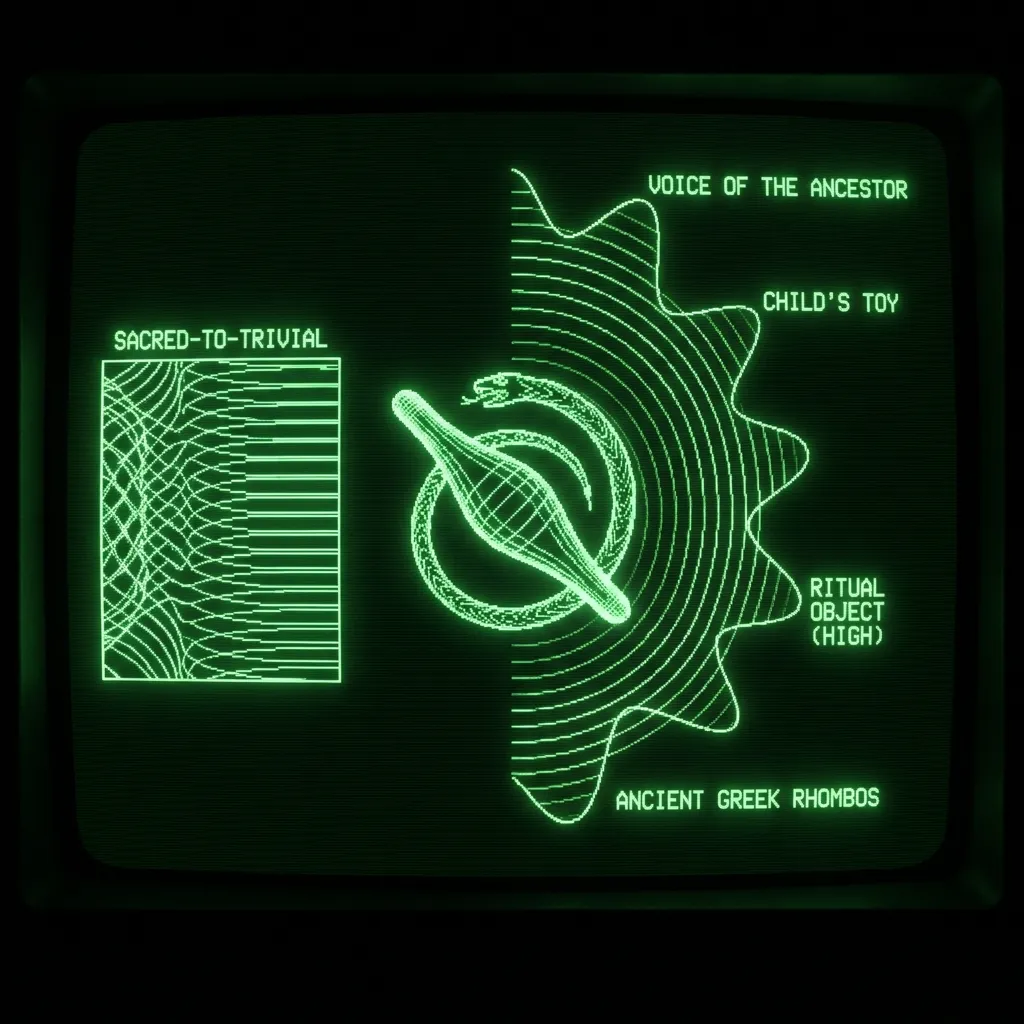
- Coded by recorded use, the regions form a near-monotonic gradient from sacred to trivial: 113 of 166 Australian records tie the instrument to initiation and 5 to play, while 88 of 147 European records are toys and only 2 involve initiation. I read that as Tylor’s Victorian “doctrine of survivals” laid out as geography.
- Deep time is anchored by Late Ice Age European blades of bone and antler, roughly 19,000–11,700 years old, with older candidates behind them. After the ice, Europe’s excavated record thins to a sparse, disputed scatter until bone whirrers reappear in medieval towns, mostly as toys.
- Sub-Saharan Africa matches New Guinea, the textbook type-site, for the crop-fertility link, and North America holds the largest cluster of curing and weather uses.
- Reduplicated onomatopoeic names — tundun, paka paka, threm-threm, jwim-jwim — recur across unrelated languages in most of the map’s major regions, and where a meaning survives the roar is almost always the voice of a being, not the weather.
“This insignificant toy is perhaps the most ancient, widely spread, and sacred religious symbol in the world.”
— Alfred C. Haddon, The Study of Man (1898), p. 258, on the bullroarer
What the Bullroarer Atlas is, and why I built it #
A bullroarer is almost nothing: a flat blade of wood, bone, or stone, drilled at one end, tied to a cord, and swung. The air stalls and reattaches over the spinning edge and the thing moans — a low, pulsing, unplaceable roar that seems to come from everywhere and from something alive. That sound has been heard, on every inhabited continent, as the voice of a god, an ancestor, or a swallowing monster. It has also been heard, in a Latvian village or an English schoolyard, as a nice noise a child can make with a bit of slat and string.
I have written about the bullroarer for years, mostly about what it means — the initiation complex, the swallowing myth, the serpent behind the roar. The Atlas is the empirical companion to that writing. Its ambition is flat-footed and total: to find every published attestation of the instrument — ethnographic account, museum specimen, excavated find, textual reference — and put them all in one place, arranged in space and time. The map now holds more than 1,200 attestations — about 420 across Australia and the Pacific, some 240 in North America, 200 in Africa, 150 in Europe, and nearly 100 in South America — plus about a hundred candidate records and a hundred documented absences. Each has its own record page, the sources it rests on, and in most cases an image of the object itself.
The point of assembling them is that no scholar ever reads the whole literature. The Australianist knows churingas; the Melanesianist knows the men’s-cult flutes and roarers; the Africanist knows the Dodo cult; the archaeologist knows a handful of Magdalenian pendants. Each works from Haddon’s 1898 survey, or Frazer, or Loeb, or Zerries, or Gourlay, plus their own region. Put the regions side by side, count them, and things become visible that were invisible one library at a time.
How old is the bullroarer? The deep-time record and its thin middle #
The catalog holds about 175 archaeological records worldwide; roughly 80 are strong enough to show on the map by default, and the rest are held as candidates. None comes with an observed use. An excavated blade counts as a bullroarer on its form, its perforation and cord wear, and, often, on replicas that roar when whirled.
The best-supported early cluster is Late Ice Age Europe: Magdalenian and Ahrensburgian bone and antler blades from roughly 19,000 to 11,700 years ago. The La Roche de Birol blade, the first object European prehistory recognized as a bullroarer, belongs here, along with Saint-Marcel, the Raymonden fragment, and the Stellmoor reindeer-bone piece, whose replica hums on a one-metre cord. Behind them stand older and weaker candidates: Solutrean pieces from Lespugue and Badegoule (c. 22,000–17,000 BC) and a perforated Aurignacian bone point from Potočka zijalka in Slovenia (c. 33,000 BC). This is the deep past of the instrument, insofar as we can hold it in our hands.
Next come the Neolithic plaques of Anatolia: the decorated, perforated bone blades of Göbekli Tepe and Körtik Tepe (c. 10,400–8000 BC), which Göbekli Tepe’s excavators Oliver Dietrich and Jens Notroff compared with bullroarers while leaving their use open. From the later, pottery-using town of Çatalhöyük (this object c. 6700–6500 BC) comes an antler blade that the site’s own worked-bone report calls a bullroarer.
After the Ice Age, Europe’s excavated record thins sharply. What survives between the Magdalenian and the Middle Ages is a sparse, contested scatter: Mesolithic bone blades from Brandenburg, a perforated stone blade from Tilburg-Kraaiven in the Netherlands (c. 5500 BC), Kongemose in Denmark, a shale blade from Tuv in Norway (c. 3000 BC), and a decorated Bronze or Iron Age plate from Gadebusch. None is a secure ritual instrument, and several may be pendants. The clearest evidence for the instrument in these millennia is not dug up at all: the Classical rhombos, the whirled instrument of the Greek mysteries, known from Clement of Alexandria and the Gurob papyrus — a text, not an object.1 When whirled bone reappears in quantity, in the towns and camps of the Low Countries, England, the Baltic, Sweden, and Novgorod from about AD 800 onward, the pattern is plain. Roughly half of these medieval and early-modern finds (8 of 14 in the Atlas) are identified as children’s toys or entertainment objects, and for the rest, Novgorod’s wooden whirrers among them, no use is recorded. None comes with evidence of ritual.
| Horizon | Where | Age | What it is |
|---|---|---|---|
| Upper Palaeolithic | France, Spain, Germany, Slovenia | ~19,000–11,700 BP for the best-supported blades; candidates to ~35,000 BP | Perforated bone and antler blades; use inferred from form and sounding tests |
| Neolithic | Anatolia | ~12,400–8,500 BP | Perforated bone plaques and an antler blade; use unknown |
| Mesolithic to Iron Age | Europe | ~11,600–2,300 BP | A sparse scatter of candidate blades; identifications disputed |
| Classical | Greece | ~2,350–1,800 BP | The rhombos of the mysteries — textual, never securely excavated |
| Medieval–modern | Northern and central Europe | ~AD 800–1900 | Bone and wooden whirrers, mostly toys; none ritual |
These dates are a floor, not a ceiling. Bone and antler survive where wood cannot, and the regions with the densest living traditions — Australia and Oceania alone hold more than a third of all records — worked in wood, which leaves nothing behind in tropical soil. Their deep past shows up as rock art rather than as surviving boards. The oldest excavated bullroarer is not the oldest bullroarer.
If the Ice Age blades served as their ethnographic parallels suggest, the same object bookends Europe’s sequence as ritual gear and as a medieval plaything. That is the deep-time version of the gradient the rest of the map describes.
From sacred instrument to children’s toy: a global gradient #
Group the records by region and code each by what its source says the instrument was for — use in initiation at one pole, use as a child’s toy at the other — and the world sorts itself into something close to a ramp. I read this as the quantified form of what Edward Tylor called, in 1871, the doctrine of survivals: the idea that a solemn ritual object in one society persists as a meaningless plaything in another, a fossil of lost seriousness. Tylor argued it from anecdote. The map puts numbers on it.
| Region | Records | Initiation use | Toy use |
|---|---|---|---|
| Australia | 166 | 113 (68%) | 5 (3%) |
| Oceania (mostly New Guinea and Melanesia) | 254 | 98 (39%) | 14 (6%) |
| Africa | 204 | 81 (40%) | 42 (21%) |
| South America | 97 | 20 (21%) | 41 (42%) |
| North America | 240 | 11 (5%) | 104 (43%) |
| Europe | 147 | 2 (1%) | 88 (60%) |
| South Asia | 32 | 1 (3%) | 25 (78%) |
The counts come from the published Atlas data as of September 2026 (1,214 attestations). A record counts under “initiation use” or “toy use” when its cited source documents that use; a record can carry both flags or neither, and a missing flag is not evidence that the use was absent. A regional snapshot cannot by itself prove a historical sequence, since a toy in Latvia need not descend from a rite in Latvia. But the European record supplies the sequence in time: the whirled blade is a sacred instrument in the Classical texts on the mysteries and a plaything in the medieval ground.
At one end, Yuin men heard the roar as the voice of Daramulun and death was the penalty for a woman who saw the source. At the other, in the Naga Hills and across South Asia, the same object is a boys’ seasonal toy — a bird-scarer, a threm-threm whirled in the fields. East Asia is the extreme case: in the literate mainstream — Han China, Yamato Japan, Korea — the bullroarer is absent from the confirmed record entirely. It survives only at the margins of those civilizations, among the Yi, the Uyghur of Turfan, the Ainu. Where the state and the written word arrive, the roaring board seems to fall silent. I have argued elsewhere that this same instrument is the near-universal marker of male initiation; the gradient is what happens to a marker once the rite it marked decays.
The bullroarer and agriculture: Africa as well as New Guinea #
The literature has a type-site for the agricultural bullroarer, and it is New Guinea — the yam cults, the men’s houses where the roarer’s voice guarantees the harvest. The Atlas confirms the association but not the uniqueness. Explicit crop links (sowing, harvest, gardens, crop fertility) are rarer than the literature suggests: 37 records carry the Atlas’s agriculture flag, with rain and weather magic coded separately. Thirteen come from New Guinea and the Torres Strait, out of about 213 records there, and ten from Sub-Saharan Africa, out of about 200. That is the same rate, roughly one record in twenty.
Africa’s cases are as fully developed as Melanesia’s: the Uukwaluudhi omathila, the “Big Birds” whose whirred voice is carried in a secret night procession to bring rain and bless the sowing; the Gwana Jukun Dodo cult of rain and harvest; the Fali roarer whose season is tied to the ripening of the red millet. Across the Atlantic, the Upper Xingu pequi-fruit festival and the Amazonian fish-increase rites belong to the same family, though the Atlas codes only a few South American records this way.
There is a second, subtler correction inside the first. The agriculture-linked records skew toward secret initiation, not away from it: 19 of the 37 are also restricted or initiatory, against about a third of the catalog as a whole. Crop fertility is seldom a free-standing weather-magic act; as often as not it is one more thing the men’s cult claims to control, embedded inside the same closed complex that owns the roar, the swallowing myth, and the exclusion of women. Fertility and secrecy are not two uses of the instrument. They are the same use.
Healing and weather: the North American cluster #
Curing belongs to North America. The continent holds the Atlas’s largest cluster of records in which the bullroarer is a healing instrument, somewhat more than a dozen, more than any other region. The Apache cut curing bullroarers from wood struck by lightning; Navajo chant-way practice turned the roar to healing; Zuni rain-priests and Southwest medicine societies made it a doctor’s tool. North America also leads every large region in weather use: 61 of its 240 records carry the weather flag, about one in four.
The comparative literature treats Southwestern curing roarers as a regional curiosity, a footnote to the Pueblo ethnographies. Assembled and counted against the rest of the world, that “curiosity” is the largest concentration anywhere. This is the recurring payoff of the exercise: a thing that looks minor inside one region’s monograph turns out to be the planet’s high-water mark once every region is on the same table.
Women, secrecy, and the charter myth #
The bullroarer is, over much of the world, a machine for excluding women. About 265 records attest the exclusion of women or the uninitiated from the sound or the sight of the instrument; the hard core — where the penalty for a woman is death — clusters in Australia, Melanesia, lowland South America, and Africa. This is the terrain of the swallowing complex: the roar is the monster, initiation is being eaten and reborn, and the secret is enforced by the worst sanction the society has.
Riding on top of that exclusion is one of anthropology’s most famous stories — the charter myth that women owned the bullroarer first, and that men stole it and now guard the theft with terror. I have hand-checked it down to a dozen-plus rock-solid cases, most in Sahul — and what makes them remarkable is that the same story recurs far outside Australia: among the Wauja and Kamaiurá of the Upper Xingu, and in the Dogon Sigui. A near-identical origin myth on three continents is a deep signal, and I have laid out the case at length in the Women and the Bullroarer essay.
What the bullroarer is called: reduplicated names, and the voice of a being #
Two things about the names on the map delight me because they are provable and no one had counted them.
First, reduplicated onomatopoeic names — a syllable doubled to mimic the roar — are a global constant. They make up roughly one recorded native name in fifteen, and they turn up across most of the map’s major regions, in languages with no relationship to each other: tundun among the Kurnai of southeast Australia, paka paka among the Wik-Mungkan of Cape York, jwim-jwim in the Gran Chaco, threm-threm in the Naga Hills, !goin!goin among the Kalahari San, burriburri in Sardinia, huhu in Polynesia. The instrument keeps naming itself, in the same way, everywhere — which is exactly what you would expect of an object whose meaning is its sound.
Second, and stronger: where a gloss for the name survives, the roar is overwhelmingly identified as the voice of a person-like being — an ancestor, a spirit, a monster — and almost never as mere weather. Of the well over a hundred records that name the sound as “the voice of X,” nearly all name a being: Daramulun, Oro, the swallowing kaiaimunu. Almost none name a force like thunder or wind as such. The bullroarer is not, at root, a weather-noise. It is somebody talking. I have pulled the full pattern apart in the global lexicon of bullroarer names.
The bullroarer and the snake #
For readers of this site the sharpest thread in the whole catalog is the serpent. The Atlas’s serpent lens flags 96 records in which the instrument is tied to a snake. About fifteen of them make the tie directly — by name, by decoration, or by myth — and they span continents that never shared a tradition. The Guugu Yimidhirr word dunggul for the instrument literally means “snake.” A Yolngu roarer painted with a python is not a picture of the great serpent Yurlunggur — swung on its cord, it is his hungry voice, and the men who whirl it become the snake that swallows the boys. A Gudanji churinga from the McArthur River carries a snake running the length of the blade under red ochre, sung with its own totemic history. In the Upper Xingu the boards carry snake zigzags; the Dogon rhombe shares its name with the serpent of the Great Mask.
And the thread reaches into deep time. One of the Körtik Tepe plaques, from the same Anatolian Neolithic world as Göbekli Tepe, carries a band of three snakes worked in hatched rhomboids. Further out on the frontier of the evidence is a ~20,000-year-old mammoth-ivory plaque from Mal’ta in Siberia, engraved with three snakes on one face and nested spirals on the other, which Soviet scholars themselves likened to Australian churingas.2 No comparative source has ever put these on one table — though the honest caveat belongs here too: the Hopi Snake Dance uses a bullroarer, but there its work is calling rain and thunder, not being a snake, and I do not count it among the direct cases. The connection I have spent years chasing between the serpent, the roar, and the origin of ritual language is not everywhere. But it is real, and it is intercontinental.
Mapping absence #
Classic surveys recorded presence. When Haddon or Frazer built a distribution, a blank on the map meant only that no one had written anything down. The Atlas also records where trained observers looked and found nothing — and that turns a blank from ignorance into data.
The cleanest example sits inside the world’s densest bullroarer region. New Guinea is saturated with the instrument, yet the Massim world of Milne Bay and the coast of Central Province — Malinowski’s own ground, and Seligmann’s — are a documented void. Ritual life there runs on Kula exchange and the great Hevehe masks instead; the roaring board simply is not the local idiom. Recording that absence is what makes a diffusion argument testable: if the instrument spread, its gaps have to be explained, and you cannot explain a gap you never wrote down. (These absences are recorded in the catalog rather than drawn on the public map.)
How to read the Atlas #
Everything above is a claim; the records are the evidence, and they are meant to be walked. You can open the map and move by region — Africa, South America, Europe — or drop straight into the archaeology and follow the deep-time dots. Every point opens a record page with its sources and, usually, the object. Alongside the map are the long essays where a single thread gets the room it needs: the swallowing complex, Women and the Bullroarer, the Iberian slate plaques, the difference between a buzzer and a true bullroarer, and the x-ray-style art that keeps company with it; on this site, Roaring Boys tells the human side. A thousand small facts, assembled, stop being a curiosity cabinet and start being an argument — about how deep this instrument goes, and about what a roaring piece of wood on a string has meant to almost everyone who ever swung one.
Footnotes #
Sources #
The Atlas is built on the classic comparative literature plus several hundred museum catalogs and regional ethnographies. The foundational works:
- Haddon, Alfred C. The Study of Man. London: Bliss, Sands & Co., 1898. The first serious global survey of the bullroarer, and the source of the “most ancient, widely spread, and sacred” claim (p. 258; p. 327 in the 1908 John Murray edition).
- Tylor, Edward B. Primitive Culture, vol. 1. London: John Murray, 1871. Origin of the “doctrine of survivals” that the sacred-to-toy gradient makes quantitative.
- Frazer, James G. The Golden Bough: A Study in Magic and Religion. Project Gutenberg edition. The comparative frame within which the bullroarer’s ritual role was first popularized.
- Loeb, Edwin M. Tribal Initiations and Secret Societies. University of California Publications in American Archaeology and Ethnology 25, no. 3 (1929): 249–288. On the initiatory core of the instrument.
- Zerries, Otto. Das Schwirrholz: Untersuchung über die Verbreitung und Bedeutung der Schwirren im Kult. Stuttgart: Strecker und Schröder, 1942. The most thorough diffusion study before this one, extended in his 1953 South American work.
- Gourlay, K. A. Sound-Producing Instruments in Traditional Society: A Study of Esoteric Instruments and Their Role in Male–Female Relations. Canberra: Australian National University, 1975. The definitive treatment of the New Guinea men’s-cult roarer.
- Van Baal, Jan. Dema: Description and Analysis of Marind-anim Culture (South New Guinea). The Hague: Martinus Nijhoff, 1966. On the roarer inside the fertility-and-secrecy complex.
- Tuzin, Donald. The Voice of the Tambaran: Truth and Illusion in Ilahita Arapesh Religion. Berkeley: University of California Press, 1980. The classic study of the sound-secret and its enforcement.
- Dietrich, Oliver, and Jens Notroff. “A Decorated Bone ‘Spatula’ from Göbekli Tepe. On the Pitfalls of Iconographic Interpretations of Early Neolithic Art.” Neo-Lithics 1/16 (2016): 22–31. The excavators’ own hedge on whether the Anatolian plaques were bullroarers.
- Dauvois, Michel. Studies of Upper Palaeolithic sound-producing objects, including the rhombes of the French Magdalenian. On the acoustics of the Ice Age specimens.
The Classical rhombos is known from the mystery-cult literature — Clement of Alexandria, the Gurob papyrus, Apollonius — rather than from an excavated specimen; the catalog tracks textual and material evidence as separate kinds of records. ↩︎
The Mal’ta plaque is pierced through the centre and sits on the map for its churinga-like engraving — a comparison Soviet scholars made themselves — alongside the whirled instruments proper. ↩︎