TL;DR
- The Book of Mormon contains hundreds of multi-word phrases and long passages that closely match the King James New Testament, including disputed material like the longer ending of Mark.
- Several core sermons (Ether 12 on faith, Alma 7 & 13 on Melchizedek, Moroni 7 & 10 on gifts and charity) appear to be structured directly on Hebrews and Paul’s letters.
- The text also mirrors anti-Universalist preaching from the burned-over district of the 1820s–30s, precisely where and when Joseph Smith lived.
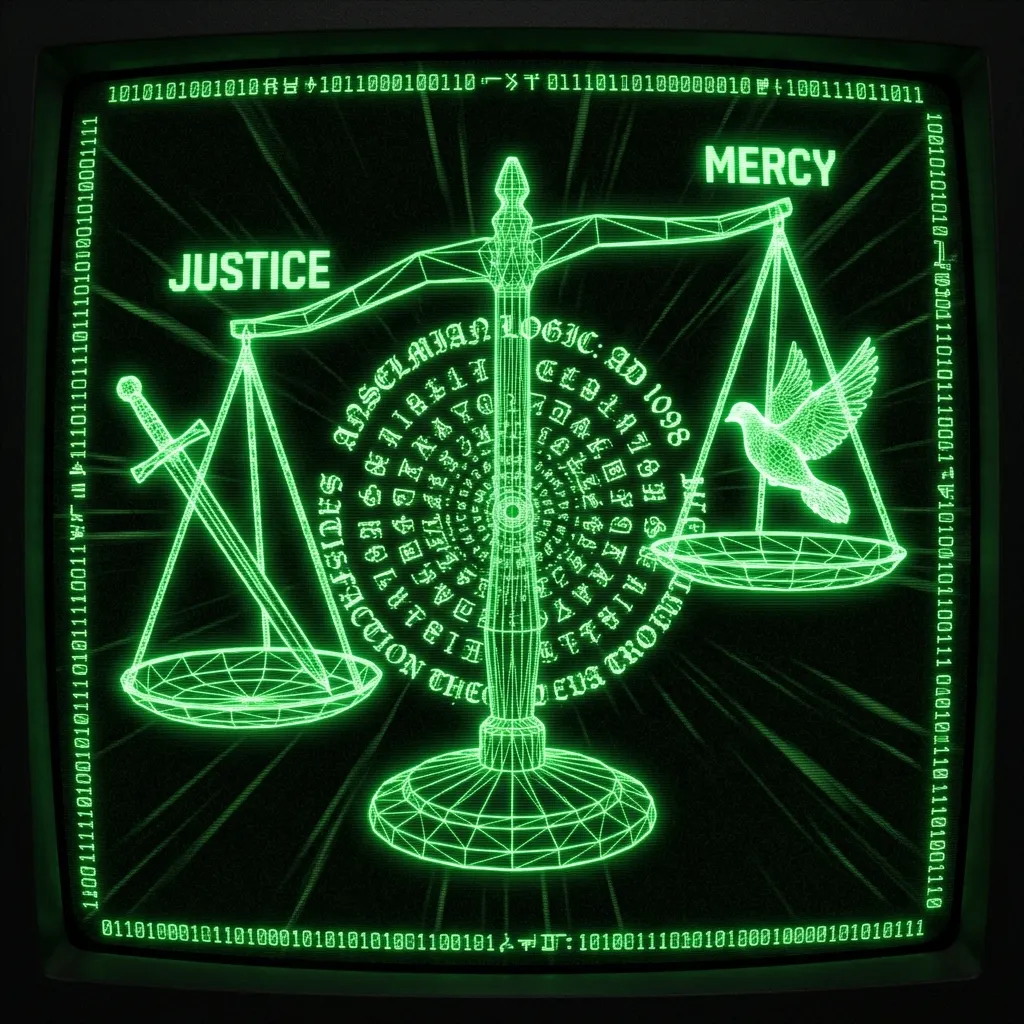
- Its account of an “infinite atonement” that reconciles justice and mercy closely resembles the medieval satisfaction theory of Anselm and its later Protestant developments.
- Taken together, these anachronisms fit effortlessly in an 1820s American milieu and are hard to reconcile with a pre-Columbian, independent record of ancient American Christianity.
“Every text builds itself as a mosaic of quotations, every text is the absorption and transformation of another.” — Julia Kristeva, Word, Dialogue, and Novel (1966)
1. What Counts as an Anachronism Here?#
The Book of Mormon presents itself as a record of Israelite migrants to the Americas ca. 600 BC–AD 400, written in “reformed Egyptian” and translated by Joseph Smith in 1829. Its writers are geographically isolated from the Old World (aside from Jesus’s post-resurrection visit) and vanish centuries before the New Testament corpus is written.
That claim gives us a clean dating test:
- New Testament language: anything that specifically depends on Greek New Testament phrasing—especially in King James English (1611)—should not show up in a pre-Columbian American record.
- Post-biblical doctrinal systems: medieval or early-modern Western theories (Universalist debates, Anselmian satisfaction atonement) should not be structuring the discourse of Iron-Age or Roman-era American prophets.
Of course, some conceptual overlap is cheap: “faith,” “repentance,” “resurrection” are generic Christian currency. The interesting question is whether we see clustered, distinctive fingerprints tied to specific late texts or controversies.
On that front, three families of evidence stand out:
- King-James-shaped New Testament quotations and paraphrases.
- Sermons attacking Universalism, a live controversy in Joseph Smith’s region and decade.
- A worked-out account of atonement that looks a lot like Anselm’s satisfaction theory rather than Second Temple Judaism.
Let’s walk through each, then ask what model of authorship they best support.
2. New Testament Fingerprints in the Book of Mormon
2.1 Counting the Overlaps#
Several independent efforts have catalogued New Testament phraseology in the Book of Mormon. Jerald and Sandra Tanner famously listed over 3,000 possible New Testament echoes. More recently, engineer Terrence L. Chambers tried to be stricter: he counted only phrases seven words or longer that match the King James New Testament verbatim.
He ended up with:
- 441 distinct phrases of ≥7 consecutive words shared between the KJV New Testament and the Book of Mormon.
- Many of these belong to longer strings drawn from specific chapters in Acts, Corinthians, Mark, and John.
Nicholas J. Frederick, a Latter-day Saint scholar specializing in intertextuality, likewise argues that the Book of Mormon contains “a great number” of clearly intentional New Testament allusions and quotations, not just random shared vocabulary.
A representative sample looks like this:
| NT Passage (KJV) | Book of Mormon Passage | Notes on Relationship |
|---|---|---|
| Mark 16:16–18 | Ether 4:18; Mormon 9:22–24 | Near-verbatim reuse of the longer ending. |
| 1 Corinthians 13:3–8, 13; 1 John 3:1–3 | Moroni 7:44–48 | Charity hymn + Johannine sonship. |
| 1 Corinthians 12:4–11 | Moroni 10:8–17 | Spiritual gifts list and structure. |
| Acts 3:22–26 | 3 Nephi 20:23–27 | Moses-prophet citation in KJV form. |
| Hebrews 11; 6 | Ether 12 | Faith as “things hoped for” plus exempla. |
| Hebrews 7 | Alma 13 | Melchizedek priesthood exposition. |
“Intertextuality” by itself isn’t suspicious—ancient texts quote each other constantly. The problem is direction and medium: a putatively ancient American record, written centuries earlier in another language, appears to be quoting an early-modern English translation of Greek texts that it should never have seen.
LDS apologetic literature tries to reframe this as God deliberately revealing the Book of Mormon in KJV flavor, or Joseph’s mind naturally casting revealed concepts into biblical English. We’ll come back to that. First, let’s look at the most salient cases.
2.2 Ether 12 and Hebrews 11: Faith by Way of King James#
Ether 12 contains Moroni’s famous discourse on faith:
“Faith is things which are hoped for and not seen; wherefore, dispute not because ye see not; for ye receive no witness until after the trial of your faith.” (Ether 12:6, KJV-style text)
This obviously echoes Hebrews 11:1 in the King James:
“Now faith is the substance of things hoped for, the evidence of things not seen.” (Hebrews 11:1, KJV)
Grant Hardy, a believing Latter-day Saint and one of the most careful literary readers of the Book of Mormon, writes that there is “clear and thorough dependence on Hebrews 6 and 11” in Ether 12. He notes not just the definition of faith, but the whole structure:
- A definition of faith as oriented toward “things not seen.”
- A catalogue of exemplars: prophets who “obtained a good report through faith” and worked miracles or suffered martyrdom.
- A rhetorical progression from individual exempla to exhortation of the audience.
In other words, Ether 12 doesn’t just happen to share a nice line about faith. It looks like an artful miniature of Hebrews’ faith chapter, rebuilt in Book of Mormon narrative voice.
Non-LDS critics go further and argue that the wording is best explained as Joseph Smith creatively riffing on the KJV text already in his memory. Even LDS commentators who defend historicity often concede the tight linkage; the apologetic work is not to deny the dependence but to interpret it as inspired “intertextuality.”
From an anachronism standpoint, the key point is timing:
- Hebrews is written in Greek in the late 1st century AD.
- The King James wording is produced in early-17th-century England.
- The Jaredite record Moroni is abridging in Ether is supposed to end around 400 BC; Moroni himself writes ca. AD 400 in the Americas.
For Ether 12 to reflect King James Hebrews in anything like its present form, you need either:
- The plates somehow encode phrase-by-phrase equivalents of future English phrasing, or
- The translation process is freely importing the KJV as a template.
Option (2) is the straightforward one.
2.3 Alma 7 & 13 and Hebrews 7: Melchizedek Goes Scholastic#
The Book of Mormon offers a relatively elaborate teaching about a “holy order” of priests after the order of the Son of God, named the “order of Melchizedek” (Alma 13). Much of this depends on a very particular reading of the odd little figure of Melchizedek in Genesis 14.
So does Hebrews 7.
John W. Welch—an LDS legal scholar—has a detailed article on the “Melchizedek material in Alma 13,” noting that Alma’s sermon shares multiple motifs and interpretive moves with Hebrews 7:
- A priesthood “without beginning of days or end of years” (Hebrews 7:3; Alma 13:7).
- Emphasis on Melchizedek as “king of Salem” and “king of peace,” with the title “prince of peace” derived from his role.
- Use of Melchizedek to explain a higher, non-Levitical priesthood and to motivate repentance.
Welch tries to argue that Alma’s treatment is independent, drawing on broader Melchizedek traditions (including Qumran). But the combination of motifs and the discursive role they play looks much more like Hebrews-shaped Christian theology than some lost Iron Age American Judaism.
Critics like David P. Wright have argued that Alma 13 is essentially a homiletic expansion of Hebrews 7, recast into a Nephite setting. Even sympathetic LDS reviewers concede there is at least a strong literary “relationship” between the texts.
Again, the temporal direction is hard to miss: a text that should be unaware of Hebrews is apparently built on it.
2.4 The Longer Ending of Mark (That Most Scholars Reject) in Mormon 9 and Ether 4#
This is the sharpest New Testament anachronism of the lot.
The Gospel of Mark ends abruptly at 16:8 in our earliest manuscripts (Codex Sinaiticus and Codex Vaticanus). The familiar verses 9–20—the resurrection appearances and “great commission” with snake-handling and poison-drinking—are almost universally regarded as a later addition by modern textual critics. A typical summary: “It is virtually certain that 16:9–20 is a later addition and not the original ending of the Gospel of Mark.”
Yet Mormon 9:22–24 gives us this, in the voice of Christ:
“And he that believeth and is baptized shall be saved, but he that believeth not shall be damned. And these signs shall follow them that believe—in my name shall they cast out devils; they shall speak with new tongues; They shall take up serpents; and if they drink any deadly thing it shall not hurt them; they shall lay hands on the sick and they shall recover.” (Mormon 9:23–24)
Compare:
“He that believeth and is baptized shall be saved; but he that believeth not shall be damned. And these signs shall follow them that believe; In my name shall they cast out devils; they shall speak with new tongues; They shall take up serpents; and if they drink any deadly thing, it shall not hurt them; they shall lay hands on the sick, and they shall recover.” (Mark 16:16–18, KJV)
Ether 4:18 likewise reproduces the “he that believeth and is baptized shall be saved; but he that believeth not shall be damned; and signs shall follow them that believe” phrasing.
Whatever else is going on, this is KJV Mark 16:9–20 turning up in a supposed 4th-century American record, almost word-for-word.
LDS apologists have proposed several moves:
- Maybe the longer ending of Mark is original and the textual critics are wrong.
- Even if it isn’t, Jesus could easily have said the same thing on multiple separate occasions (Old World and New World), so “verbatim coincidence” is no problem.
These are logically possible, but notice what they have to accomplish:
- Jesus must pre-quote a later scribal interpolation before that interpolation even exists, in a way that just happens to match the 17th-century English wording adopted by the translators of the KJV.
- The translation must selectively align with the KJV—including its distinctive (and now widely rejected) textual decisions—while still being the product of a miraculous “tight” process.
From a critical perspective, a much cheaper explanation is that Joseph Smith’s revelatory imagination was saturated with the KJV, including Mark 16:9–20, and that these phrases poured out naturally into the dictation.
2.5 The Bigger Picture: A Mosaic of KJV New Testament#
The long-ending issue is just the most spectacular case. Table-style studies of phrase matching show a broader pattern.
An evangelical analysis catalogues numerous close parallels, many in multi-verse blocks, including:
- 1 Nephi 3:20 / Acts 3:21 (“all things… spoken by the mouth of all his holy prophets since the world began”),
- Moroni 7:44–48 / 1 Corinthians 13 and 1 John 3,
- Moroni 10:8–17 / 1 Corinthians 12:4–11.
Chambers’s 441 long-phrase list confirms that these parallels are not just vague “Bible-ish” language but often string together long runs of identical words, on the order of entire KJV clauses.
Even LDS-friendly linguists like Royal Skousen and Stanford Carmack acknowledge that the Book of Mormon is shot through with Early Modern English and KJV-style phrasing—they just interpret this as evidence for a divinely controlled translation in an archaic register, not plagiarism.
From an anachronism standpoint, the conclusion is straightforward:
- Whatever else the Book of Mormon is, its English surface is heavily dependent on the KJV New Testament.
- That is easiest to understand if the text itself originated in the early-19th-century Anglophone world, with the KJV as its main linguistic and theological reservoir.
3. Doctrinal Anachronisms I: Anti-Universalist Rhetoric
3.1 Universalism in the Burned-Over District#
Universalism—the doctrine that God will ultimately save everyone—was one of the hottest theological controversies in the early United States. Universalist preachers like Hosea Ballou campaigned across New England and upstate New York, arguing that eternal damnation was incompatible with divine love.
Some key background facts:
- Universalism was brought to North America in the 18th century and spread rapidly; by the 1830s, it was among the largest denominations.
- Debates over Universalism raged especially in New England and the so-called “burned-over district” of western New York—the exact region where the Smith family lived.
- Joseph Smith’s father, Joseph Smith Sr., helped found a Universalist Society in Topsfield, Massachusetts; the family had internal tension between his Universalism and Lucy Mack Smith’s orthodox Calvinism.
A specialized article on “Universalism and the Latter Day Saint movement” notes that the Book of Mormon is widely seen (even by some LDS scholars) as containing anti-Universalist rhetoric of the 1820s, directed against precisely the idea that “all mankind will be saved.”
Historian Ann Lee Bressler’s The Universalist Movement in America, 1770–1880 documents how orthodox ministers like Lyman Beecher were publishing sermons “against the doctrine of universal salvation” in 1830—the very year the Book of Mormon appeared.
So the debate is historically local and very loud.
3.2 Vogel’s Argument: The Book of Mormon as Anti-Universalist Tract#
Dan Vogel’s chapter “Anti-Universalist Rhetoric in the Book of Mormon” in New Approaches to the Book of Mormon argues that a series of Book of Mormon passages track orthodox critiques of Universalism almost point by point. These include:
- 2 Nephi 28: those who say “eat, drink, and be merry, for tomorrow we die; and it shall be well with us,” and “God will beat us with a few stripes, and at last we shall be saved in the kingdom of God” (vv. 7–8).
- Alma 1; 11; 34; 40–42: disputes over whether God will “save all men” irrespective of repentance, whether there is a real hell and eternal punishment, and whether justice can be set aside.
Vogel argues that these debates mirror the specific claims of early-19th-century Restorationist and Ultra-Universalist preachers:
- Restorationists often held that the wicked would be punished for a finite time before eventual universal restoration.
- Orthodox opponents caricatured this as “a few stripes” before universal salvation—language that reappears in 2 Nephi 28.
The Book of Mormon’s response emphasizes:
- A very real and eternal hell for the impenitent.
- The impossibility of mercy “robbing” justice.
- The error of those who say that God will “save all men” regardless of their response.
Brodie and others before Vogel had already pointed out that this looks like an 1820s anti-Universalist sermon cycle transplanted into an ancient American setting.
Even LDS-friendly reviewers of Vogel’s work concede that he has identified genuine parallels between Book of Mormon rhetoric and 19th-century debates; they mostly object that similar anti-universalist ideas existed in antiquity as well.
That last point is true in the thin sense—many Christian writers rejected universal salvation. The issue is density:
- The precise slogans and counter-slogans in the Book of Mormon are anchored in early-American preaching.
- The Smith family’s home life put Joseph directly in the crossfire of these debates.
Again, the pattern sits naturally in 1820s upstate New York.
4. Doctrinal Anachronisms II: Satisfaction Theory and the “Infinite Atonement”
4.1 Anselm’s Satisfaction Theory in Brief#
In the 11th century, Anselm of Canterbury wrote Cur Deus Homo (Why God Became Man), pioneering a new way of understanding the cross. Instead of the older “ransom to Satan” model, he argued that:
- Humanity owes God a debt of honor and obedience.
- Sin withholds that debt, creating an imbalance that divine justice cannot simply ignore.
- Only a God-man can render the infinite satisfaction required to repair the offense.
This “satisfaction theory of atonement” shaped Latin medieval theology and influenced later Protestant views of penal substitution. It is deeply concerned with satisfying the demands of justice in a quasi-legal or quasi-feudal sense.
You do not find this precise structure in the New Testament or early Jewish apocalyptic thought, which lean more on sacrificial, covenantal, and victory-over-evil imagery. The tight “ledger” language of justice vs. mercy is a medieval-Western thing.
4.2 Alma 34 and the Infinite, Justice-Satisfying Atonement#
Now read Alma 34:
“There can be nothing which is short of an infinite atonement which will suffice for the sins of the world.” (Alma 34:12)
Amulek goes on to argue that:
- The law “requireth the life” of the offender.
- No animal sacrifice can ultimately satisfy; there must be a “great and last sacrifice” of a divine, infinite being.
- This sacrifice allows mercy to satisfy the demands of justice without violating it.
BYU’s Religious Studies Center summarizes Alma’s teaching as a “perfect balance between justice and mercy” in which Christ’s infinite atonement satisfies the full requirements of divine justice. Another LDS essay explicitly ties Alma’s ideas to Anselm’s satisfaction theory, noting that Anselm likewise reconciled justice and mercy by positing the sacrifice of an infinite being.
In other words, LDS expositors themselves read Alma as teaching something like a satisfaction model.
From an anachronism lens, that’s the problem:
- Alma is a pre-Christian Nephite prophet around 74 BC in the Americas.
- He is offering a worked-out theological explanation of atonement that looks as if it had digested medieval Latin and Reformation debates.
One can argue that revelation allowed ancient prophets to see the atonement more clearly than their historical peers, but again, the explanatory burden grows: why does that revelation take the form of a scholastic ledger argument invented a millennium later, rather than the forms available in Second Temple Judaism?
5. How Do Apologists Deal With This?#
It’s worth steelmanning the believing responses before drawing conclusions.
5.1 “Translationese”: God Speaks KJV Because Joseph Does#
One popular LDS model treats the English Book of Mormon as a loose translation cast into the language of Joseph’s mind. On this view:
- God reveals concepts or sometimes wording.
- Joseph naturally expresses them in KJV-saturated English, quoting and adapting biblical phrases he already knows.
Royal Skousen and Stanford Carmack’s work on Early Modern English in the Book of Mormon complicates the simple “Joseph just imitated King James” story, but they still accept heavy dependence on KJV phrasing and sometimes direct borrowing (for example, in Isaiah quotations). FAIR and other LDS organizations explicitly categorize New Testament parallels by type—simple reuse, expansion, condensation—as part of an intertextual translation strategy.
Under this model:
- Ether 12 sounds like Hebrews 11 because that’s the natural way a 19th-century American would talk about faith, even if the underlying Jaredite record was independently discussing the same concept.
- Mormon 9 reproduces Mark 16:16–18 because Christ really did teach something like that, and the KJV offered a ready-made phrasing Joseph could use.
This solves the English surface problem, at the cost of pushing all the heavy lifting onto an invisible underlying text we don’t have. It also doesn’t help much with the doctrinal anachronisms: why should a pre-Christian American prophet’s revealed theology track so closely with medieval and early-American controversies rather than, say, Pauline or Johannine models?
5.2 “Scriptural Reuse is Normal”#
Another apologetic move is to note that biblical authors constantly reuse and recontextualize earlier scripture; the Book of Mormon is simply participating in that intertextual scriptural culture. On this reading:
- The Book of Mormon’s reuse of KJV language is a feature, not a bug.
- God has no problem quoting himself the same way in multiple dispensations.
Again, in the abstract, that’s fine. But it blurs two distinct questions:
- Is it theologically acceptable for God to reuse phrasing? Sure.
- Is it historically plausible that Nephite scribes in the Americas wrote Greek-turning-into-Jacobean-English phrases centuries before the Greek existed?
Once you fix the timeline, the direction of dependence becomes asymmetrical. The New Testament demonstrably predates the English KJV; the Book of Mormon demonstrably postdates it. Only one of these can be the target of “translationese.”
5.3 “Ancient Parallels to Anti-Universalism and Satisfaction”#
LDS defenders of historicity also point out that:
- There were ancient debates about universal salvation (e.g., Origen vs. later critics).
- Concepts like justice, mercy, and sacrificial atonement are present in biblical and Second Temple texts.
All true. But the Book of Mormon doesn’t just say “there is a hell” or “God is just.” It drops into a very specific rhetorical groove—“few stripes, then universal salvation” vs. eternal punishment—that lines up neatly with early-19th-century anti-Universalist preaching. It also deploys an atonement model that modern LDS expositors recognize as strikingly Anselmian.
These are not generic Christian themes; they are located styles of argument.
6. Which Timeline Does the Evidence Fit?#
Given all this, we can sketch how the competing models handle the data.
| Feature | Ancient-plates Model | 19th-century Composition Model |
|---|---|---|
| KJV NT phrase clusters (441 ≥7-word) | Translation “borrows” known biblical phrasing for revealed ideas | Joseph is creatively repurposing KJV language. |
| Ether 12 ↔ Hebrews 11 | Moroni independently taught same faith discourse; KJV used to render it | Hebrews is Joseph’s template; Ether 12 is midrash on Hebrews. |
| Alma 13 ↔ Hebrews 7 on Melchizedek | Shared ancient Melchizedek traditions via lost sources | Alma 13 is homily on KJV Hebrews 7. |
| Mark 16:9–20 in Mormon 9 & Ether 4 | Longer ending is original, or Jesus re-used same wording, rendered with KJV | Joseph quotes KJV Mark, including later addition. |
| Anti-Universalist rhetoric | Ancient prophets also fought proto-Universalism | Text channels 1820s New York sermon wars. |
| Satisfaction-style atonement in Alma 34 | God revealed advanced atonement theory to Nephites | Alma reflects Anselmian and Protestant atonement debates. |
You can always patch the ancient-plates model with more ad hoc miracles: God pre-quotes late scribal additions, gives Nephite prophets medieval-Latin-style atonement theory, and then ensures that the 1829 translation lands in precisely the idiom of the KJV and contemporary New England debates.
But parsimoniously, the data look like what they are: the product of a 19th-century mind steeped in the King James Bible and local theological controversies.
FAQ#
Q1. Does the Book of Mormon really quote the longer ending of Mark? A. Mormon 9:23–24 and Ether 4:18 closely reproduce Mark 16:16–18 in KJV wording, including the snake-handling and deadly-drink promises, which textual critics generally regard as a later addition to Mark (16:9–20).
Q2. Are similarities between Ether 12 and Hebrews 11 just generic “faith” talk? A. No. Ether 12 mirrors Hebrews 6 and 11 in structure (definition of faith, exemplar catalog, rhetorical flow) as well as key phrasing about “things hoped for” and “not seen,” leading Grant Hardy to speak of “clear and thorough dependence” on Hebrews.
Q3. Didn’t ancient Christians already reject Universalism? A. Some did, but the Book of Mormon’s anti-Universalist rhetoric—“few stripes and then saved,” denial that God will “save all men” unconditionally—tracks the specific Universalist vs. orthodox debates of 1820s New England and upstate New York, where Joseph Smith lived.
Q4. Is the “infinite atonement” concept unique to the Book of Mormon? A. Not really. The language is distinct, but the logic—only an infinite, divine sacrifice can satisfy divine justice while allowing mercy—closely parallels Anselm’s satisfaction theory and later Protestant refinements, a medieval-Western development.
Q5. Can’t a believer just say God chose to speak in KJV idiom? A. A believer can, and some do; but that move concedes the English text is historically 19th-century in its surface form. The more tightly that surface aligns with specific post-biblical controversies, the more one has to posit that God wrapped an ancient record in a very modern shell.
Sources#
- Terrence L. Chambers, “New Testament Words and Quotations in the Book of Mormon,” IOSR Journal of Humanities and Social Science 22(2) (2017): 120–147. PDF.
- Grant Hardy, Understanding the Book of Mormon: A Reader’s Guide (Oxford University Press, 2010). Especially his discussion of Ether 12’s dependence on Hebrews.
- Nicholas J. Frederick, “Evaluating the Interaction between the New Testament and the Book of Mormon,” Journal of Book of Mormon Studies 24 (2015). ScholarsArchive.
- “Satisfaction Theory of Atonement,” in Wikipedia: The Free Encyclopedia (summary of Anselm’s model and its later development). Article.
- Jerald and Sandra Tanner, Joseph Smith’s Plagiarism of the Bible in the Book of Mormon (Utah Lighthouse Ministry, various eds.), and summarized discussions in Chambers’s article.
- “The ‘Fiery Darts’ in Ephesians 6:16 and in the Book of Mormon,” Institute for Religious Research (2016), with appended table of major New Testament/Book of Mormon parallels. Article.
- “Anachronisms in the Book of Mormon,” Wikipedia: The Free Encyclopedia, esp. sections on New Testament anachronisms and doctrinal anachronisms. Article.
- John W. Welch, “The Melchizedek Material in Alma 13:13–19,” Journal of Book of Mormon Studies (BYU Maxwell Institute). PDF.
- “Mormon 9,” Book of Mormon (official LDS edition). Online text.
- “Mark 16,” Wikipedia: The Free Encyclopedia, esp. discussion of the longer ending and scholarly consensus. Article. See also James R. Edwards, The Gospel according to Mark (Pillar New Testament Commentary, 2002), summary in The Gospel Coalition column.
- “Why Does Part of the Long Ending of Mark Show Up in the Book of Mormon?” Scripture Central (FAIR-adjacent LDS apologetic), KnoWhy #613 (2021). Article.
- David P. Wright, various essays on Alma 13 and Hebrews 7, summarized and critiqued in LDS venues; see, e.g., John Tvedtnes’s response archived at BH Roberts Foundation.
- “Universalism and the Latter Day Saint Movement,” Wikipedia: The Free Encyclopedia, summarizing Universalist debates and their reflection in the Book of Mormon.
- Ann Lee Bressler, The Universalist Movement in America, 1770–1880 (Oxford University Press, 2001). See also Lyman Beecher, Sermon against the Doctrine of Universal Salvation (Boston, 1830).
- Dan Vogel, “Anti-Universalist Rhetoric in the Book of Mormon,” in Brent Lee Metcalfe, ed., New Approaches to the Book of Mormon: Explorations in Critical Methodology (Signature Books, 1993), 21–52. Archive.
- “Universalism and the Latter Day Saint movement,” Wikipedia: The Free Encyclopedia (esp. discussion of Smith family Universalism and Book of Mormon rhetoric). Article.
- Royal Skousen, “The Language of the Original Text of the Book of Mormon,” BYU Studies Quarterly 57:3 (2018). PDF.
- Stanford Carmack, “Book of Mormon Grammar and Translation,” BYU Studies Quarterly (2024). ScholarsArchive.
- “Christian Universalism” and “History of Christian Universalism,” Wikipedia: The Free Encyclopedia; see also Ken R. Vincent, “Where Have All the Universalists Gone?” The Universalist Herald (2006).
- “Universalism and the Latter Day Saint Movement,” esp. statistics on Universalist congregations in the Finger Lakes region ca. 1823.
- “Religious Revivals and Revivalism in 1830s New England,” Teach US History, summarizing the Second Great Awakening and burned-over district revivals. Article.
- “Why Must There Be an Infinite and Eternal Sacrifice?” Scripture Central KnoWhy #142 (2020), on Alma 34’s infinite atonement.
- “Justice, Mercy and the Atonement in the Teachings of Alma to Corianton,” Religious Studies Center, Brigham Young University. Article.
- Jeff Lindsay, “Mercy, Justice, and the Atonement in the Book of Mormon,” LDSFAQ (2016), explicitly connecting Alma’s account to Anselm’s satisfaction theory. Article.
- Fawn M. Brodie, No Man Knows My History: The Life of Joseph Smith (2nd ed., Alfred A. Knopf, 1971), esp. her discussion of the Book of Mormon’s theological milieu. (For context and LDS reassessment, see Louis Midgley, “Brodie Revisited,” Dialogue.)
- FAIR Latter-day Saints, “The New Testament and the Book of Mormon,” outlining LDS approaches to NT parallels. Article.