~/egypt/mormonism
Book of Abraham Facsimiles: What the Egyptian Says
Joseph Smith explained 27 figures in three Egyptian drawings. Read against the Egyptian, he got one right, twelve half right and thirteen wrong, and the text of Abraham grew from fourteen words of a burial rubric.
TL;DR
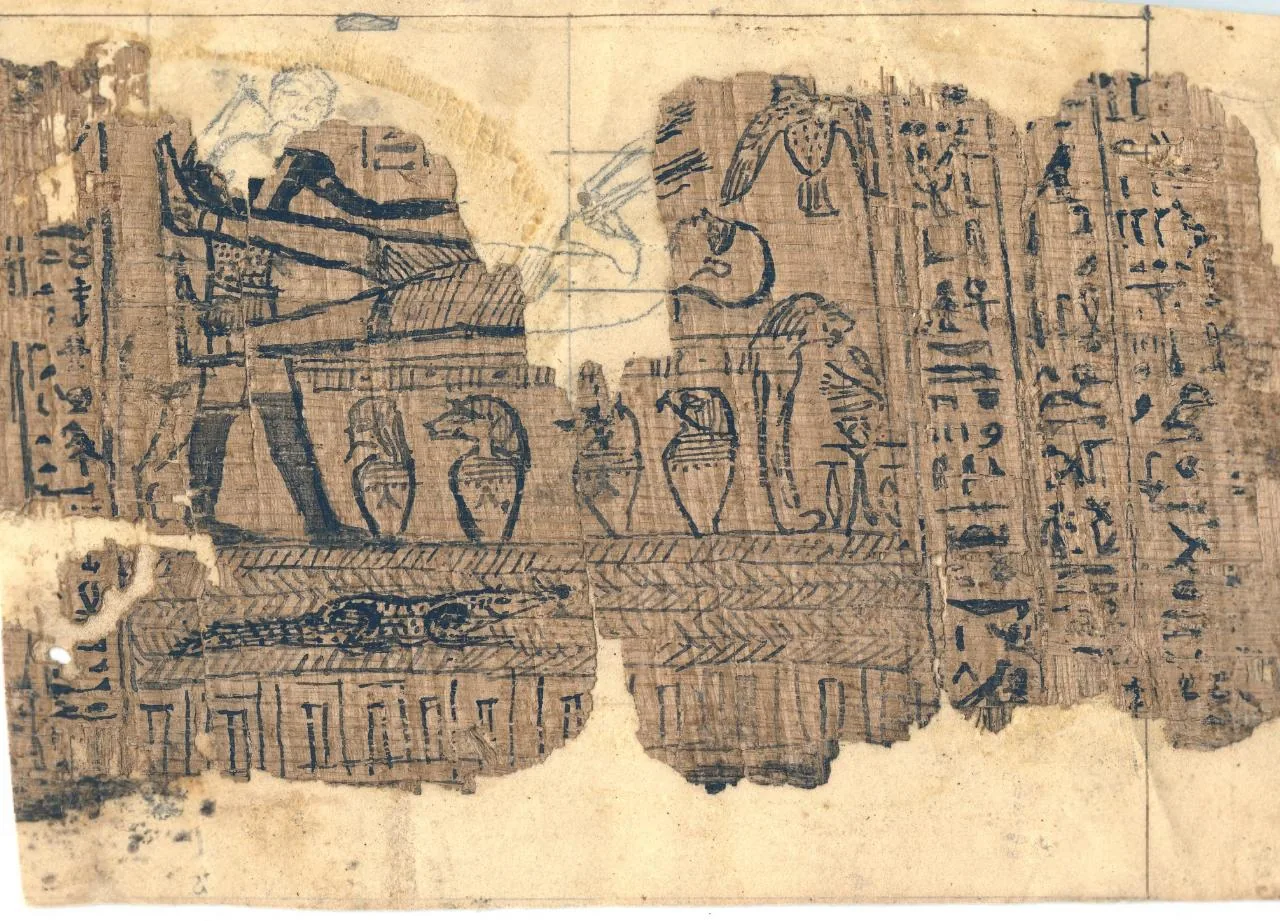
- Facsimiles 1 and 3 come from the Breathing Document of Hor, a Theban priest’s funerary papyrus of the second century BC; Facsimile 2 is a hypocephalus made for a man named Sheshonq (Baer 1968; Ritner 2000).
- Judged on the originals, Smith’s 27 figure explanations score 1 hit, 12 partial, 13 misses. The partials name the right kind of thing (a god, a spirit, a judge, a light in the sky) and the wrong identity.
- All three times Smith said the characters above a figure gave its name, the characters name someone else: Isis, Maat and “the Osiris Hor.”
- The knife in Facsimile 1, the boat in Facsimile 2 figure 3 and a third of the hypocephalus rim are 1842 restorations. Part of the rim was filled with hieratic from Hor’s papyrus, upside down.
- The “dove” of the Holy Ghost is a falcon-headed serpent on legs, presenting an eye to a god with an erection.
- Abraham 1:1–2:18, 2,121 words in the 1835 manuscript, was set beside about fourteen Egyptian words of a burial instruction. Six characters were invented over gaps, and they carry Egyptus and Ham’s priesthood curse.
Also. If the world can find out these numbers, so let it be. Amen. — Joseph Smith, explanation of Facsimile 2, fig. 11 (1842)
I grew up with the Pearl of Great Price, and the facsimiles were the part I loved: real Egyptian pictures in a book of scripture, with numbered figures and a prophet’s key to each. Kolob, Oliblish, Shulem, “one day to a cubit.” Nothing else in the canon looked like it.
The figures can now be checked. Fragments of the papyri survive, including the original of Facsimile 1. Egyptologists inside and outside the church have read them, and the Joseph Smith Papers publish photographs of the papyri and of every manuscript. Below, each figure sits beside Smith’s explanation, word for word, and what the figure is and what its writing says. Tap a number, or use the arrow keys. Verdicts: hit, partial (right kind of thing, wrong identity), miss; Smith is judged on the original, not on the 1842 restorations (hatched).
Facsimile 1: Osiris rising, not Abraham on an altar #
The opening vignette of Hor's Breathing Document
Facsimile 1
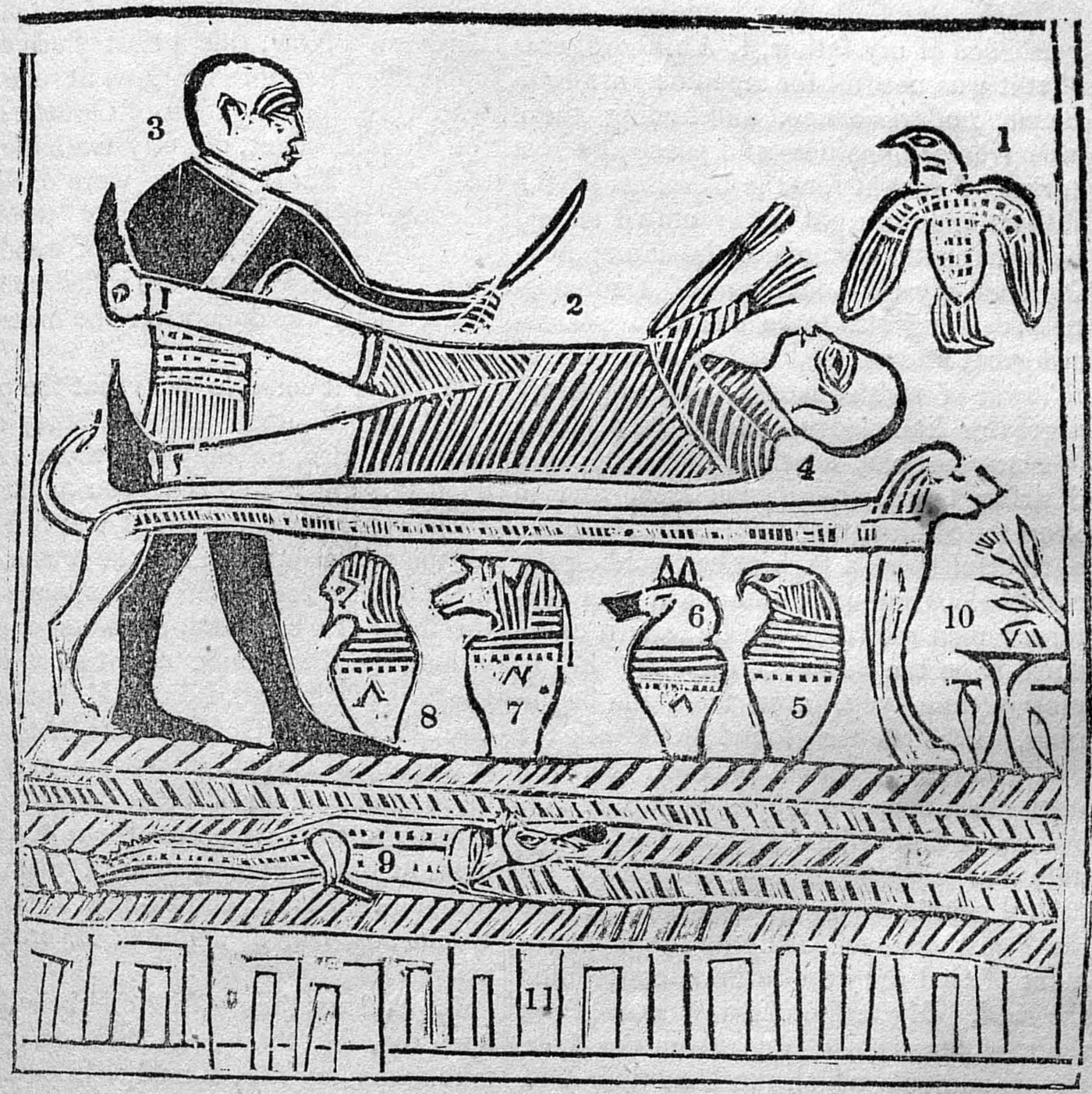
Times and Seasons, 1 March 1842, engraved by Reuben Hedlock
Tap or hover a number on the woodcut to set Joseph Smith's explanation beside the Egyptian.
- Fig. 1 PARTIAL
Smith“The Angel of the Lord.”
What it isThe ba, the dead man’s own soul: a human-headed bird hovering over his head. The falcon head in the woodcut is a restoration.
VerdictA winged spirit, yes. But it is Hor’s soul, not a messenger of God.
- Fig. 2 MISS
Smith“Abraham fastened upon an altar.”
What it isOsiris, who is also the dead priest Hor, reviving on a lion-headed funeral couch. You can’t see his groin in the woodcut: the papyrus is broken there (the hatched box), and the engraver filled the gap with a second raised hand. In the matching scenes at Dendera, Osiris lies on this couch with an erect penis, and Isis, as a kite, hovers on top of it to conceive Horus. That is most likely what the broken middle showed. Only a wingtip of her may survive, in what the woodcut made into his raised hand (Baer, Parker; Ritner reads it as a winged sun disk). The bird over his head, fig. 1, is a different bird: his own ba.
The EgyptianHor is named in the columns beside the scene, which the woodcut leaves out.
VerdictNot Abraham, not bound. A resurrection and a begetting, not a sacrifice.
- Fig. 3 MISS
Smith“The idolatrous priest of Elkenah attempting to offer up Abraham as a sacrifice.”
What it isAnubis, the black-bodied jackal god of embalming. His head and the knife fall in the gap and were supplied in 1842. Baer: “He is, of course, not holding a knife.”
VerdictThe sacrifice rests on the restored knife. John Gee’s masked-priest reading would save “priest,” not “attempting to offer up.”
- Fig. 4 MISS
Smith“The altar for sacrifice by the idolatrous priests, standing before the gods of Elkenah, Libnah, Mahmackrah, Korash, and Pharaoh.”
What it isA lion-headed funeral couch, the bier.
VerdictSmith’s own text calls the altar “after the form of a bedstead” (Abr. 1:13). He saw the bed and named it an altar.
- Fig. 5 PARTIAL
Smith“The idolatrous god of Elkenah.”
What it isCanopic jar with a falcon lid: Qebehsenuef, one of the four sons of Horus. Baer gives this jar Duamutef; the falcon head says Qebehsenuef, and we think Baer swapped figs. 5 and 6.
VerdictA god, yes. Elkenah, no.
- Fig. 6 PARTIAL
Smith“The idolatrous god of Libnah.”
What it isCanopic jar with a jackal lid: Duamutef (our reading; Baer has Qebehsenuef).
VerdictA god, yes. Libnah, no.
- Fig. 7 PARTIAL
Smith“The idolatrous god of Mahmackrah.”
What it isCanopic jar with a baboon lid: Hapi.
VerdictA god, yes. Mahmackrah, no.
- Fig. 8 PARTIAL
Smith“The idolatrous god of Korash.”
What it isCanopic jar with a human lid: Imsety.
VerdictA god, yes. Korash, no.
- Fig. 9 PARTIAL
Smith“The idolatrous god of Pharaoh.”
What it isHorus as a crocodile, swimming to retrieve Osiris’s body from the Nile.
VerdictThe closest call in Fac. 1. The crocodile is Horus, the god every living king embodied. But Smith meant the god Pharaoh worshipped, and that is not the Egyptian sense.
- Fig. 10 MISS
Smith“Abraham in Egypt.”
What it isAn offering stand with a jug and lotus flowers, with two vases beside it.
VerdictFurniture, not a person.
- Fig. 11 MISS
Smith“Designed to represent the pillars of heaven, as understood by the Egyptians.”
What it isA niched palace-facade pattern, the decorative base of the scene.
VerdictEgyptians did put the sky on supports, but this is a building’s front.
- Fig. 12 MISS
Smith“Raukeeyang, signifying expanse, or the firmament over our heads; but in this case, in relation to this subject, the Egyptians meant it to signify Shaumau, to be high, or the heavens, answering to the Hebrew word, Shaumahyeem.”
What it isThe zigzag water under the bier: the Nile, where the crocodile swims.
VerdictThe water lies below the dead man, not over our heads. Raukeeyang and Shaumahyeem are Hebrew (rāqîaʿ, šāmayim), not Egyptian.
Smith saw a sacrifice: an idolatrous priest with a knife standing over Abraham, bound on an altar, with the angel of the Lord coming to save him. The Egyptian scene is a resurrection. Osiris, who is also the dead Hor, lies on a lion-headed funeral couch while Anubis, the black-bodied god of embalming, attends him. Hor’s soul hovers over his head as a human-headed bird. Under the couch stand the four canopic jars, and in the water below swims Horus as a crocodile.
The sacrifice is in the restorations. The original has a gap where the standing figure’s head and raised hand, and the middle and one raised hand of the reclining figure, should be. The 1842 engraver filled it with a bald human head and a knife. “He is, of course, not holding a knife,” Baer wrote. The gap also took his groin, so the woodcut never shows what the original most likely did. In the matching scenes at Dendera, Osiris lies on this couch with an erect penis, and Isis, as a kite, hovers on top of it to conceive Horus: he is “ready to beget Horus,” she is “in the act of copulation” (Baer 119). What the woodcut made into the reclining figure’s raised hand may be her wingtip. She is a second bird: the one above his head, fig. 1, is his own ba, and on the papyrus it has a human head.
Smith’s best call here is the crocodile, “the idolatrous god of Pharaoh.” It is Horus, and every living king was Horus. But Smith meant the god the king worshipped, not the god the king was. The four jars get the same treatment as the rest: gods, yes, but Elkenah, Libnah, Mahmackrah and Korash are not their names. The water under the couch, which Smith called the firmament, he named with two Hebrew words.
Facsimile 2: the hypocephalus of Sheshonq #
The hypocephalus of Sheshonq
Facsimile 2
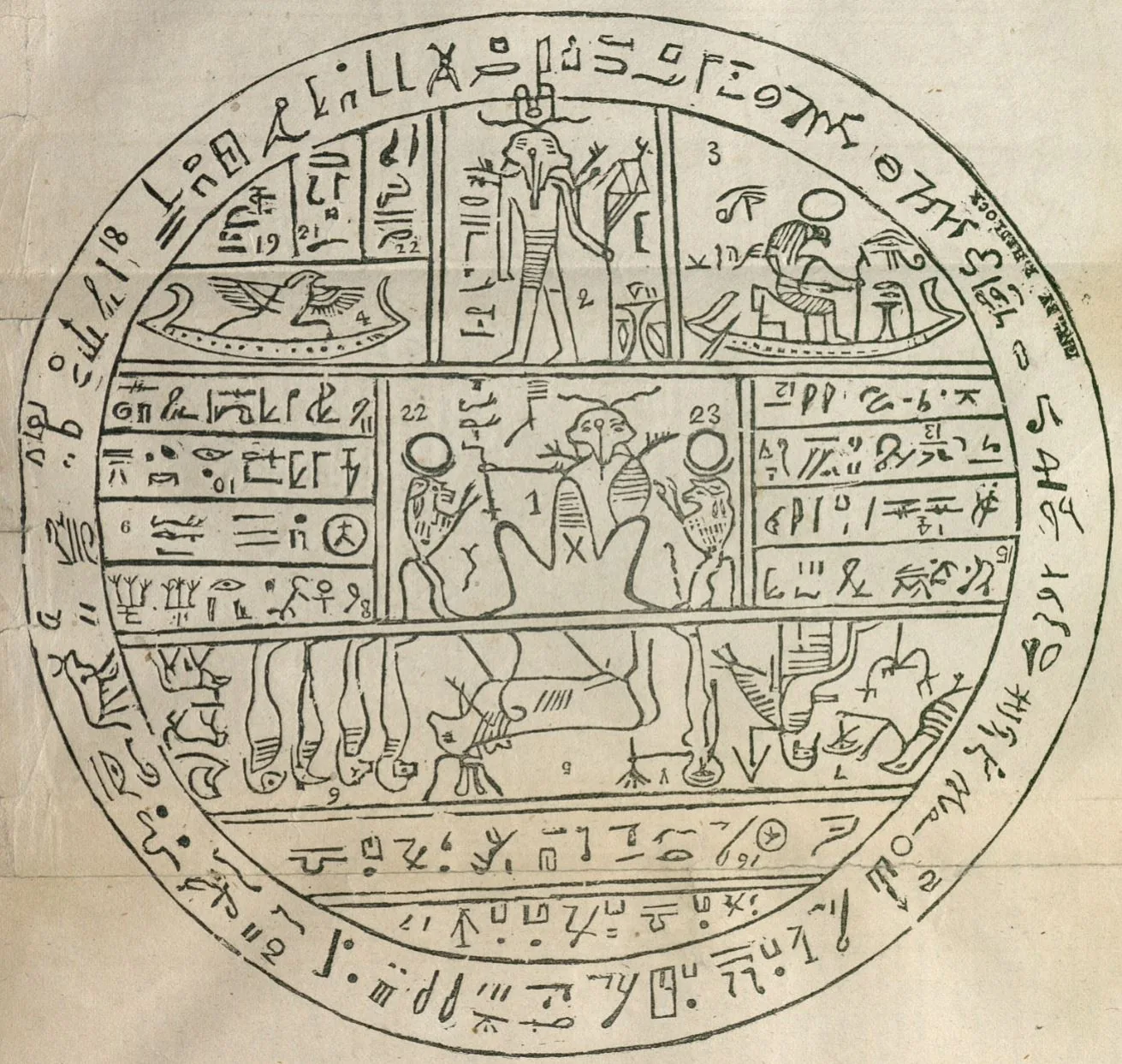
Times and Seasons, March 1842, engraved by Reuben Hedlock
Tap or hover a number on the woodcut to set Joseph Smith's explanation beside the Egyptian.
- Fig. 1 PARTIAL
Smith“Kolob, signifying the first creation, nearest to the celestial, or the residence of God. First in government, the last pertaining to the measurement of time. The measurement according to celestial time, which celestial time signifies one day to a cubit. One day in Kolob is equal to a thousand years according to the measurement of this earth, which is called by the Egyptians Jah-oh-eh.”
What it isThe seated creator sun god with four ram heads, Amun-Re uniting Re, Shu, Geb and Osiris: the usual centre of a hypocephalus. His upper body is restored.
The EgyptianThe rim names him (fig. 18).
VerdictThe supreme creator who rules and measures time: the right register. But Kolob is a star, not a god, and “one day to a cubit” and “Jah-oh-eh” have no Egyptian basis.
- Fig. 2 MISS
Smith“Stands next to Kolob, called by the Egyptians Oliblish, which is the next grand governing creation near to the celestial or the place where God resides; holding the key of power also, pertaining to other planets; as revealed from God to Abraham, as he offered sacrifice upon an altar, which he had built unto the Lord.”
What it isTwo-faced Amun-Re with double plumes and ram horns, holding the jackal standard of Wepwawet and an ankh.
The Egyptianrn n nṯr ꜥꜣ pn, “The name of this great god.”
VerdictOliblish is unattested. The “key of power” could be the ankh, but nothing here is planetary.
- Fig. 3 RESTORED
Smith“Is made to represent God, sitting upon his throne, clothed with power and authority; with a crown of eternal light upon his head; representing also the grand Key-words of the Holy Priesthood, as revealed to Adam in the Garden of Eden, as also to Seth, Noah, Melchizedek, Abraham, and all to whom the Priesthood was revealed.”
What it isRestoration. Falcon-headed Re with a sun disk, enthroned in a boat. The original panel was empty; its filler matches a barque in another Book of the Dead.
The Egyptiandp.t-nṯr, “the god’s ship” (also restored).
Verdict“A crown of eternal light” fits the sun disk, but Smith’s circle drew this panel. It cannot count as a reading of the original.
- Fig. 4 MISS
Smith“Answers to the Hebrew word Raukeeyang, signifying expanse, or the firmament of the heavens; also a numerical figure, in Egyptian signifying one thousand; answering to the measuring of the time of Oliblish, which is equal with Kolob in its revolution and in its measuring of time.”
What it isA mummiform falcon, Sokar or Horus-Soped, with outspread wings on a boat.
VerdictSpread wings can stand for the sky, and Rhodes points to a “ship of 1000 cubits” in the Coffin Texts. But the figure is no numeral (1000 is the lotus sign), and Raukeeyang is Hebrew.
- Fig. 5 PARTIAL
Smith“Is called in Egyptian Enish-go-on-dosh; this is one of the governing planets also, and is said by the Egyptians to be the Sun, and to borrow its light from Kolob through the medium of Kae-e-vanrash, which is the grand Key, or, in other words, the governing power, which governs fifteen other fixed planets or stars, as also Floeese or the Moon, the Earth and the Sun in their annual revolutions. This planet receives its power through the medium of Kli-flos-is-es, or Hah-ko-kau-beam, the stars represented by numbers 22 and 23, receiving light from the revolutions of Kolob.”
What it isThe Ihet-Hathor cow of Book of the Dead spell 162, sun disk between her horns: the cow who bore Re. Behind her a goddess with a wedjat-eye head holds out a lotus.
VerdictSmith’s best astronomy: the cow carries the sun and is its mother. But the disk is drawn on her head, the names are not Egyptian, and Hah-ko-kau-beam is Hebrew ha-kôkābîm, “the stars.”
- Fig. 6 HIT
Smith“Represents this earth in its four quarters.”
What it isThe four sons of Horus, standing mummiform. Beside them a god’s name in lotus, lion and ram, which Smith passes over.
VerdictThe one hit. The sons of Horus guard the four cardinal points. But four figures as the four corners of the earth is the obvious Bible guess (Isa. 11:12), and in Fac. 1 Smith gave the same four gods invented names.
- Fig. 7 PARTIAL / MISS
Smith“Represents God sitting upon his throne, revealing through the heavens the grand Key-words of the Priesthood; as, also, the sign of the Holy Ghost unto Abraham, in the form of a dove.”
What it isIthyphallic Min, enthroned, flail raised, with an erect penis. Facing it is a falcon-headed serpent with legs, holding out the wedjat eye: Nehebkau, per Ritner.
VerdictAn enthroned god, yes. The Holy Ghost as a dove, no: it is a snake with legs, and the god it serves has an erection. The 1913 church edition erased the phallus; current editions print it.
- Fig. 8 NO CLAIM
Smith“Contains writings that cannot be revealed unto the world; but is to be had in the Holy Temple of God.”
What it isThe last line of a four-line prayer (figs. 11 to 8).
The Egyptianmj ꜥnḫ bꜣ n Wsjr Ššnq: “grant that the ba of the Osiris Sheshonq may live.”
VerdictThe commonest wish on any hypocephalus. Nothing secret.
- Fig. 9 NO CLAIM
Smith“Ought not to be revealed at the present time.”
What it isThird line of the prayer.
The Egyptian“of the underworld, the waters and the mountains”
- Fig. 10 NO CLAIM
Smith“Also.”
What it isSecond line of the prayer.
The Egyptiannṯr ꜥꜣ nb p.t tꜣ: “great god, lord of sky and earth”
- Fig. 11 NO CLAIM
Smith“Also. If the world can find out these numbers, so let it be. Amen.”
What it isFirst line of the prayer.
The Egyptian“O noble god since the first time” (Ritner; Rhodes reads “God of the Sleeping Ones,” the dead).
VerdictThe world has found the numbers. Figures 11, 10, 9 and 8 are one sentence.
- Fig. 12–15 NO CLAIM
Smith“Figures 12, 13, 14, 15, 16, 17, 18, 19, 20, and 21 will be given in the own due time of the Lord.”
What it isThe right-hand panel. The inner halves keep the original text; the outer halves were filled with hieratic copied upside down from Hor’s Breathing Document.
The EgyptianRow 14 has hieratic snsn, “breathing”: a Breathing Document word pasted into a hypocephalus.
VerdictSmith promised to explain rows that are partly a different papyrus, upside down.
- Fig. 16 NO CLAIM
Smith(Covered by the promise for 12–21.)
What it isLower band of text.
The Egyptianbꜣ pn ḥnꜥ nb=f nn th.tw=f m dwꜣ.t r nḥḥ: “This ba and his lord will not be attacked in the underworld forever.”
- Fig. 17 NO CLAIM
Smith(Covered by the promise for 12–21.)
What it isLowest band, upside down.
The EgyptianRitner: “Back, injury, back! There is none who attacks you.” Rhodes emends it to “this tomb shall not be violated.”
- Fig. 18 NO CLAIM
Smith(Covered by the promise for 12–21.)
What it isThe rim: the creator sun god speaking. Its right third is restored hieratic from Hor’s papyrus.
The Egyptianjnk Ḏbꜣty m Ḥw.t-bnbn m Jwnw … kꜣ nk nn snw=f: “I am the Punisher in the Mansion of the Benben in Heliopolis … the bull who fucks, who has no equal.” nk is written with the ejaculating-phallus sign.
VerdictRitner: “the copulating bull.” Rhodes softens it to “virile bull.”
- Fig. 19–21 NO CLAIM
Smith(Covered by the promise for 12–21.)
What it isThree short columns at upper left. The 1842 cut numbers them 19, 21 and 22: there is no 20, and 22 is used twice.
The Egyptianjw=k r nḥḥ mj nṯr pf Ḏdw.ty: “You shall be forever like that god, the one of Busiris” (Osiris).
- Fig. 22–23 PARTIAL
Smith“Kli-flos-is-es, or Hah-ko-kau-beam, the stars represented by numbers 22 and 23, receiving light from the revolutions of Kolob. (From the fig. 5 entry.)”
What it isTwo baboons crowned with moon disks, adoring the sun god between them.
VerdictTwo moon-crowned figures flank the sun: a real contact. But they are baboons with moons, not stars, and the name is Hebrew.
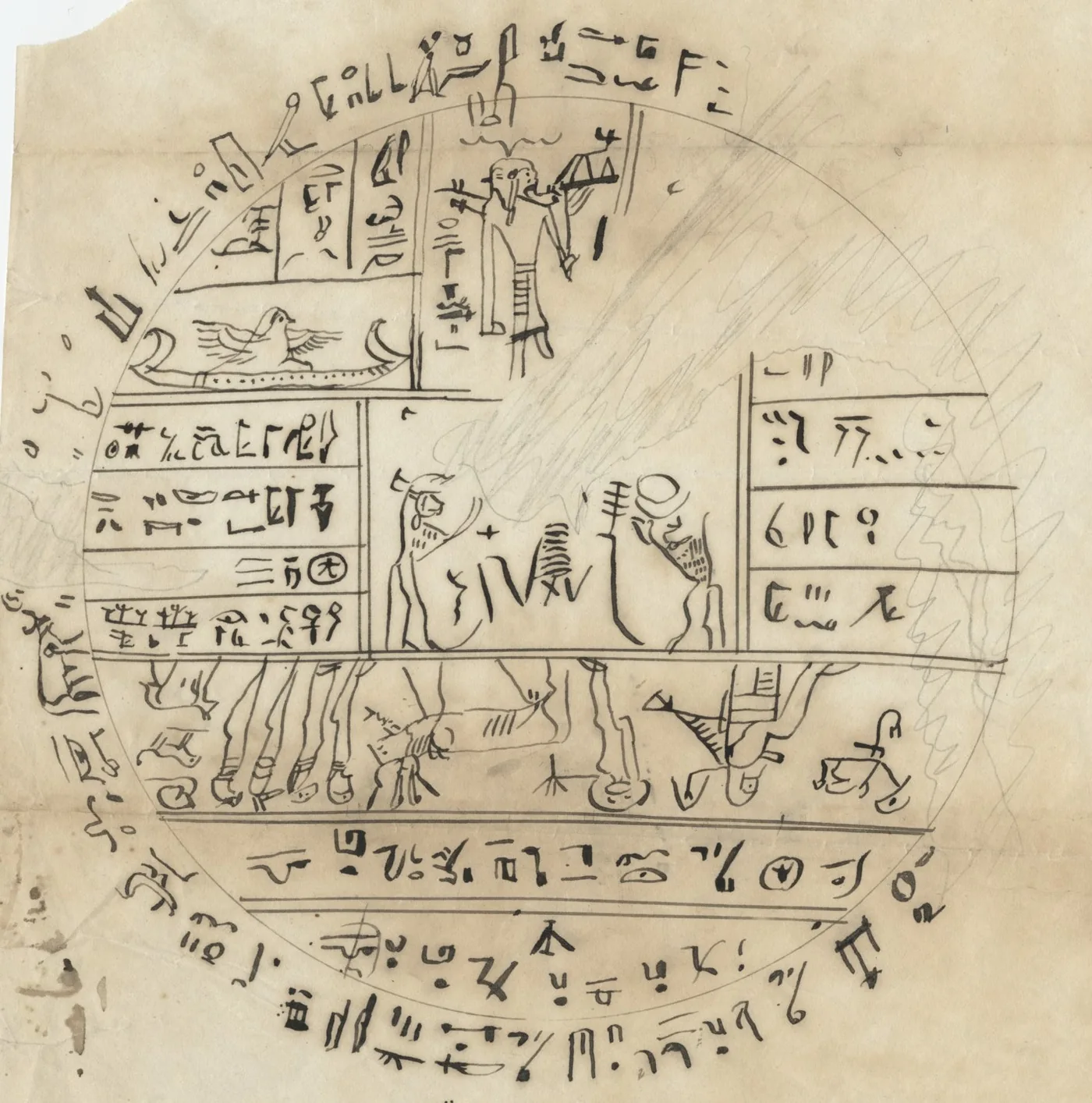
A hypocephalus is a disk placed under a mummy’s head; its pictures come from Book of the Dead spell 162. This one, made for a man named Sheshonq, is lost. What survives is the 1842 woodcut and an ink copy of about the same date that shows the original’s damage.
The copy shows how much was missing. The whole panel of figure 3, a falcon-headed god in a boat, is pencil hatching in the copy: the woodcut’s boat was borrowed from a barque vignette in another papyrus. The top of figure 1 was lost and filled with a double face that looks borrowed from figure 2. The right third of the rim and the outer halves of rows 12–15 were filled with hieratic copied from Hor’s Breathing Document, upside down (Rhodes). Row 14 contains the word snsn, “breathing,” which belongs to a Breathing Document, not to a hypocephalus.
Smith’s explanation is the most ambitious in the book: Kolob, the star nearest the throne of God, a governing hierarchy of planets, and one day in Kolob equal to a thousand years. The disk is a picture of the creator sun and his company, and a prayer for Sheshonq’s soul. At the centre sits the creator sun with four ram heads, and the rim is his speech. The four lines of writing on the left, which Smith said “cannot be revealed unto the world” or “ought not to be revealed at the present time,” are one stock prayer: “O noble god since the first time, great god, lord of sky and earth, of the underworld, the waters and the mountains, grant that the ba of the Osiris Sheshonq may live.” “If the world can find out these numbers, so let it be.” It has.
Smith does best on this disk where it touches the sky. The cow of figure 5 carries the sun between her horns and, in the spell the hypocephalus comes from, she is the sun’s mother, so “said by the Egyptians to be the Sun” is close. Two baboons crowned with moons flank the sun god, and Smith called them stars taking light from Kolob. And the four sons of Horus, figure 6, do stand for the four cardinal points: Smith’s “this earth in its four quarters” is the one hit in the book, if also the easiest guess.
Facsimile 3: the characters name someone else #
The closing vignette of Hor's Breathing Document
Facsimile 3
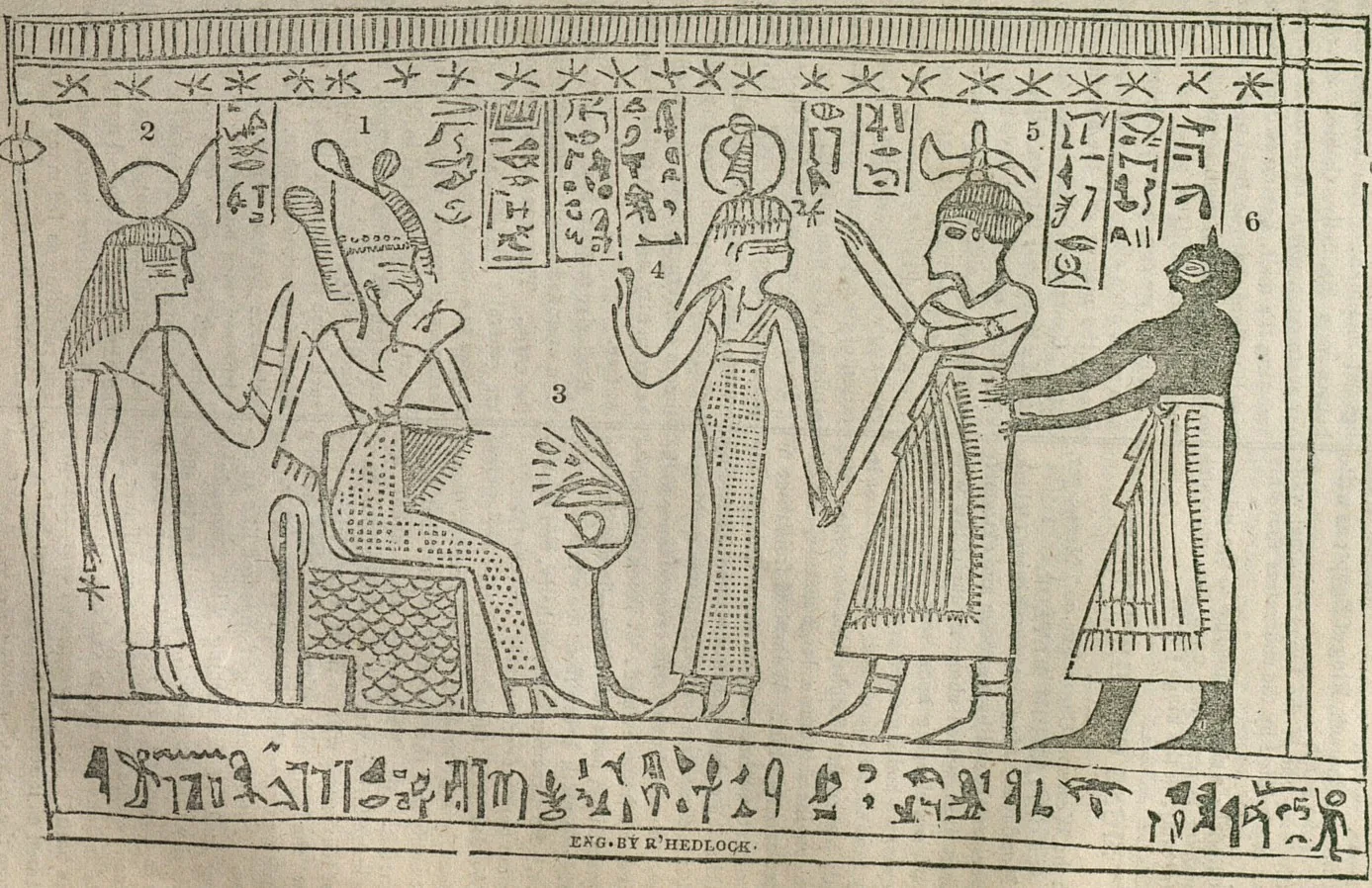
Times and Seasons, May 1842, engraved by Reuben Hedlock
Tap or hover a number on the woodcut to set Joseph Smith's explanation beside the Egyptian.
- Fig. 1 PARTIAL
Smith“Abraham sitting upon Pharaoh's throne, by the politeness of the king, with a crown upon his head, representing the Priesthood, as emblematical of the grand Presidency in Heaven; with the scepter of justice and judgment in his hand.”
What it isOsiris, king and judge of the dead, in the atef crown with crook and flail: the close of a judgment scene.
The Egyptian“Recitation by Osiris, Foremost of the Westerners, Lord of Abydos, the great god, forever and ever.”
VerdictNot Abraham; the label names Osiris. But “justice and judgment” is right for the judge of the dead, and that is the part a viewer could not see.
- Fig. 2 MISS
Smith“King Pharaoh, whose name is given in the characters above his head.”
What it isIsis, a woman in the horned sun-disk crown.
The EgyptianꜢs.t wr.t mw.t-nṯr: “Isis the great, the god’s mother.”
VerdictSmith staked this on the characters. They name a goddess.
- Fig. 3 MISS
Smith“Signifies Abraham in Egypt as given also in Figure 10 of Facsimile No. 1.”
What it isAn offering stand with a jug and lotus.
VerdictConsistent with Fac. 1 fig. 10, the same object, and wrong the same way.
- Fig. 4 MISS
Smith“Prince of Pharaoh, King of Egypt, as written above the hand.”
What it isMaat, goddess of right order, with her feather.
The EgyptianMꜣꜥ.t ḥnw.t nṯr.w: “Maat, mistress of the gods.”
VerdictStaked on the text again: a goddess called mistress of the gods, read as a male prince.
- Fig. 5 MISS
Smith“Shulem, one of the king's principal waiters, as represented by the characters above his hand.”
What it isHor himself, owner of the papyrus, perfume cone on his head, led in by Maat and Anubis.
The EgyptianWsjr Ḥr mꜣꜥ-ḫrw r ḏ.t: “The Osiris Hor, justified forever.”
VerdictThe characters above his hand give his name, and it is Hor, a priest of Amun-Re and Min. This label is how Baer tied Fac. 3 to the papyrus of Fac. 1.
- Fig. 6 MISS
Smith“Olimlah, a slave belonging to the prince.”
What it isAnubis, black-bodied guide of the dead. The woodcut gives him a human head.
The Egyptian“Recitation by Anubis, who makes protection, foremost of the embalming booth …”
VerdictA god, not a slave. Ritner: the black body is the god’s color, not a slave’s.
- Bottom line PARTIAL
Smith“Abraham is reasoning upon the principles of Astronomy, in the king's court.”
What it isThe dead man presented in the court of Osiris, king of the dead, under a canopy painted with stars.
The Egyptian“O gods of the necropolis, gods of the caverns, gods of the south, north, west and east, keep safe the Osiris Hor, the justified, whom Taikhibit bore.”
VerdictA king’s court with stars overhead. No astronomy in the text: it is a prayer for Hor’s safety.
Facsimile 3 is the closing vignette of Hor’s papyrus, a judgment scene: Osiris enthroned, Isis behind him, Maat and Anubis leading Hor in, all under a canopy of stars. Here Smith staked his reading on the writing. Figure 2 is King Pharaoh, “whose name is given in the characters above his head.” Figure 4 is a prince, “as written above the hand.” Figure 5 is Shulem, a royal waiter, “as represented by the characters above his hand.”
The characters are legible even in the woodcut. Above figure 2: “Isis the great, the god’s mother.” Above figure 4: “Maat, mistress of the gods.” Above figure 5: “The Osiris Hor, justified forever.” Two goddesses and the papyrus owner, read as a king, a prince and a waiter. The figure Smith called the slave Olimlah is Anubis, whose head the engraver drew human.
Smith’s figure 1 deserves its partial. He called it Abraham on Pharaoh’s throne, crowned, holding “the scepter of justice and judgment.” Throne, crown and sceptre are in the picture. “Judgment” is not, and it is exactly right: this is Osiris presiding at the judgment of the dead.
Where the Book of Abraham papyri came from #
In 1835 Michael Chandler brought four mummies and several rolls of papyrus to Kirtland, Ohio, and church members bought them (Gospel Topics essay, 2014). That year Smith’s scribes wrote the first chapters of the Book of Abraham, with Egyptian characters in the margin (Manuscript C, Joseph Smith Papers). In 1842 the church paper Times and Seasons printed the five chapters with three woodcuts, the facsimiles, each with Smith’s numbered explanation (Times and Seasons, 1 March 1842).
In 1967 the Metropolitan Museum of Art gave the church ten fragments, and an eleventh turned up in the Church Historian’s Office (Gospel Topics essay). One of them is the original of Facsimile 1. Within a year Klaus Baer of the Oriental Institute had translated the papyrus it heads: a Breathing Document, the late funerary text that let the dead “breathe like the bas of the gods,” made for a priest named Hor (Baer 1968). The Joseph Smith Papers date it between 238 and about 153 BC (JSP, Book of Breathing for Horos).
Hor was a prophet of Amun-Re, King of the Gods, of Min “who slaughters his enemies,” and of Khonsu, son of Osorwer and of Taikhibit, a sistrum-player of Amun-Re. All of this is written in the five columns that frame Facsimile 1 and that the 1842 woodcut leaves out. Facsimile 3, whose original is lost, names Hor in its captions, so it is the same scroll’s closing picture. Facsimile 2 belonged to someone else.
Smith is judged on the original, not on the parts restored for the 1842 printing. The hatched areas on the woodcuts mark those restorations; the button under each figure hides them. Identifications follow Baer and Robert Ritner for the Hor papyrus and Michael Rhodes for the hypocephalus. The English of the Egyptian captions is our own engine’s reading, made from the transliterations with a scholar’s translation as a check; where it differs from the scholars, the entry says so.
The serpents in the facsimiles #
Serpents run through these drawings, and Smith passed over every one.
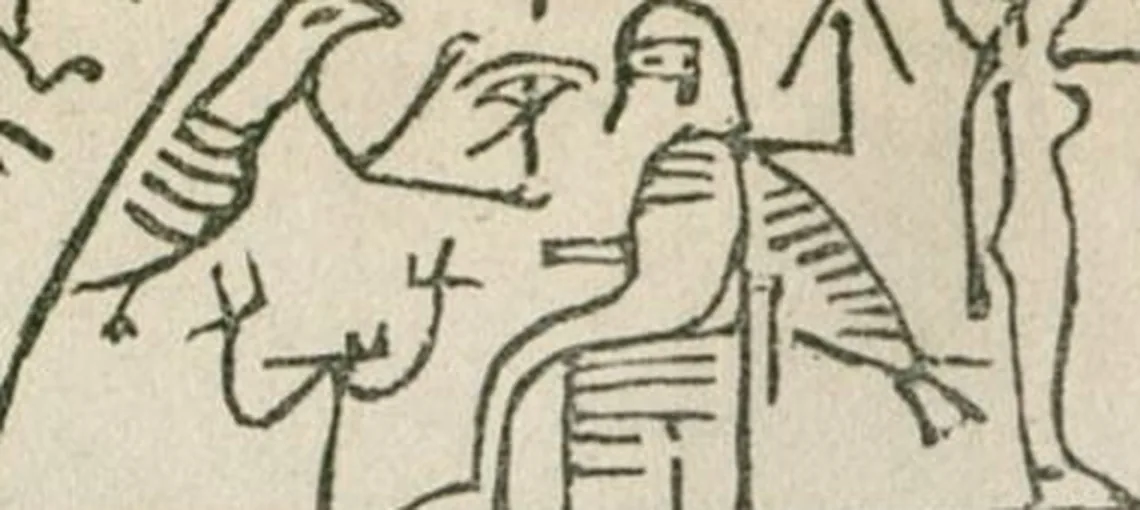
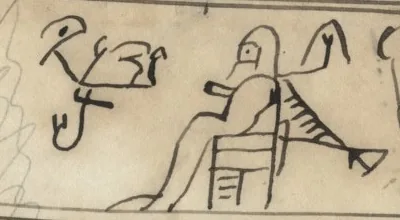
The clearest is figure 7 of the hypocephalus. Smith described “God sitting upon his throne, revealing through the heavens the grand Key-words of the Priesthood; as, also, the sign of the Holy Ghost unto Abraham, in the form of a dove.” The god is Min, seated, flail raised, his erect penis pointing at the creature in front of him. The creature has a falcon’s head, a long striped serpent body and two pairs of legs, and it holds out the wedjat, the eye of Horus. Ritner identifies it as Nehebkau, the serpent god “who provides the kas,” the powers that make a person (see Neheb-Ka, Binder of Souls). Other hypocephali put a snake, an ape or a falcon-headed snake in the same place. Rhodes calls it a bird. The church’s 1913 edition erased Min’s penis; current editions print it again.
The god on the rim is no gentler. The sun god’s speech that rings the disk calls him kꜣ nk nn snw=f, “the bull who fucks, who has no equal.” Nk is the plain verb, and the scribe spelled it with the sign of a penis ejaculating. Ritner translates “the copulating bull.” Rhodes softened it to “virile bull.”
Two more snakes flank the sun god at the centre of the disk, uncommented. And the horned viper, the hieroglyph for the sound f, is written all through the texts as the suffix “his.” It is in Min’s “who slaughters his enemies” on Facsimile 1, where “enemies” also takes the viper. It appears three times in the line beside which Smith set God’s covenant with Abraham: “they have clasped,” “his two arms,” “his heart.” The covenant of Abraham 2:9–11 sits beside a snake.
Where the text of Abraham came from #
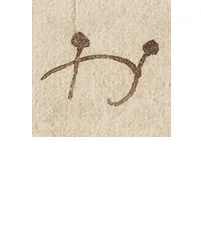
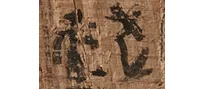
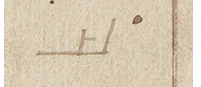
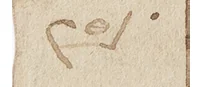
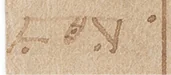
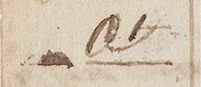
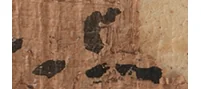
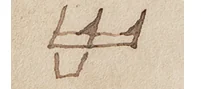
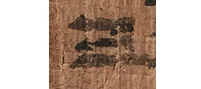
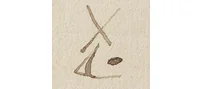
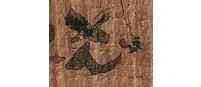
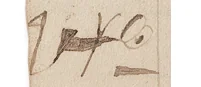
The facsimiles are pictures with captions. The text of the Book of Abraham has a different source, and the 1835 manuscripts show it. Down the left margin of each manuscript runs a column of Egyptian characters, one beside each block of English. They are copied, in order, from the first column of text in Hor’s Breathing Document (Ritner’s column II), which follows the Facsimile 1 vignette.
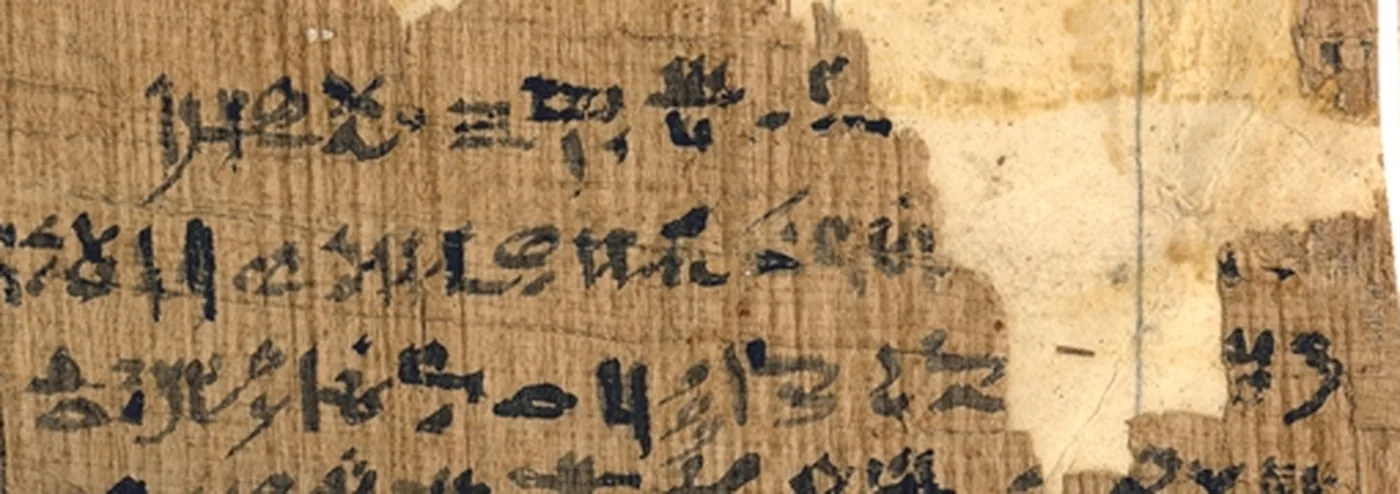
Those lines are a burial instruction. In Ritner’s transliteration, with our engine’s English:
| Line | Egyptian | English |
|---|---|---|
| 1 | [jw=w sṯꜣ Wsjr r] ẖnw n pꜣ š wr n Ḫnsw | [Osiris shall be towed] into the great lake of Khonsu, |
| 2 | [Wsjr Ḥr mꜣꜥ-ḫrw] ms.n Tꜣy-ḫy-by.t mꜣꜥ.t-ḫrw mj.ty | and likewise [the Osiris Hor, justified], born of Taikhibit, justified, |
| 3 | m-ḫ[t ḫfꜥ=w] ꜥ.wy=f r ḥꜣ.ty=f jw=w qr- | after [they have clasped] his two arms to his heart, and |
| 4 | -s tꜣ šꜥ.t n snsn … | the Breathing Document shall be wrapped … |
Baer’s translation says the same, apart from wording (“conveyed” for “towed,” “pool” for “lake”). Everyone, our engine included, softens ḫfꜥ to “placed”; it means “clasp,” and the line describes the dead man’s arms crossed on his chest.
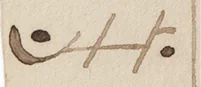
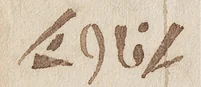
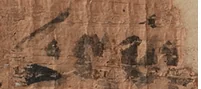
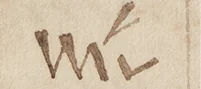
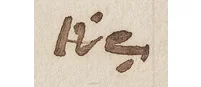
Manuscript C sets all of Abraham 1:1–2:18, 2,121 words, beside about fourteen of these Egyptian words. The words in square brackets were already lost when Smith’s clerks copied the line. That is about 150 words of scripture per Egyptian word. “Khonsu,” the moon god’s name, carries 170 words, including God’s “my name is Jehovah.”
Manuscript C, 1835 · Abraham 1:1–2:18
27 characters, 2121 words of scripture
copied from the papyrus invented over a gap (379 words) no source in this line
5.27
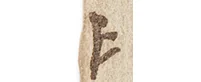
no papyrus source
Abr. 1:1a In the land of the Chaldeans
11 words
5.28
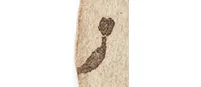
no papyrus source
Abr. 1:1b–2a Abraham seeks the blessings of the fathers
54 words
3.11
not placed in col. i
Abr. 1:2b–3 the right of the firstborn
90 words
2 invented
[sṯꜣ] [tow]
Abr. 1:4 Abraham seeks the priesthood
20 words
3 invented
[Wsjr] [Osiris]
Abr. 1:5 the fathers turn to idolatry
30 words
4 invented
[r] [into]
Abr. 1:6–7 the gods of the heathen
88 words
5
ẖnw into
Abr. 1:8–10 the priest of Elkenah; human sacrifice
123 words
6
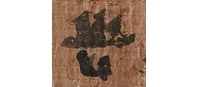
(n) pꜣ the
Abr. 1:11 three virgins killed on the altar
59 words
7
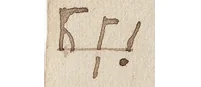
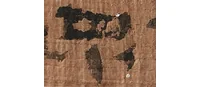
š (1) lake, first half
Abr. 1:12 the priests lay violence on Abraham
59 words
8
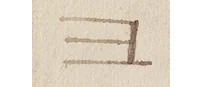
š (2) lake, second half
Abr. 1:13–14 the altar like a bedstead
71 words
9
wr great
Abr. 1:15 the angel looses his bands
62 words
10
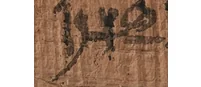
Ḫnsw Khonsu
Abr. 1:16–19 "my name is Jehovah"
170 words
11 trace
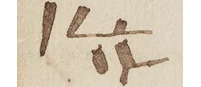
Wsjr Osiris
Abr. 1:20–22 "Pharaoh signifies king by royal blood"
103 words
12 invented
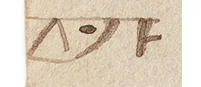
[Ḥr] [Hor]
Abr. 1:23–24 Egyptus finds Egypt under water
64 words
13 invented
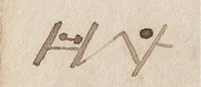
[mꜣꜥ-ḫrw] [justified]
Abr. 1:25–26 Noah curses Pharaoh's priesthood
107 words
14 invented
[lost] [end of the gap]
Abr. 1:27–28 Pharaoh's line denied the priesthood
70 words
15
ms.n born of
Abr. 1:29–31a famine; records of the planets and stars
130 words
16
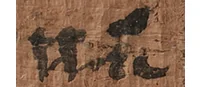
Tꜣy- Tai-
Abr. 1:31b "I shall endeavor to write"
24 words
17
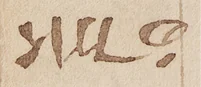
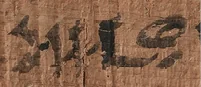
-ḫy-by.t -khibit
Abr. 2:1–2a Abram takes Sarai
55 words
18
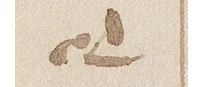
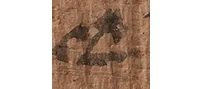
(seated woman) a woman
Abr. 2:2b "who was the daughter of Haran"
6 words
19
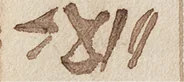
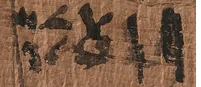
mꜣꜥ.t-ḫrw mj.ty justified, likewise
Abr. 2:3–5 "get thee out of thy country"
109 words
20
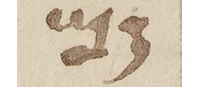
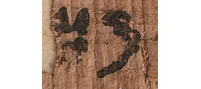
m-ḫ(t) after
Abr. 2:6 a minister in a strange land
73 words
21 trace
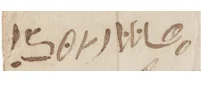
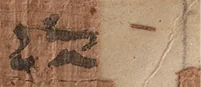
[ḫfꜥ=w] [they have clasped]
Abr. 2:7–9a "the earth is my footstool"
103 words
22
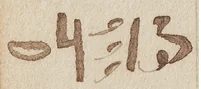
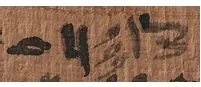
ꜥ.wy=f r his two arms to
Abr. 2:9b–11 the Abrahamic covenant
152 words
23
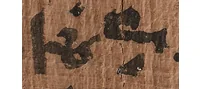
ḥꜣ.ty=f his heart
Abr. 2:12–14 Abram leaves Haran
96 words
24
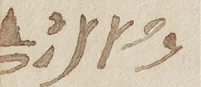
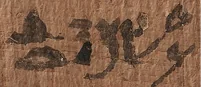
jw=w qr(s) while they wrap
Abr. 2:15–16 the souls won in Haran
87 words
25
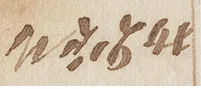
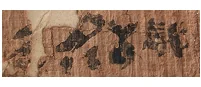
-s tꜣ šꜥ.t … the document
Abr. 2:17–18 an altar; the plains of Moreh
105 words
Six of the characters, 2–4 and 12–14, stand where the papyrus was already broken. Smith’s shapes for them “bear no resemblance to the signs that certainly were on the papyrus” (Baer 129); they were invented to fill the gap. Those six carry 379 words: the opening of Abraham’s quest for the priesthood, the story of Egyptus finding Egypt under water, and the verses in which Noah curses Pharaoh’s line “as pertaining to the priesthood.” Those verses were later used to justify the church’s priesthood ban.
The matches between sign and verse are not random. The god’s name, written with the seated-god sign, carries the speech of God. The seated-woman sign after the mother’s name carries exactly six words, “who was the daughter of Haran,” the shortest block in the book and the only one about a woman. That is how Smith’s Grammar and Alphabet of the Egyptian Language assigns meanings: by “degrees,” from what a character suggests. The characters and the verses were matched on purpose. None of the matches is a translation.
The best case for Smith #
The defence has real points, and it deserves them stated at full strength.
The hits are real. The four sons of Horus do guard the four quarters, and the 2014 Gospel Topics essay cites it. The cow does carry the sun and is its mother. The crocodile is Horus, the god every king embodied. Osiris does sit as judge. Smith repeatedly guessed the right register: a god, a spirit, a throne, a light in the sky.
Some names have defenders. The essay notes that Elkenah is not in the Bible but was worshipped in the ancient Near East; Kevin Barney connects it with ʾEl-qōnê, “El, creator [of earth].” Rhodes points to a “ship of 1000 cubits” in the Coffin Texts to explain Smith’s “one thousand” in figure 4, and the essay’s case for the firmament under the bier is that Egyptians knew a heavenly ocean. John Gee argues that the Anubis of Facsimile 1 could be a priest in a jackal mask.
The surviving papyrus may not be the source. Hugh Nibley argued that the marginal characters were placed in the manuscripts without reference to the text. Witnesses spoke of “a long roll” of papyrus, and the essay suggests much of it is lost.
Translation may not mean translation. The essay’s last position is that the papyri “catalyzed a process whereby God gave to Joseph Smith a revelation about the life of Abraham.” On this view the Egyptian on the scrolls is beside the point.
Each argument fails at the same place: the evidence Smith himself pointed to. The hits are the ones anyone could make from the drawing, and the same four sons of Horus he got right on Facsimile 2 he called four invented idols on Facsimile 1. Elkenah may be a real Near Eastern god, but the figure Smith gave that name is a canopic jar of Qebehsenuef. The thousand-cubit ship does not make a falcon a numeral. The masked priest saves the word “priest” and loses the knife. The long-roll theory cannot explain why the characters in the margin come from this papyrus, from this column, in this order, with gaps where this papyrus has gaps. And the catalyst theory, whatever it says about the text, cannot rescue the facsimiles. Smith did not say the figure of Isis inspired him to think of Pharaoh. He said Pharaoh’s name “is given in the characters above his head.” It is not.
What Smith got right: the tally #
| Facsimile | Hit | Partial | Miss | Not judged |
|---|---|---|---|---|
| 1. Osiris on the bier | 0 | 6 | 6 | — |
| 2. Hypocephalus | 1 | 4 | 2 | fig. 3 (restored); figs. 8–21 no claim |
| 3. Judgment scene | 0 | 2 | 5 | — |
| All | 1 | 12 | 13 |
Every proper name and “Egyptian” word Smith gave is unattested or Hebrew: Kolob, Oliblish, Enish-go-on-dosh, Kae-e-vanrash, Floeese, Kli-flos-is-es, Jah-oh-eh, Elkenah, Libnah, Mahmackrah, Korash, Shulem and Olimlah are not Egyptian. Raukeeyang, Shaumahyeem and Hah-ko-kau-beam are Hebrew: rāqîaʿ “firmament,” šāmayim “heavens,” ha-kôkābîm “the stars.”
What the papyri say is in its own way stranger than the Book of Abraham. A priest of Min, crossed arms clasped to his heart, is towed into the great lake of Khonsu, given a document that lets him breathe “like the bas of the gods, forever and ever,” and led into the court of Osiris. Another man’s disk, patched in 1842 with Hor’s own words, promises its owner’s soul life and calls the sun a bull who fucks. For a book about the snake cult, the most interesting creature in the Pearl of Great Price turns out to be the one Smith called a dove (see also The Serpent Was the First Hieroglyph).
Sources #
- Baer, Klaus. “The Breathing Permit of Hor: A Translation of the Apparent Source of the Book of Abraham.” Dialogue 3(3) (1968): 109–134.
- Ritner, Robert K. “The ‘Breathing Permit of Hor’ Thirty-four Years Later.” Dialogue 33(4) (2000): 97–119.
- Ritner, Robert K. The Joseph Smith Egyptian Papyri: A Complete Edition (2013); hypocephalus readings as quoted in “Joseph Smith Hypocephalus.” Wikipedia.
- Rhodes, Michael D. The Joseph Smith Hypocephalus … Seventeen Years Later. FARMS, 1994.
- The Church of Jesus Christ of Latter-day Saints. “Translation and Historicity of the Book of Abraham.” Gospel Topics Essays, 2014.
- The Pearl of Great Price. Facsimile 1, Facsimile 2, Facsimile 3, explanations quoted verbatim.
- The Joseph Smith Papers. “Book of Abraham Manuscript, circa July–circa November 1835–C.”
- The Joseph Smith Papers. “Comparison of Characters.”
- The Joseph Smith Papers. “Fragment of Book of Breathing for Horos-A, between 238 and circa 153 BC.”
- Times and Seasons, 1 March 1842 (Facsimile 1); Facsimiles 2 and 3 followed in March and May 1842.
- SnakeCult engine readings of the Fac. 1 columns, the Fac. 3 captions, the hypocephalus and Breathing Document col. i, lines 1–9 (translate run S1), with Ritner’s transliterations as input.