~/etoc/consciousness
Before the First Smile
The Daoist classics date the Fall in the cradle: a child taught to say ‘who’, a mind that came to know mind, and the venom that knowing became.
TL;DR
- In the Zhuangzi, Laozi gives a history of the mind in four reigns. Under the sage-king Shun, babies were taught to talk at five months, and “before they reached the first smile they began to say ‘who’”. Then “for the first time people died young” (Zhuangzi, Tianyun).
- An old note on the passage defines the word: “‘who’ means telling people apart” (Taiping yulan 360). The first word of the fallen mind is the word that sorts persons.
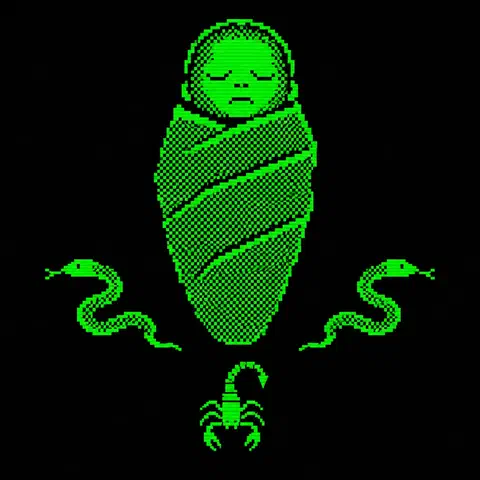
- Laozi wants to be “an infant that has not yet smiled” (Daodejing 20). That infant, he says, is the one “wasps, scorpions, vipers and snakes do not sting” (Daodejing 55, in the received text and the Mawangdui silk manuscript).
- The sages’ knowing, in the same Zhuangzi chapter, “is more grievous than the scorpion’s tail”. In Daoist China, knowledge is a sting.
- The Zhuangzi and Huainanzi place the start of the decline under Fuxi, the serpent-bodied first king. “Knowing first began to dawn”, and later “mind came to know mind”.
- Laozi’s four reigns track Hesiod’s ages of man station by station. Both have a first age that does not grieve its dead, a mistimed infancy with lives cut short, and then a race of private minds and war.
- The Daoists told the Eve Theory’s sequence as their own history: a mind that was one, then a taught word for persons, then self-knowledge, and with it death. They counted it a Fall, as Genesis does.
我獨泊兮其未兆,如嬰兒之未孩。
“I alone am still, with no sign yet, like an infant that has not yet smiled.”
— Daodejing 20 (Wang Bi text)
What did Laozi say about the child who said “who”? #
The scene is in the “Turning of Heaven” (天運, Tianyun) chapter of the Zhuangzi, among the outer chapters compiled by Zhuangzi’s school in the late Warring States and early Han, around the 3rd century BCE. Confucius has just come back from visiting Laozi. For three days he does not speak. When his disciples press him, he says:
“Now at last I have seen a dragon. A dragon coils and is a body, uncoils and is a pattern; it rides the cloud-breath and feeds on yin and yang. My mouth fell open and I could not shut it.” (吾乃今於是乎見龍……予口張而不能嗋)
His disciple Zigong goes to see the dragon for himself. He tells the old man that the sage-kings of the past all ruled differently but all deserve their fame. Laozi tells him to come closer and gives him a different history, one king at a time (Zhuangzi, Tianyun):
“When the Yellow Emperor governed the world, he made the people’s hearts one. If a man’s parent died and he did not weep, no one blamed him.
When Yao governed the world, he made the people’s hearts kin-minded. If they graded their mourning by nearness of kin, no one blamed them.
When Shun governed the world, he made the people’s hearts compete. Pregnant women bore their children at ten months; the child could speak at five months; before it reached the first smile it began to say ‘who’; and then for the first time people died young.
When Yu governed the world, he made the people’s hearts change. Every man had a mind of his own, and taking up arms was called reasonable: ‘killing a robber is not killing a man.’ … The world was in uproar, and the Confucians and Mohists all arose.”
The Chinese of the central line is short and hard:
舜之治天下,使民心競,民孕婦十月生子,子生五月而能言,不至乎孩而始誰,則人始有夭矣。
Then Laozi gives his verdict on all of them:
“The knowing of the Three Sovereigns rebelled against the brightness of sun and moon above, went against the essence of hills and streams below, and broke the round of the four seasons between. Their knowing was more grievous than the scorpion’s tail. Not even the smallest beast could rest in the truth of its nature and its life, and still they thought themselves sages. Have they no shame?” (其知憯於𧓽蠆之尾)
Zigong stands there, the text says, unable to keep still.
What does “who” mean in the Zhuangzi? #
The key word is 誰, shui, “who”. It is the question word for persons. You can’t ask “who?” until you know that there are distinct persons and that one of them is the answer.
The Song encyclopaedia Taiping yulan (977–983 CE) quotes the passage with an old interlinear note that says this outright (Taiping yulan 360, 人事部一 · 孕):
誰者,別人之意。未孩已擇人言,競教速成。
“‘Who’ means telling people apart. Before it could smile it was already choosing among people’s words: competing to teach, they rushed it to completion.”
Three things stand in those two lines.
The word for persons is taught. Nothing in the passage grows by itself. Shun “made” (使) the hearts compete, the note says the children were taught (教之速, “they taught it fast”), and the teaching was a race. The person-word arrives from outside, from instruction.
It comes in order. First the mind is “one” and death is not mourned. Then comes the kin-mind, which ranks the dead by nearness. Then comes “who”, the word that tells one person from another. Then “every man had a mind of his own” (人有心). It runs from undivided, to kin, to persons, to private minds. That is a developmental sequence for the species, set out as four reigns.
It is mistimed. The baby says “who” before the first smile. 孩 is the infant’s first laugh or social smile: the Shuowen (100 CE) defines 咳 as “a small child’s laugh” and gives 孩 as its old form. Shun’s babies have the sorting word before they have the bond. The text treats the hurry as the crime, but the hurry only makes plain what is being taught: the word for persons and the mind that goes with it.
The Eve Theory of Consciousness holds that the inner “I” was discovered, and then taught, generation after generation, before it was ever innate. It also holds that person-words, the pronouns, spread with self-awareness itself. The Tianyun gives a Chinese school’s version of the same sequence: a person-word taught to children, and a people who were not like that before.
Why does early death come with the first “who”? #
The sentence ends 則人始有夭矣: “and then for the first time people died young”. 夭 is untimely death, a life cut off before its term. The Zhuangzi says it more than once. In the chapter “Mending Nature” (繕性, Shanxing) the first age is described this way (Zhuangzi, Shanxing):
“The ancients lived in the murk of chaos, and the whole age was at peace with them. In that time yin and yang were calm, ghosts and spirits did no harm, the four seasons kept their measure, the ten thousand things came to no hurt, and no living thing died young. Though men had knowing, they had no use for it. This is called the Utmost One.”
(古之人,在混芒之中……羣生不夭,人雖有知,无所用之,此之謂至一。)
Then the decline begins, and it begins with a serpent:
“Virtue declined, until Suiren and Fuxi first took the world in hand … Virtue declined further, until Shennong and the Yellow Emperor … Virtue declined further, until Tang and Yu [Yao and Shun] … Then men left their nature and followed the mind. Mind came to know mind (心與心識), and knowing was not enough to settle the world, so they added letters to it and enlarged it with learning.”
Fuxi is the serpent-bodied first king, paired with the serpent-bodied Nüwa on Han tomb reliefs. The Huainanzi, presented to the Han throne in 139 BCE, tells the same decline in the same order and is plainer still about what happened under him (Huainanzi 2, Chuzhen):
“When the age declined and came to Fuxi … then knowing first began, dimly, to dawn: all of them wanted to leave their childlike, unopened mind, and woke up to look about between heaven and earth. So their virtue became troubled and could no longer be one.”
(知乃始昧昧晽晽,皆欲離其童蒙之心,而覺視於天地之間)
The mind before the Fall is a child’s mind, 童蒙, “childlike and unopened”. The Fall is waking up and looking. Two chapters later the Huainanzi puts the price in a single line (Huainanzi 4, Zhuixing):
食穀者知慧而夭。
“Those who eat grain are knowing and wise, but die young.”
It is the same 夭 as the Zhuangzi’s. Knowing and early death come as a pair, and they come with the eating of a crop. Genesis tells it in the same order: “in the day that thou eatest thereof thou shalt surely die”, then “your eyes shall be opened”, then “in the sweat of thy face shalt thou eat bread, till thou return unto the ground” (Genesis 2:17, 3:5, 3:19, KJV).
Why should a word for persons bring death? The first reign answers. Under the Yellow Emperor, when hearts were “one”, a man did not weep for his dead parent and no one thought it wrong. Nobody had yet been sorted out as this person, so nobody could be lost as this person. Grief needs a “who”. Once there are persons there is a someone who ends. Early death in the Zhuangzi is the death that registers, the life that stops before its time because it is now somebody’s life. That is the oldest claim in the Fall: the creature that learns it is a self learns that it will die.
How close are Laozi’s four reigns to Hesiod’s ages of man? #
Strikingly close. Hesiod’s Works and Days, composed in Boeotia in central Greece around 700 BCE, tells the decline as a series of races. It’s Hard to Be God reads that series as the history of the self: a Golden race with no inner “I”, a Silver race in which the self was born badly, a Bronze race that turned it to war. Laozi’s four reigns run through the same stations in the same order.
The Golden race “lived like gods without sorrow of heart … and when they died, it was as though they were overcome with sleep” (Works and Days 112–116, Evelyn-White 1914). The Yellow Emperor’s people, whose hearts were “one”, did not weep when a parent died, and no one thought it wrong. Death without grief is the same mark on both first ages.
Then comes the Silver race:
ἀλλ᾽ ἑκατὸν μὲν παῖς ἔτεα παρὰ μητέρι κεδνῇ / ἐτρέφετ᾽ ἀτάλλων, μέγα νήπιος, ᾧ ἐνὶ οἴκῳ· / ἀλλ᾽ ὅτ᾽ ἄρ᾽ ἡβήσαι … / παυρίδιον ζώεσκον ἐπὶ χρόνον, ἄλγε᾽ ἔχοντες / ἀφραδίῃς
“A child was brought up at his good mother’s side an hundred years, an utter simpleton [mega nēpios], playing childishly in his own home. But when they were full grown … they lived only a little time in sorrow because of their foolishness, for they could not keep from sinning and from wronging one another.” (Works and Days 130–135, Evelyn-White 1914)
Nēpios is the Greek word for an infant too young to speak, “not-word”. Hesiod’s Silver men stay speechless babies too long; Shun’s babies are made to speak too soon. The faults run in opposite directions, but the two texts set the same two things side by side: a mistimed passage into speech, and lives cut short (Hesiod’s παυρίδιον, Zhuangzi’s 夭). In both, the trouble sits in the infancy and with the mother. Hesiod’s child is kept “at his good mother’s side”; Shun’s reform begins with “pregnant women” and their ten-month children.
The Bronze race “loved the lamentable works of Ares and deeds of violence” (Works and Days 145–146). Under Yu “every man had a mind of his own, and taking up arms was called reasonable: ‘killing a robber is not killing a man’”, and “the world was in uproar”. Once there is a private mind, there is a war.
| Station | Hesiod, Works and Days (Greece, c. 700 BCE) | Laozi in the Zhuangzi, Tianyun (China, 3rd c. BCE) |
|---|---|---|
| The first age | Golden race: “without sorrow of heart”; death “as though overcome with sleep” | Yellow Emperor: hearts “one”; no weeping for a dead parent |
| The turn | — | Yao: the kin-mind; mourning graded by nearness |
| The mistimed infancy | Silver race: a hundred years a speechless nēpios at his mother’s side, then “only a little time” | Shun: speech at five months, “who” before the first smile, and “people first died young” |
| The armed mind | Bronze race: “the lamentable works of Ares and deeds of violence” | Yu: “every man had a mind of his own”; arms called reasonable; the world in uproar |
| The verdict | “Would that I were not among the men of the fifth generation” (174–175) | “Their knowing was more grievous than the scorpion’s tail” |
Plato’s Statesman has a god who “himself was their shepherd” in the first age, before men had to rule themselves (271e). Laozi’s first kings rule the same way: they make the people’s hearts, and the people do not yet have hearts of their own. Three texts from opposite ends of Eurasia tell the coming of the self as a fall from a first age through a disastrous childhood into private minds and war. That is the order the Eve Theory gives, and the order the Daoists gave first in the reigns of kings.
Which infant do snakes not bite? #
Now turn to Laozi himself. The Daodejing returns to the infant again and again as the state to recover. Chapter 10: “Concentrating the breath, reaching utmost softness: can you be an infant?” Chapter 28: “Know the male, keep to the female … and return to being an infant” (知其雄,守其雌……復歸於嬰兒). Chapter 20 names the exact stage. While the crowd feasts and climbs terraces in spring, Laozi says:
“I alone am still, with no sign yet, like an infant that has not yet smiled.” (如嬰兒之未孩)
It is the same 孩, the first smile, that Shun’s babies never reached before they said “who”. The two texts mark the same point in the cradle. The Zhuangzi says the Fall happened before it, and the Daodejing says the sage goes back to it. Wang Bi (226–249 CE), whose commentary fixed the received text, glosses the feasting crowd as men whose “desire to advance makes their hearts compete” (欲進心競). That is the very 心競 Shun gave his people. He glosses Laozi’s “fool’s heart” in the next line as a heart that “divides and sorts nothing” (心無所別析): no telling apart, no “who” (Wang Bi, Daodejing 20).
Then chapter 55 says what that infant is safe from:
“One who holds virtue in fullness is like a newborn. Wasps, scorpions, vipers and snakes do not sting him; fierce beasts do not seize him; birds of prey do not strike him. His bones are soft, his sinews supple, yet his grip is firm. He does not yet know the joining of female and male, yet his member stirs: that is the height of essence. He howls all day and is never hoarse: that is the height of harmony.”
(含德之厚,比於赤子。蜂蠆虺蛇不螫,猛獸不據,攫鳥不搏……)
This is not a late gloss. The line stands in the Mawangdui silk manuscript, buried around 168 BCE: 蜂蠆虺蛇弗螫, “wasps, scorpions, vipers and snakes do not sting” (Mawangdui text). Wang Bi explains why:
赤子無求無欲,不犯眾物,故毒蟲之物無犯之人也。
“The newborn seeks nothing and desires nothing. It offends no creature, and so poisonous creatures do not offend it.”
The Huainanzi sets the same immunity at the start of history. In the age of Rongcheng, before the decline, “they left their babies in nests … tigers and leopards could be followed by the tail, and vipers and snakes could be trodden on, and no one knew why it was so” (虺蛇可蹍, Huainanzi 8, Benjing). The same chapter goes on to the sowing of grain, the digging of wells, the penning of beasts and the invention of writing, when “Heaven rained grain and the ghosts wailed at night”.
So there are two figures, and they face each other.
- The unsmiling infant. It has no “who”, no desire and no knowledge of the sexes, and the snake will not bite it.
- The sage-king’s knowing. It is “more grievous than the scorpion’s tail”.
The scorpion’s 蠆 is the same character in both places: the creature that will not sting the infant is the creature whose sting knowledge outdoes. The Daoist texts put knowing and venom on the same side of the line, and the child before the first “who” on the other.
That is the frame this site gives the serpent’s gift: the fruit of knowledge was a venom, and the bite and the waking are one event. Read the Daodejing that way and the chapters fit together. The sage has gone back behind the bite. He stands where the snake has no business with him, because there is no one there for it to wake.
How do the Daoist classics tell the Fall? #
The decline of minds is not one fable. It runs through the Daoist corpus in several tellings, and they agree on its stages.
| Text (date) | The first state | What breaks it | What follows |
|---|---|---|---|
| Zhuangzi, Tianyun (3rd c. BCE) | Hearts “one”; no weeping for a dead parent | Shun teaches children to say “who” before the first smile | “People first died young”; “every man had a mind of his own”; knowing worse than a scorpion’s sting |
| Zhuangzi, Shanxing (3rd c. BCE) | “Utmost One”: no creature died young; knowing had no use | Decline from Suiren and Fuxi to Yao and Shun | “Mind came to know mind”; letters and learning added |
| Zhuangzi, Mati (3rd c. BCE) | People lived among the beasts, “alike in not-knowing”; no telling gentleman from petty man | The sages bring benevolence and right | “The world first began to doubt … first began to divide” |
| Zhuangzi, Ying diwang (4th c. BCE) | Hundun, the Emperor of the Centre, with no openings | Shu and Hu bore seven holes, “to see, hear, eat and breathe” | “On the seventh day Hundun died” |
| Huainanzi 2 (139 BCE) | “The childlike, unopened mind” | Under Fuxi, “knowing first began to dawn”; people “woke up to look” | Shennong and the Yellow Emperor “bored openings into heaven and earth” |
| Huainanzi 8 (139 BCE) | Babies left in nests; vipers could be trodden on | Grain, wells, herding, writing | “The ghosts wailed at night” |
| Huainanzi 4 (139 BCE) | Those who eat breath live long; those who do not eat are gods | Eating grain | “Knowing and wise, but die young” |
| Daodejing 20, 52, 55 (4th–2nd c. BCE) | The infant “not yet smiled”; the newborn snakes will not sting | Opening the “openings”, pursuing affairs | “To the end of your life you cannot be saved” |
The Zhuangzi’s “Horses’ Hooves” (馬蹄, Mati) chapter gives the flavour of the first state: “In the age of perfect virtue men lived together with the birds and beasts … alike in not-knowing, their virtue did not leave them … how would they know gentleman from petty man?” (同乎无知……惡乎知君子小人哉). Then the sages came, “and the world first began to doubt … and the world first began to divide” (天下始疑矣……天下始分矣) (Zhuangzi, Mati). Doubt and division are where it starts. “Who” is the question that divides.
The serpent stands at the hinge more than once. In two tellings the decline opens under Fuxi. The Liezi, a received text of about the 4th century CE, says that “Fuxi, Nüwa, Shennong and the lord of Xia had snake bodies and human faces … shapes that were not human, and the virtue of great sages”. These “divine sages of high antiquity knew the dispositions of all things and understood the voices of every other kind”. Meanwhile the tyrants who came later “had faces and seven openings just like men, and the hearts of beasts” (Liezi, Huangdi). The snake-bodied pair are the teachers of a lost knowledge, and the seven openings belong to the fallen.
What do Hundun’s seven openings have to do with it? #
The last story of the Zhuangzi’s inner chapters is the shortest Fall in literature (Zhuangzi, Ying diwang):
“Shu and Hu planned how to repay Hundun’s kindness. ‘All men have seven openings, to see, hear, eat and breathe. He alone has none. Let us try boring them.’ Each day they bored one opening. On the seventh day Hundun died.”
(人皆有七竅,以視聽食息,此獨无有,嘗試鑿之。日鑿一竅,七日而渾沌死。)
Hundun is the sealed first being, and his opening is a gift that kills. He belongs to a world-wide family of sealed first humans. That family, from the Mandaean Adam who “had not opened his mouth” to the Arrernte first people cut open with a stone knife, is the subject of The First Man Was Sealed, and the Australian rite that re-stages it is told in The Mouth Is Opened Twice and on the Bullroarer Atlas.
What the Daoists add is the instruction to reverse it. Daodejing 52:
“The world had a beginning, and it is the Mother of the world. Once you have the mother, you know the child; once you know the child, go back and keep to the mother, and to the end of your life you are in no danger. Stop up the openings, shut the doors, and to the end of your life you will not toil. Open the openings, pursue affairs, and to the end of your life you cannot be saved.”
(塞其兌,閉其門,終身不勤。開其兌,濟其事,終身不救。)
Chapter 56 repeats it: “Those who know do not speak; those who speak do not know. Stop up the openings, shut the doors” (知者不言,言者不知。塞其兌,閉其門). Hundun was killed by having his openings bored, and the sage is told to stop his own. The mother comes before the child, and the way back runs through her.
Can the taught self be taken off again? #
The Daoists did more than mourn the first mind. They gave instructions for getting back to it, and the instructions read as a self being taken apart in the reverse of the order it was put together.
In “Making All Things Equal” (齊物論, Qiwulun), Ziqi of the southern wall sits leaning on his armrest, looks up and breathes out, “slack, as if he had lost his other half” (嗒焉似喪其耦). His student asks what has happened, and he says: “Just now, I lost me” (今者吾喪我). Then he explains it with a picture of sound. “The great clod belches out breath, and its name is wind. As long as it does not blow, nothing happens; when it blows, the ten thousand openings howl” (作則萬竅怒呺) (Zhuangzi, Qiwulun). Openings are where the voice comes from, and the one who has lost his “me” listens to the wind playing through them.
In “The Great Ancestral Teacher” (大宗師, Dazongshi), Yan Hui tells Confucius he has forgotten benevolence and right, then rites and music, and finally that he “sits and forgets” (坐忘): “I let my limbs drop, dismiss hearing and sight, leave my form and cast off knowing, and become one with the Great Thoroughfare” (墮枝體,黜聰明,離形去知,同於大通). The pupil becomes the master, and Confucius asks to follow him (Zhuangzi, Dazongshi).
Put the pieces in order. The Fall went from one heart, to telling people apart, to mind knowing mind, to the openings bored. The way back goes through losing the “me”, shutting the openings, dismissing sight and hearing, and becoming the infant who has not yet smiled. A tradition that thought the self was simply human nature would have no use for that ladder. The Daoists treat the self as a thing that was put on, and so a thing a disciplined man can take off.
What do real babies do before the first smile? #
Here the old texts and the nursery agree on the order of events. Infants give the first social smile at around six to eight weeks (CDC developmental milestones). They recognise themselves in a mirror at around eighteen to twenty-four months (Amsterdam 1972), and the first-person pronouns and the question “who?” come in the second and third years. The Han ritual lore quoted in the same Taiping yulan chapter knows the slow order. “When a person is first born he lacks five things: his eyes do not see, he cannot eat, cannot walk, cannot speak, cannot transform … At three years the fontanelle closes, and then he can speak.” It also knows that girls run ahead at every stage it names: teeth at seven months against eight, milk teeth lost at seven years against eight, “transformation” [puberty] at fourteen against sixteen (Taiping yulan 360, quoting the Kongzi jiayu).
Against that measure Shun’s five-month-old who says “who” is a prodigy and a warning. Each child goes through the whole history in its first years. It starts at the “one” heart, with no “who” and no death. Then it takes the word for persons from the people who teach it, and with that it finds out who it is and that it will die. The Daoist classics wrote that history down as the reigns of kings, and they put the serpent at both ends of it. The snake-bodied first king was on the throne when knowing dawned, and the snake still will not bite the newborn who has not yet learned to ask “who”.
Sources #
Primary texts (all quoted from the Chinese; translations are the author’s)
Zhuangzi 莊子: 應帝王 Ying diwang; 齊物論 Qiwulun; 大宗師 Dazongshi; 馬蹄 Mati; 天運 Tianyun; 繕性 Shanxing. Chinese Wikisource. Inner chapters 4th c. BCE; outer chapters 3rd–2nd c. BCE. A public-domain English version is James Legge, The Texts of Taoism, Sacred Books of the East 39–40 (Oxford, 1891).
Daodejing 道德經, with Wang Bi’s commentary (3rd c. CE): Wang Bi text. Mawangdui silk manuscripts A and B (tomb closed c. 168 BCE), collated text: 老子 (帛書校勘版).
Liezi 列子 (received text c. 3rd–4th c. CE): 黃帝篇.
Taiping yulan 太平御覽 (977–983 CE), juan 360, 人事部一 (叙人; 孕), quoting the Zhuangzi with an old interlinear note and the Kongzi jiayu: 卷0360.
Genesis 2–3, King James Version.
Hesiod, Works and Days, trans. Hugh G. Evelyn-White (Loeb, 1914), Project Gutenberg. Greek text: Perseus.
Plato, Statesman 271e.
Secondary
- Centers for Disease Control and Prevention, “Milestones in Action: by 2 months”.
- Beulah Amsterdam, “Mirror self-image reactions before age two”, Developmental Psychobiology 5 (1972): 297–305, doi:10.1002/dev.420050403.