Snake Cult / The swallowed hero
Bald from the Belly
Heracles, a Cherokee hunter, and thirty-odd other heroes come out of the monster without their hair.
Enter the belly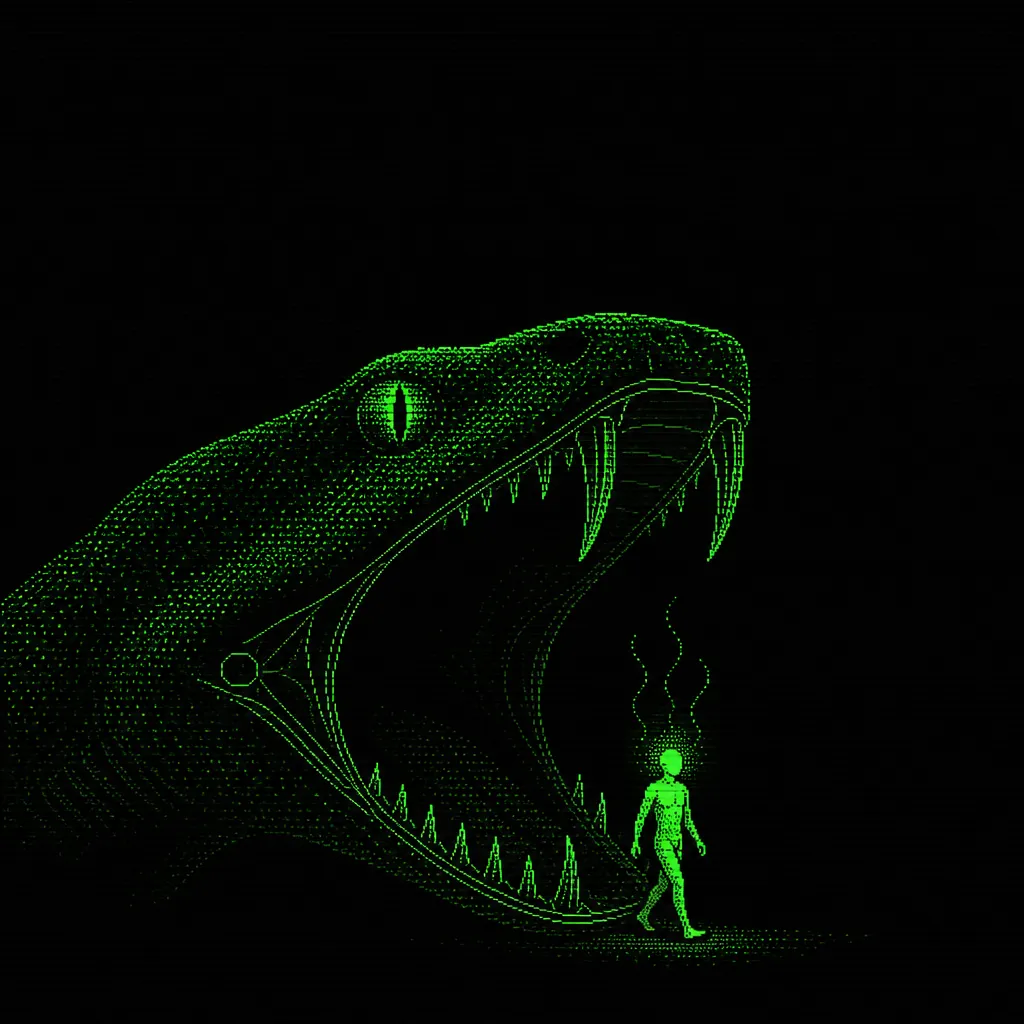
TL;DR
- In one Greek telling, Heracles kills the sea monster of Troy from inside its belly and comes out bald. Swallowed heroes in the Torres Strait, among the Cherokee, and on the British Columbia coast leave the belly the same way.
- Leo Frobenius (1904) judged this “crazy ending” too strange to have been invented twice. Berezkin’s motif catalogue now lists thirty-five bald exits, and later Jewish legend gives Jonah the same fate.
- The bald exits cluster on the Northwest Coast, in lowland South America, and in Oceania, with a thin trail across Eurasia to Greece.
- Frobenius read the lost hair as the sun’s rays. The tellers and the rites point to initiation, where boys are swallowed by a monster whose voice is the bullroarer and come back shorn.
Why did Heracles come out of the sea monster bald? #
Heracles spent three days inside the monster that came for Hesione. He had leapt into its open mouth on the beach at Troy, where King Laomedon had chained his daughter as an offering to Poseidon, and he cut the creature apart from within. Lycophron, a Hellenistic poet of the third century BC, tells the scene in his riddling Alexandra:
… the lion that was begotten in three evenings, whom of old Triton’s hound of jagged teeth devoured with his jaws. But he, a living carver of the monster’s liver, seething in steam of cauldron on a flameless hearth, shed to ground the bristles of his head.
Most ancient writers have Heracles fight the monster from the shore with arrows or a club. Theoi’s dossier on the Trojan ketos collects them. The swallowing is old all the same: a note on the Iliad, citing the fifth-century mythographer Hellanicus, says Heracles went in through the mouth into the monster’s belly and destroyed its flanks. Hellanicus, FHG I, fr. 136. The baldness first appears in Lycophron. John Tzetzes, a Byzantine scholar of the twelfth century AD, explained the poem line by line. Heracles, he says, “leapt all at once into its mouth,” cut it apart from within for three days, and came out “having lost even the hair of his own head,” because of the heat and moisture of the entrails. Tzetzes on Alexandra 33–37, ed. Scheer, vol. 2, pp. 28–30.1
No ancient author says why the strongest of the Greek heroes should come out of his victory with a bare scalp.
Where the hero comes out bald #
Heracles has company. The folklorists Yuri Berezkin and Evgeny Duvakin have built a catalogue of mythological motifs across nearly a thousand traditions. Their motif K8A, “Jonah: swallowed by monster,” covers anyone who enters the belly of a water or chthonic creature and kills it from inside or escapes. The Russian definition adds that, on leaving the belly, the hero “often turns out to be bald.” Berezkin & Duvakin, K8A. Stith Thompson’s Motif-Index of Folk-Literature gives the detail its own number, F921, “Swallowed person becomes bald.” Thompson, section F.
About 270 traditions in the catalogue tell the swallowing story. Thirty-five send the hero out bald. With Jonah, whose hair falls out in later Jewish legend, the map shows thirty-six.
01 / The crazy ending
Where the hero comes out bald
Select a point to read its version. Arrow keys step between points.
- Comes out bald (36)
- Fire lit inside
- Heart or liver cut
- Named anchor
- Other swallowed-hero tales
Data table: the bald versions (36)
| People | Region | Story | Source |
|---|---|---|---|
| Bena-Lulua (Kasai) | Bantu Africa | Kalulu Kadimuke is swallowed by the ogre Tshilumi-Tshikuru and cuts a hole with his razor; he and everyone inside emerge stripped of hair and scalp. | Frobenius 1983: 158 |
| Ancient Greece (Troy) | Aegean (Troy) | Heracles leaps into the sea-monster (ketos) sent against Troy, tears out its innards from within, and the heat burns off his hair. | Lycophron, Alexandra 31–37 and scholia |
| Hebrew Bible (Jonah) | Near East | Jonah is swallowed by a great fish and vomited onto dry land after three days. The Bible has no fight; later Jewish legend says the heat of the belly burned his garments and made his hair fall out. | Jonah 1–2; Ginzberg 1913, IV: 252 |
| Georgian | Caucasus–Asia Minor | Amiran is swallowed by a black dragon, cuts it open from inside and comes out without hair, beard or moustache; the god Igri makes him new hair. | Dzhanashvili 1903: 160–61 |
| Tuvan | South Siberia–Mongolia | A hero is carried into a six-headed monster; the people swallowed before him come out of its belly bald, and a lama regrows their hair. | Khabunova 2017: 97–117 |
| Walman (Sepik coast, PNG) | Melanesia | A diving boy is swallowed by a fish, cuts out with a bamboo blade, is washed in hot water and goes bald. | Becker 1971, no. 56: 814–15 |
| Badu (Torres Strait) | Melanesia | Mutuk is swallowed by a shark, cuts out with the shell knife behind his ear when it strands on Boigu, and finds his hair has fallen out. | Haddon 1890: 56–60 |
| Hawaii, Oahu (Kaulu) | Micronesia–Polynesia | Kaulu tears open the jaws of the shark chief; his brother Kaeha comes out with his hair all worn away. | Beckwith 1940: 437 |
| Hawaii (Kukuipahu) | Micronesia–Polynesia | Kukuipahu of Hawaii is swallowed by a shark, lives inside it for days and comes ashore at Hana with all his hair worn off. | Beckwith 1940: 132–33 |
| Tuamotu | Micronesia–Polynesia | Tangaroa is swallowed by a whale, cuts it open from inside and emerges bald, then reaches the island of women. | Beckwith 1940: 503 |
| Nootka (Nuu-chah-nulth) | Northwest Coast | Kwatyaht and his brothers train in a cooking box as hot as the monster’s belly, let Canoe-swallower take them, cut out its heart, and come out bald because they had not bathed their heads in the hot water. | Boas 1895: 101–02; Sapir & Swadesh 1939: 38–39 |
| Comox | Coast–Plateau | Mink is swallowed by a whale, lights a fire to roast herring, cuts its throat, and is found bald from the heat. | Boas 1895: 75 |
| Quileute | Coast–Plateau | Raven lets a whale swallow him and cuts it from inside; when people butcher the stranded carcass he comes out bald. | Andrade 1931, no. 16: 45–47 |
| Tututni | Coast–Plateau | The trickster jumps into a whale and lives inside it for five years, losing his hair and skin, then cuts out with the knife from his ear. | Farrand 1915, no. 18: 233–38 |
| Coquille | Coast–Plateau | Coyote rides inside a stranded whale and comes out bald and blind. | Jacobs 2007: 159–72 |
| Coast Salish (Cowichan) | Coast–Plateau | Two boys are swallowed by a whale; it is so hot inside that they lose all their hair before people cut them out. | Boas 1895: 51 |
| Hupa | California | A ruined gambler throws himself into a lake and is swallowed; he is found on the shore naked and bald. | Curtis 1924, vol. 13: 183–84 |
| Clallam | Coast–Plateau | Kekaiyash is swallowed by a whale with his canoe, cuts off its heart and comes out bald when people butcher the carcass. | Gunther 1925: 145 |
| Lillooet | Coast–Plateau | A whale swallows a canoe; old Kutler lights a fire, renders the fat and cuts out the heart; the swallowed come out bald, which is why people go bald. | Elliott 1931: 177–78 |
| Pech | Honduras–Panama | The hunter Setuska is swallowed by a river serpent, kills it as it nears the shore, and comes out bald; in a variant he cuts out its heart. | Flores 1989: 36–40 |
| Cherokee | US Southeast | The great fish Dakwa swallows a man in the Tennessee River; he cuts out with a mussel shell, but the juices have scalded off his hair for good. | Mooney 1900: 320–21 |
| Canelo (Kichwa) | Western Amazonia | A man swallowed by a serpent (his transformed brother) cuts its heart and comes out bald, dying soon after. | Coloma et al. 1986: 77–79 |
| Coreguaje | Western Amazonia | A swallowed man comes out bald. | Jimenez 1989, no. 25: 54 |
| Witoto | Northwest Amazonia | A father leaps into the serpent that ate his daughter, slits its belly with a shell, and comes out bald; his daughters give him leaf wings. | Preuss 1921, no. 5: 64–65 |
| Yagua | Northwest Amazonia | A man falls into an anaconda and finds a deer inside; both go bald before they cut out with piranha teeth. | Payne 1992: 172–85 |
| Cuiva | Llanos | A youth swallowed by the water monster oyoyota cuts its side with the shell of a swallowed turtle and returns to his mother bald. | Wilbert & Simoneau 1991, no. 130: 195–96 |
| Mestizos (Leticia) | Northwest Amazonia | A fisherman swallowed by a serpent cuts his way out after two weeks and is found completely bald. | Rodríguez de Montes 1981, no. 5C: 97–98 |
| Yaruro (Pumé) | Llanos | The water serpent Po Ana swallows two brothers; they cut through its side and come out bald and skinless. | Wilbert & Simoneau 1990, nos. 65–67: 92–97 |
| Yámana (Yaghan) | Southern Cone | Little Lasix leaps with a knife into a great “dolphin” (a pilot whale) and cuts it apart from inside. Boys about to be initiated in the kina find him in the beached carcass, bald; the men sprinkle charcoal on his head to regrow the hair. | Wilbert 1977, no. 40: 113–18; Gusinde 1937 |
| Mosetén | Bolivia–Guaporé | A man with a knife and maize is swallowed by a serpent, cuts its heart and exits through its side bald and white; genipa paint regrows his hair. | Nordenskiöld 1929: 146–47 |
| Chorote | Chaco | A water serpent swallows a man with a knife; he cuts its heart and comes out red and bald, unrecognised by his wife. | Wilbert & Simoneau 1985, no. 110: 217 |
| Warao | Guiana | A man swallowed by a water spirit comes out bald. | Wilbert 1970, no. 160: 342–43 |
| Pemon | Guiana | A man swallowed by a caiman cuts open its side and discovers while washing that he is bald; in other tales a shaman lights a fire inside the swallower. | Armellada 1947, no. 69; Armellada 1988, no. 35 |
| Maká | Chaco | A son-in-law swallowed by a serpent cuts its heart and comes out bald; his wife's comb makes the hair grow back. | Wilbert & Simoneau 1991, no. 79: 172–73 |
| Waiwai | Guiana | The furred serpent Uruperi swallows a man and spits him out; the heat inside has made him bald. | Fock 1963: 91–92 |
| Trio | Guiana | A drunk youth swallowed by an anaconda wakes from the heat, cuts his way out, and stays bald. | Magaña 1977, no. 78: 148 |
| Region | Examples | Typical swallower |
|---|---|---|
| North America | Nootka, Cowichan, Comox, Lillooet, Clallam, Quileute, Tututni, Hupa, Cherokee | Whale, giant fish |
| South America, from the Orinoco to Tierra del Fuego | Warao, Pemon, Trio, Witoto, Yagua, Canelo, Mosetén, Chorote, Maká, Yámana | Anaconda, water serpent, caiman, pilot whale |
| Oceania | Badu (Torres Strait), Walman (New Guinea), Tuamotu, Hawaii | Shark, whale |
| Old World | Greece, Georgia, Israel (Jonah in later legend), Tuva, Bena-Lulua (Kasai) | Sea monster, dragon, fish |
The bald exits wrap around the Pacific. They are thickest on the Northwest Coast and in the Amazon basin, with a scatter across Melanesia and Polynesia. West of the Pacific a thin trail runs through the Tuvans of southern Siberia to a pocket between the Black Sea and the Levant, where it reaches the Georgian hero Amiran, Jonah, and Heracles. One African version, from the Bena-Lulua of the Kasai, stands apart.
Across much of South America the swallower is a snake. A Maká man sent across a river for firewood by his father-in-law is swallowed by a water snake, cuts its heart, and comes out bald. His wife restores his hair with a comb her father gives her. The Greek ketos itself appears as a long, serpentine sea beast on the earliest vase that shows it. Boston MFA 63.420.
Swallowed and bald in the Torres Strait, Tennessee, and British Columbia #
In 1888 the anthropologist Alfred Haddon wrote down a story from the island of Badu, in the Torres Strait between Australia and New Guinea:
Once upon a time a Badu man named Mutuk was fishing in the sea off a rock, when his line fouled and he dived into the water to free it; a passing shark swallowed him (“swilled him down”) without hurting him.
The shark swam on northwards, and on passing over the reef of Mangrove I. Mutuk felt warm, and said to himself, “Now we are in shallow water.” When the shark plunged into deeper water Mutuk felt cold and knew they had descended again; later on the shark swam to Boigu and was left stranded on the reef by the receding tide. Mutuk felt the heat of the sun beating upon the body of the fish and knew that he was high and dry, so taking a sharp shell which he carried behind his ear, he hacked away at the belly of the shark until he had sufficiently ripped it open; on emerging from his strange prison he found all his hair had fallen off.
— Haddon, “Legends from Torres Straits,” Folk-Lore 1 (1890), p. 56
James Mooney heard the next one from the Cherokee storytellers Swimmer and Ta’gwadihi’. A great fish called the Dakwa’ lived in the Tennessee River where Toco Creek comes in. It rose under a war canoe and snapped up one of the men:
As soon as the hunter came to his senses he found that he had not been hurt, but it was so hot and close inside the Dakwa’ that he was nearly smothered. As he groped around in the dark his hand struck a lot of mussel shells which the fish had swallowed, and taking one of these for a knife he began to cut his way out … Reaching up he climbed out from the side of the fish, moving very carefully so that the Dakwa’ would not know it, and then waded to shore and got back to the settlement, but the juices in the stomach of the great fish had scalded all the hair from his head and he was bald ever after.
Franz Boas collected a third among the Cowichan of Vancouver Island. Two boys in a canoe shouted insults at a whale until it swallowed them, canoe and all. The whale told them they could eat its flesh but must not hurt its stomach. They were afraid it would carry them out to sea forever, so the elder had his brother lift him up, and he cut the stomach with their stone knife. The dead whale drifted to the mouth of the Cowichan River, where a man building a canoe heard voices singing from inside it: “Oh, we are sitting in the whale. Come and free us. It is so hot here that we are almost burned.” The boys’ father was among the people who came down to the beach. They cut the whale open, and the boys came out. “But it had been so hot in the whale’s stomach that they had lost all their hair.” Boas, Indianische Sagen (1895), p. 51.2
A little farther up the coast, the Comox told how Mink shouted “Phew, how you stink, Whale!” four times and was swallowed with his canoe. Inside he lit a small fire and dried herring on a rack until the heat made him sick. He cut the whale’s throat, rode the carcass ashore, and jumped out when the villagers opened its stomach, without a hair left on him (p. 75).
Frobenius and the “crazy ending” #
In 1904 the German ethnologist Leo Frobenius set these stories side by side. The second book of his Das Zeitalter des Sonnengottes (The Age of the Sun God), “The Sun God in the Belly of the Fish,” runs to over 160 pages of whale and dragon tales from the Solomon Islands, Tasmania, the Northwest Coast, the Zulu, Mongolia, Babylon, and Greece. Frobenius 1904, pp. 59–222. He broke the plot into parts and charted them on a fold-out plate: the swallowing, the sea voyage, the journey from west to east, the heart, the fire, the landing, the opening, the escape, and the hair (p. 193).
The hair convinced him. In his introduction he notes that in Northwest America, in the Torres Strait, and among the ancient Greeks, the tale closes with the same words: it was so hot in the animal’s belly that the hero’s hair fell out. “I must admit,” he writes, “that my mind cannot grasp how ‘chance’ could have produced the same crazy ending here” (denselben verrückten Schluß; p. 36). Anyone might imagine being eaten by a monster and escaping. Few would think to add that the hero lost his hair, and when the same unneeded detail turns up in three oceans, it is easier to believe the story traveled than that it was invented three times.
Frobenius also thought he knew what the story meant. He belonged to the last generation of the solar school, which read myths as encoded astronomy. His hero is swallowed in the west and released in the east, so he must be the sun, eaten by the sea at nightfall and reborn at dawn. The hair is the sun’s rays, full at sunset and missing when the sun lifts suddenly out of the ocean (pp. 194–95). Carl Jung borrowed the chart and gave psychology the phrase “night sea journey,” and Joseph Campbell made it “The Belly of the Whale,” a stage of The Hero with a Thousand Faces (1949).
The tellers never mention rays. When they explain the baldness they talk about heat, steam, and stomach juices. And the sun reading leaves the rest of the pattern unexplained. Suns do not find their parents inside the whale, train for the ordeal, or grow their hair back.
Inside the whale #
Edward Nelson recorded a Raven story on Bering Strait in the 1880s. Raven flies down a whale’s throat, carrying his fire-drill under his wing, and finds himself “at the entrance of a fine room, at one end of which burned a lamp”:
He went in and was surprised to see a very beautiful young woman sitting there. The place was clean and dry, the roof being supported by the whale’s spine, while its ribs formed the walls. From a tube that extended along the whale’s backbone, oil was dropping slowly into the lamp.
The woman is the whale’s soul, and she forbids him to touch the tube. When she leaves, Raven tears a piece from it. The light goes out and the room rolls wildly for four days until the whale dies, “for Raven had torn off a part of one of the heart vessels.” The carcass drifts ashore, the villagers cut a hole in its back, and Raven slips out while they carry the meat away.
In the Cook Islands, the missionary William Wyatt Gill wrote down the voyage of Rata’s canoe. A whale opens its jaws around the canoe, and the young Nganaoa, who has come on the voyage to find his lost parents, props the jaws open with his broken spear and jumps in:
… and looked down into the stomach, and lo! there sat his long lost father Tairitokerau and his mother Vaiaroa, who had been swallowed alive when fishing by this monster of the deep. … Breaking this prop into two pieces, he converted them into fire-sticks. He desired his father to hold firmly the lower one, whilst he worked assiduously with the upper stick, until at length the fire smouldered. Blowing it to a flame, Nganaoa set fire to the fatty portion of the stomach. The monster, writhing in agony, sought relief in swimming to the nearest land, where, on reaching the sandy beach, father, mother, and son quietly walked out through the open mouth of the stranded and dying whale.
— Gill, Myths and Songs from the South Pacific (1876), pp. 147–48
On Lake Superior, the Ojibwe hero Manabozho went fishing because his grandmother’s hair was “fast falling off” for want of fish oil. The King of Fishes swallowed him, canoe and all. He found his war-club and “immediately struck the heart of the fish,” wedged his canoe across its throat so he would not be vomited into the lake, and waited for the carcass to beach. Then “he heard birds scratching on the body, and all at once the rays of light broke in. He could see the heads of gulls, who were looking in by the opening they had made.” Schoolcraft, Algic Researches (1839), pp. 144–46. Longfellow put the scene into The Song of Hiawatha.
In the Finnish Kalevala, the old singer Väinämöinen stumbles into the mouth of the sleeping giant Antero Vipunen and builds a forge in his stomach:
With his shirt he made a smithy,
With his shirt-sleeves made his bellows,
With the fur he made the wind-bag,
With his trousers made the air-pipe …
He hammers night and day until the giant groans, “In my mouth the coals are rising, / On my tongue are firebrands resting.”
Heracles, carving the liver on his “flameless hearth,” belongs with them.
What the tellers say about the hair #
In the Nootka story Boas recorded, a whale in Barclay Sound called Swallower of Lashed-Together Canoes ate Kwo’tiath’s mother. Kwo’tiath boiled water in a great box and had his brothers jump in, and each said as he climbed out, “I wonder whether the whale’s belly is as hot as this water.” Then they let the whale take them, cut its entrails with mussel shells, and cut off its heart. When the animal-people opened the carcass on the beach, the brothers looked at each other and laughed. One of them had lost all his hair (Boas 1895, pp. 101–02). In Edward Sapir’s telling of the same story, the brothers who come out bald are bald because they “had not bathed their heads in hot water” while training in the cooking box. Sapir & Swadesh 1939, no. 5, p. 39.
The Georgian hero Amiran is swallowed by a black dragon and cuts his way out “alive and well, but he had lost his hair, beard, and moustache.” The god Igri makes him new hair. Dzhanashvili 1903, pp. 160–61. The Mosetén hero of the Bolivian lowlands comes out of a serpent “bald and white” and paints himself with genipa until the hair returns. The Chorote hero, swallowed by a water snake, “turned completely red and lost all the hair on his head.” Wilbert & Simoneau 1985, no. 110, p. 217. In Tuva, crowds of people emerge from the belly of the monster Mangys, and those swallowed longest are bald until a lama gives them medicine. The Lillooet end their version with a rule for everyone: since then, people go bald. Mutuk, sheltered for a month by the chief of Boigu and given three wives, finds that “his hair began to grow again.”
Jonah gets the same treatment in rabbinic legend. Louis Ginzberg’s Legends of the Jews describes the fish God made for him at the creation of the world:
He was so large that the prophet was as comfortable inside of him as in a spacious synagogue. The eyes of the fish served Jonah as windows, and, besides, there was a diamond, which shone as brilliantly as the sun at midday, so that Jonah could see all things in the sea down to its very bottom.
The fish shows him Leviathan, the river from which the ocean flows, Gehenna, and Sheol. Afterwards, “the intense heat in the belly of the fish had consumed his garments, and made his hair fall out, and he was sore plagued by swarms of insects. To afford Jonah protection, God caused the kikayon to grow up” (p. 252).3 The book of Jonah already dwells on his head: the plant grows as a shade “over his head,” and when it withers, “the sun beat upon the head of Jonah” (Jonah 4:6–8).
In each of these stories the person who comes out of the monster is marked by it, and the mark is later taken away.
Swallowed in the rite #
James Frazer collected the fullest accounts of the ritual from New Guinea. Among the Yabim, Bukaua, Kai, and Tami of the Huon Gulf, circumcision was “conceived … as a process of being swallowed and disgorged by a mythical monster, whose voice is heard in the humming sound of the bull-roarer.” The men built the monster:
For this purpose a hut about a hundred feet long is erected either in the village or in a lonely part of the forest. It is modelled in the shape of the mythical monster; at the end which represents his head it is high, and it tapers away at the other end. A betel-palm, grubbed up with the roots, stands for the backbone of the great being and its clustering fibres for his hair; and to complete the resemblance the butt end of the building is adorned by a native artist with a pair of goggle eyes and a gaping mouth. When after a tearful parting from their mothers and women folk, who believe or pretend to believe in the monster that swallows their dear ones, the awe-struck novices are brought face to face with this imposing structure, the huge creature emits a sullen growl, which is in fact no other than the humming note of bull-roarers swung by men concealed in the monster’s belly.
The boys lived for months inside the hut that was the monster’s belly. When they came home, the women wept “as if the grave had given up its dead.” The young men kept their eyes shut or sealed with chalk and seemed not to understand speech, and only the next day did they wash off “the crust of white chalk with which their bodies had been coated.”
On Ceram, in the Moluccas, boys entering the Kakian society were sometimes pushed through an opening “in the shape of a crocodile’s jaws or a cassowary’s beak, and it is then said that the devil has swallowed them.” They were dyed yellow “to give them the appearance of having been swallowed.” Afterwards their sponsors taught them to walk and eat “as if they were new-born children,” and for twenty or thirty days no woman could comb their hair. Then the high priest led them into the forest and cut “a lock of hair from the crown of each of their heads” (Frazer, pp. 249–51).
In Arnhem Land, the Yolŋu tell how the great python Yurlunggur swallowed the two Wawalag sisters and their children and vomited them up again. During initiation the men tell the women that the snake has swallowed the boys. Eliade, Rites and Symbols of Initiation (1958), pp. 48–50, after Ronald Berndt’s Kunapipi. The Bullroarer Atlas follows the same pairing of roaring board, swallowing monster, and reborn boys from Australia and New Guinea to Orphic Greece, the Kwakwaka’wakw Hamatsa of the Northwest Coast, and the yuruparí cult of the Northwest Amazon, whose charter myth has an anaconda swallow the novices.
Some of these rites survive. Among the Tikuna of the upper Amazon, a girl secluded at her first menstruation is besieged at the end of her seclusion by masked demons, while sacred trumpets that women may not see are blown outside her enclosure. At the climax of the festival her hair is plucked out by hand. Portal Amazônia. A bullroarer collected for the festival’s mask dance in 1929 was called mare, “great roar.” Bullroarer Atlas. In the 1930s, Lovedu boys in South Africa left the circumcision lodge with their heads shaved except for a crown, and the lodge was burned behind them, while at night herd boys whirled the bullroarer as the roar of a lion. Bullroarer Atlas, after Krige 1943. Ndembu men in Zambia told Victor Turner that the bullroarer of their Mukanda circumcision meant a monster had come to swallow the boys. Bullroarer Atlas, after Turner 1967. Xhosa initiates in the Eastern Cape still have their heads shaved and their bodies painted with white clay. Wikipedia, “Ulwaluko”.
Arnold van Gennep, who coined “rites of passage,” put the rule simply: “To cut the hair is to separate oneself from the previous world.” van Gennep, The Rites of Passage, pp. 166–67. The colour recurs as well. The New Guinea novices came home chalk-white, the Mosetén hero came out of the serpent bald and white, and Jean-Loïc Le Quellec, surveying the whale myths, found heroes who come out “bald, or … all white, or both” in both Americas, India, and Sumatra. Le Quellec 2017. The myth tells from inside the belly what the rite stages from outside.
What was the common root? #
The map shows that the bald hero traveled. It does not show where he started.
In 1929 the anthropologist Edwin Loeb made Frobenius’s argument about the rite instead of the myth. The initiations of Australia and New Guinea share a bullroarer forbidden to women, circumcision or other marks on the body, a devouring-monster drama, and men impersonating spirits. Loeb pointed out that “no psychological principle … would necessarily group these elements together,” and concluded that the bundle had “a common point of origin.” Loeb, Tribal Initiations and Secret Societies (1929), via the Bullroarer Atlas. The bald ending is a trait of the same kind. Being swallowed does not require losing your hair, and the regions where the bald hero clusters are regions where boys were swallowed in ritual.
Le Quellec, working from about 170 versions, traces the whale myth to Eurasia and reads the fire inside and the bald or white exit as signs of “a very old, prehistoric diffusion.” He suggests that the cut liver is older than the cut heart, which replaced it near Beringia; if so, Heracles carving the monster’s liver keeps the old form at the far western end of the range. Julien d’Huy places a water serpent at the base of his tree of dragon myths. d’Huy 2013. On that reading the whale is a coastal stand-in for an older swallowing snake, which in the Amazon stayed an anaconda. The Greek record fits a long transmission. Homer knows the monster at Troy but not the swallowing, Hellanicus has the swallowing in the fifth century BC, and Lycophron the baldness in the third. Frobenius wrote that the bald Heracles “stands alone” in European myth, a sign that the whole story had once been told in the Mediterranean (pp. 178–79).
That leaves the question of what cult swallowed boys and returned them as men from Arnhem Land to the Amazon to the Aegean. This site’s answer is the snake cult of consciousness, a serpent initiation voiced by the bullroarer that taught people to see themselves as selves. The case is made in The Snake Cult of Consciousness, in the Bullroarer Atlas and its essay on the swallowing complex, and on this site in The Bullroarer: A Global Marker of Cultural Diffusion and Male Initiation, The Serpent-Mother Who Swallows Souls, and Contra d’Huy on the African Root.
The bald man in the kina hut #
A red-figure cup painted by Douris around 480 BC shows the serpent that guarded the Golden Fleece disgorging a limp Jason while Athena watches. No surviving text tells that version. Douris kylix, Vatican 16545. The leader of the Argonauts, a crew of young men on their first great voyage, was swallowed by a snake and given back.
At the other end of the world, the Yámana of Tierra del Fuego told of Little Lasix, who leapt with his knife into the mouth of a great “dolphin” (the editor identifies it as a pilot whale) and cut it apart from inside, saving the heart for last. The carcass drifted ashore while the men were holding the kina, their secret ceremony. Two boys about to be initiated were sent to cut meat, and from inside the whale a voice begged them not to cut him. They found Little Lasix “pale and thin, bald, and near death.” The men carried him in secret to the kina hut, and there they sprinkled powdered charcoal on his bald head to make the hair grow back. Wilbert 1977, no. 40, pp. 113–18.
Methodology note #
The map plots the bald exits in Berezkin and Duvakin’s K8A, checked against Frobenius (1904), Thompson’s F921, and Beckwith’s Hawaiian Mythology (1940). The other layers show the whole K8A distribution and the fire motif L56. Coordinates are approximate group centroids. We read the Greek, Georgian, Chorote, Nootka, Cowichan, Comox, Cherokee, Yámana, and Torres Strait texts in the originals; several other South American entries rely on Berezkin’s summaries. Jonah’s hair comes from Ginzberg’s synthesis, whose primary source is unclear. Thompson’s F921 also cites an Irish case we could not trace, and Le Quellec’s Indian and Sumatran bald or white exits are not on the map.
Collection is uneven. Franz Boas worked intensively on the Northwest Coast, and Johannes Wilbert and Karin Simoneau compiled a long series of South American folk literatures, so those clusters partly reflect effort. The Arctic, Subarctic, and Plains samples are also large and tell the swallowing story often, but almost never send the hero out bald, so the bald clusters are more than a measure of collecting. Absent dots are not absent stories: much of Africa and Asia is thinly sampled for this motif.
Sources #
- Lycophron. Alexandra. Translated by A. W. Mair. Loeb Classical Library, 1921.
- Tzetzes, John. Scholia on Lycophron, in Eduard Scheer, ed., Lycophronis Alexandra, vol. 2. Berlin, 1908.
- Hellanicus, fr. 136, in Karl Müller, ed., Fragmenta Historicorum Graecorum, vol. 1. Paris, 1841. (= FGrH 4 F26b.)
- Haddon, Alfred C. “Legends from Torres Straits.” Folk-Lore 1 (1890): 47–81.
- Mooney, James. Myths of the Cherokee. Bureau of American Ethnology, 19th Annual Report, 1900.
- Boas, Franz. Indianische Sagen von der Nord-Pacifischen Küste Amerikas. Berlin: A. Asher, 1895.
- Frobenius, Leo. Das Zeitalter des Sonnengottes. Vol. 1. Berlin: Georg Reimer, 1904.
- Nelson, Edward W. The Eskimo about Bering Strait. Bureau of American Ethnology, 18th Annual Report, 1899.
- Gill, William Wyatt. Myths and Songs from the South Pacific. London: Henry S. King, 1876.
- Schoolcraft, Henry Rowe. Algic Researches. Vol. 1. New York: Harper, 1839.
- Kalevala: The Land of Heroes. Translated by W. F. Kirby. Vol. 1. London: Dent, 1907.
- Berezkin, Yuri, and Evgeny Duvakin. “K8A. Jonah: swallowed by monster” and “L56. Fire in monster’s belly.” Thematic Classification and Distribution of Folklore and Mythological Motifs by Areas.
- Thompson, Stith. Motif-Index of Folk-Literature, section F. Rev. ed., 1955–58.
- Beckwith, Martha. Hawaiian Mythology. Yale University Press, 1940.
- Sapir, Edward, and Morris Swadesh. Nootka Texts. Linguistic Society of America, 1939.
- Dzhanashvili, M. G. “Gruzinskoe predanie ob Amirane.” SMOMPK 32 (1903): 158–67.
- Wilbert, Johannes, and Karin Simoneau, eds. Folk Literature of the Chorote Indians. UCLA Latin American Center, 1985.
- Ginzberg, Louis. The Legends of the Jews, vol. 4. Jewish Publication Society, 1913.
- Frazer, James George. Balder the Beautiful. Vol. 2. The Golden Bough, 3rd ed., part 7. Macmillan, 1913.
- Eliade, Mircea. Rites and Symbols of Initiation. Harper, 1958.
- van Gennep, Arnold. The Rites of Passage. 1909; trans. 1960.
- Le Quellec, Jean-Loïc. “The Long Tale of a Whale.” In Sang-mog Lee, ed., Whale on the Rock. Ulsan Petroglyph Museum, 2017, pp. 9–43.
- d’Huy, Julien. “Le motif du dragon serait paléolithique.” Préhistoire du Sud-Ouest 21 (2013).
- Wilbert, Johannes, ed. Folk Literature of the Yamana Indians. University of California Press, 1977.
- Beazley Archive. “Douris kylix, Vatican 16545.”
- Campbell, Joseph. The Hero with a Thousand Faces. Pantheon, 1949.
Tzetzes explains Lycophron’s epithet “three-evening” (triesperos) by the three days in the belly, “evenings” because the belly is dark. The usual ancient explanation is the triple-length night in which Zeus fathered Heracles on Alcmene. The three days may be Tzetzes’ own inference from the epithet, perhaps influenced by Jonah. ↩︎
Boas’s 1895 collection is in German; the translations here are ours. The Cowichan are a Coast Salish people of southeastern Vancouver Island. ↩︎
Ginzberg’s note (vol. 6, p. 350) refers the hair to Ibn Ezra on Jonah 4:6, but the printed commentary there says only that Jonah’s skin had grown soft in the fish and could not bear the heat. The legend is attested in Ginzberg’s compilation; its earliest source remains to be found. ↩︎