~/mythology/dionysus
Bachofen, Mother Right: The 1861 Preface in English
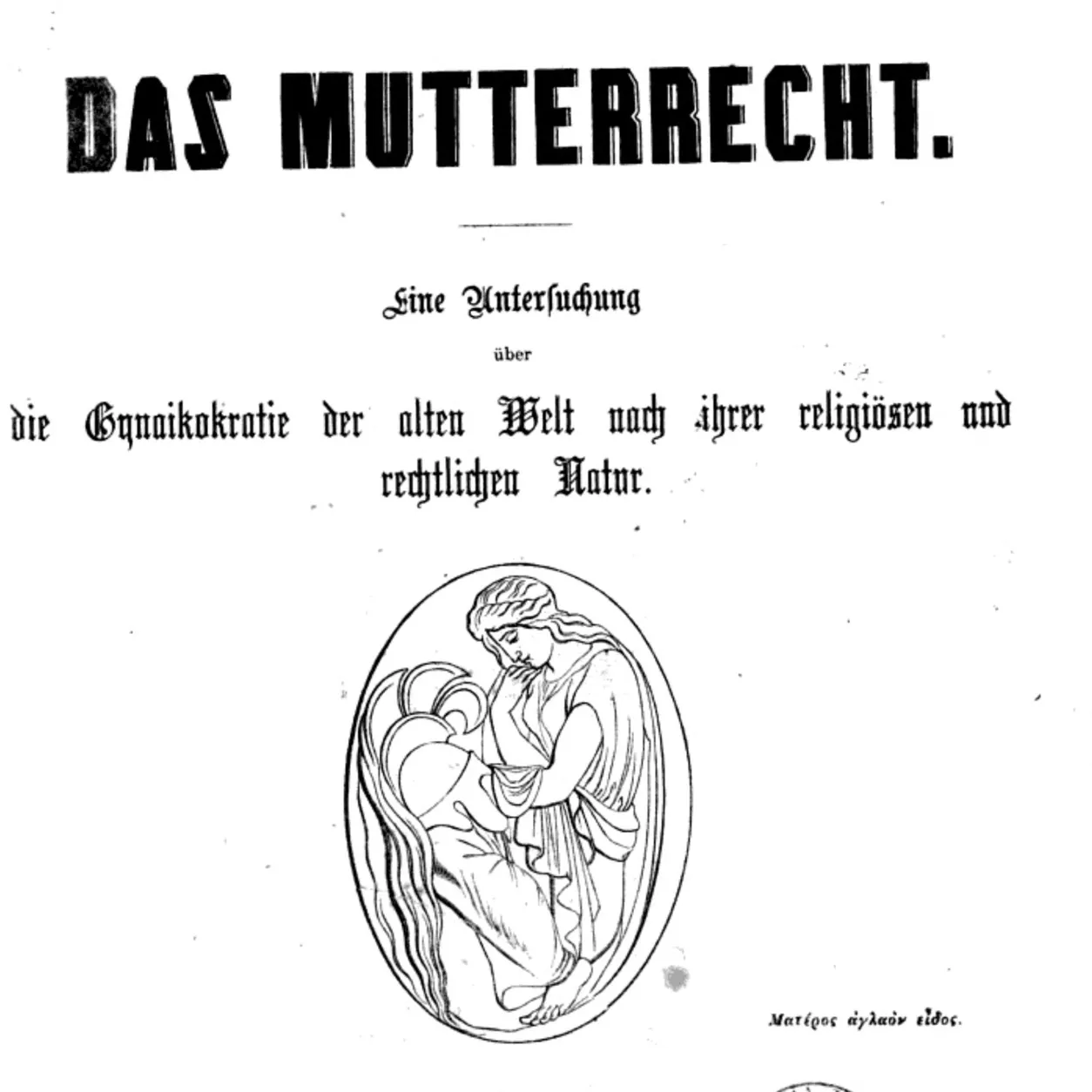
The whole Vorrede of Das Mutterrecht, translated from the first edition, with page numbers: mother right, the Amazons, and Dionysus as the founder of paternity.
TL;DR
- Das Mutterrecht (1861) argued that rule and descent through the mother came before father right across the ancient world. Its preface states the whole theory. This is the complete preface, pp. V–XXXIII of the first edition, in a new English translation with the page numbers marked.
- Bachofen’s history runs in stages: unregulated “hetaerism”, the Amazons’ armed revolt, Demetrian mother right with marriage and the mysteries, then father right.
- On p. XXII, “Dionysus appears at the head of the great fighters against mother right”. On p. XXIX he is “the founder of paternity”.
- Woman is the first bearer of religion, and mother right and the mystery are “twin siblings, always joined” (p. XV).
- Bachofen never mentions the bullroarer. Clement of Alexandria puts the rhombos among the toys of the child Dionysus, and Andrew Lang identified it as a bullroarer in 1884.
Dionysos erscheint an der Spitze der grossen Bekämpfer des Mutterrechts, insbesondere der amazonischen Steigerung desselben. “Dionysus appears at the head of the great fighters against mother right, and in particular against its Amazonian intensification.” — J. J. Bachofen, Das Mutterrecht (1861), p. XXII
Why does Bachofen’s preface matter for the bullroarer? #
Johann Jakob Bachofen (1815–1887) was a Basel jurist and historian of Roman law. His Das Mutterrecht put the idea of matriarchy into scholarship; Lewis Henry Morgan and Friedrich Engels built on it. He worked only from Greek and Roman texts, and he read their myths as memories of real events.
The story he drew from them is the story the bullroarer tells wherever it is still sacred. In Australia, New Guinea and the Amazon the men’s secret instrument is said to have belonged to women first, until men took it and made it death for a woman to see it (the bullroarer and male initiation). Bachofen has the same sequence without the instrument. Women hold religion and the mystery first: mother right and the mystery are “twin siblings, always joined” (p. XV). Then a male god breaks their rule. On p. XXII that god is Dionysus, and on p. XXIX the German calls him Begründer der Paternität, “the founder of paternity”.
The instrument was in that god’s mysteries. Clement of Alexandria lists the ῥόμβος (rhombos) among the toys with which the Titans lured the child Dionysus (Protrepticus 2.17–18), and Andrew Lang showed that the rhombos is the bullroarer (Custom and Myth, 1884, p. 39). Bachofen does not make this connection; it is ours. For the Ice Age end of the same chain see Cook and Lang on the Saint-Marcel pendant and Peyrony on the La Roche bullroarer; for the Great Mother’s own bullroarer see Cybele and the mystery cults.
Bachofen’s preface to Das Mutterrecht, complete #
The subject: mother right #
[p. V] The present treatise discusses a historical phenomenon that few have noticed and no one has investigated in its full extent. The study of antiquity up to now does not name mother right. The expression is new, and the state of the family that it denotes is unknown. To treat such a subject offers unusual difficulties beside unusual attractions. It is not only that preliminary work of any consequence is lacking: research up to now has done nothing at all to explain the period of culture to which mother right belongs. We are therefore entering a field that awaits its first clearing. We find ourselves carried back from the better-known ages of antiquity into earlier periods, from the world of thought that alone has been familiar to us until now into a wholly different, older one.
Those peoples with whose names the glory of ancient greatness is usually exclusively linked step into the background. Others, who never reached the height of classical culture, take their place. An unknown world opens before our eyes. The deeper we penetrate into it, the stranger everything around us becomes. Everywhere contrasts to the ideas of a more developed culture, everywhere older views, a world age with a stamp of its own, a civilization that can be judged only by its own fundamental law. The gynaecocratic family law stands as something foreign not only to our consciousness today but already to that of antiquity. Foreign and strange in its design, beside the Hellenic, appears that more original law of life to which mother right belongs, from which it arose, and from which alone it can be explained.
It is the highest aim of the following investigation to set out the moving principle of the gynaecocratic world age and to assign it its right relation, on the one side to lower stages of life, on the other to a more developed culture. My research thus sets itself a far more comprehensive task than the title chosen for it seems to announce. It extends over all parts of gynaecocratic civilization, seeks to determine its individual traits and then the fundamental idea in which they unite, and so to restore in recognizable form the picture of a stage of culture that was pushed back or wholly overcome by the later development of antiquity. The goal is set high. But only by the greatest widening of the field of view can true understanding be reached and scientific thought be carried through to that clarity and completeness which make up the essence of knowledge.
I will try to set out the development and scope of my ideas in outline, and so to prepare and ease the study of the treatise that follows.
Lycia, and what myth is worth as evidence #
Of all the reports that bear witness to the existence and inner structure of mother right, those concerning the Lycian people are the clearest and most valuable. The Lycians, Herodotus reports, named their children not after their fathers, as the Hellenes did, but exclusively after their mothers; in all genealogical statements they brought out only the maternal line of ancestors, and they judged the status of children exclusively by that of the mother. Nicolaus of Damascus completes this statement by stressing the exclusive right of daughters to inherit, which he traces to Lycian customary law, the unwritten law that, by Socrates’ definition, is given by the deity itself. All these customs are expressions of one and the same basic view. If Herodotus sees in them nothing more than an odd departure from Hellenic customs, observation of their [p. VI] inner connection must lead to a deeper understanding.
It is not disorder but system, not arbitrariness but necessity that meets us, and since any influence of positive legislation is expressly denied, the assumption of a meaningless anomaly loses its last appearance of justification. Beside the Hellenic-Roman father principle there stands a family law wholly opposed to it in its foundation as in its development, and by comparing the two the peculiarities of each are set in a still brighter light. This view is confirmed by the discovery of related conceptions among other peoples. To the exclusive right of daughters to inherit under Lycian law corresponds the equally exclusive duty of daughters to support aged parents under Egyptian custom, to which Diodorus bears witness. If this provision seems to complete the structure of the Lycian system, a report about the Cantabrians preserved by Strabo leads us to yet a further consequence of the same basic view: the giving in marriage and dowering of brothers by their sisters.
If all these traits unite in one common idea, they also contain a lesson of quite general significance. They establish the conviction that mother right belongs to no particular people but to a stage of culture; that consequently, because human nature is uniform and law-governed, it cannot be conditioned or limited by any kinship of peoples; and finally that it is less the sameness of the individual expressions than the agreement of the basic view that must be kept in sight. To this series of general points of view, consideration of Polybius’s reports on the hundred noble houses of the Epizephyrian Locrians, distinguished by maternal genealogy, adds two more, inwardly connected, whose correctness and significance prove themselves especially in the course of the investigation.
Mother right belongs to an earlier period of culture than the system of paternity; its full and undiminished flowering goes to decay with the victorious development of the latter. In agreement with this, gynaecocratic forms of life show themselves chiefly among those tribes that stand over against the Hellenic peoples as older races; they are an essential part of that original culture whose peculiar stamp is as closely bound up with the primacy of motherhood as that of Hellenism is with the rule of paternity. These principles, drawn from a small number of facts, gain unshakeable certainty in the course of the investigation from a mass of phenomena flowing in ever more abundantly. If the Locrians lead us to the Leleges, these are soon joined by the Carians, Aetolians, Pelasgians, Caucones, Arcadians, Epeians, Minyans and Teleboans, and among all of them mother right and the civilization resting on it come out in a great variety of individual traits.
The phenomenon of female power and greatness, the contemplation of which already roused astonishment among the ancients, gives each of the individual pictures of peoples, however peculiar its colouring may otherwise be, the same character throughout of archaic sublimity and of an originality wholly different from Hellenic culture. We recognize the fundamental idea which the genealogical system of the Naupactia, the Eoiai and the Catalogues follows; from which springs the union of immortal mothers with mortal fathers, the emphasis on the mother’s property, the mother’s name, and the closeness of siblings by the same mother; and on which, finally, rest the name “motherland”, the greater sanctity of female sacrifices, and above all the inexpiability of matricide. Here, where the point is not to state particulars but to bring out comprehensive points of view, the significance of mythical tradition for our investigation must be especially stressed.
The preferential connection of mother right with the oldest tribes of the Greek world means that precisely that first form of tradition gains special importance for knowledge of gynaecocracy, and likewise it can be expected from the outset that the place of mother right in myth will correspond to the high importance it holds in life as the centre of a whole culture. All the more pressing is the question what significance we are to assign, in our field, to that primal form of human tradition, and what use we are entitled to make of its testimonies. The answer is to be prepared by considering a single example belonging to the Lycian cycle of legend. Beside the wholly historical testimony of Herodotus, the mythical history of the kings offers a case of inheritance passed through the mother.
Not the sons of Sarpedon but Laodamia, the daughter, has the right to inherit, and she passes the kingdom to her son, who excludes his uncles. A story reported by Eustathius gives this system of inheritance a symbolic expression in which the basic idea of mother right can be recognized in its sensual sexuality. If [p. VII] the testimonies of Herodotus and Nicolaus were lost to us, the prevailing way of looking at things would first try to weaken Eustathius’s story with the objection that its authenticity cannot be shown from any older, let alone contemporary, sources; then its very enigmatic character would be put forward as proof that some silly mythographer invented it; and finally the fact around which the myth has formed like the shell around its kernel would, on the contrary, be presented as abstracted from the myth, and so as invented backwards out of it, and consigned as worthless sweepings to those useless notices whose daily growing number attests the destructive progress of the so-called critical sifting of the transmitted material.
Comparison of the mythical with the historical reports sets the whole wrongheadedness of this procedure in the clearest light. Confirmed by the test of historically established facts, the mythical tradition will have to be acknowledged as genuine testimony of primeval times, wholly independent of the influence of freely creating imagination, and Laodamia’s precedence over her brothers regarded as, by itself alone, sufficient attestation of Lycian mother right. There is hardly a trait belonging to the gynaecocratic system for which a similar test of truth is lacking, even if it cannot always be taken from the history of the same people. Indeed even the overall character that gynaecocratic culture bears is by no means without such a parallel: both are the result of the at least partial survival of mother right into late times.
In mythical and in strictly historical traditions the peculiarities of the same system meet us in agreeing form. Phenomena of the oldest time and phenomena of later, sometimes very recent periods stand side by side, surprise us by their harmony, and make us quite forget the wide intervals that separate them. What influence this parallelism must have on the whole way of regarding mythical tradition, how it makes the standpoint that present-day research takes toward it untenable, and deprives that in any case so wavering distinction between historical and prehistoric times of all justification precisely for the most important part of history, the knowledge of ancient views and conditions, needs no further exposition. Mythical tradition, so the question raised above is now answered, appears as the faithful expression of the law of life of those times in which the historical development of the ancient world has its foundations, as the manifestation of the original way of thinking, as direct historical revelation, and consequently as a true source of history, distinguished by high reliability.
Laodamia’s precedence over her brothers leads Eustathius to remark that such a favouring of the sons before the daughters is wholly contrary to Hellenic views. This remark deserves the more attention the later the source in which we meet it. Unlike the representatives of today’s criticism, the learned Byzantine does not let the anomaly that the legend seems to him to contain lead him to cast suspicion on what has been handed down, still less to alter it. This unexamining, believing subordination to tradition, often blamed as thoughtless copying, is the best guarantee of the reliability even of late reports. In all fields of the study of antiquity there prevails the same fidelity and exactness in holding fast and passing on the tradition, the same dread of laying sacrilegious hands on the remains of the earlier world.1
To it we owe the possibility of recognizing with certainty the inner constitution of the oldest time, and of following the history of the human world of thought back to those beginnings from which the later development arose. The slighter the bent toward criticism and subjective combination, the greater the reliability and the more remote the danger of falsification. For mother right in particular, myth offers yet a further guarantee of authenticity. Its opposition to the ideas of the later time is so deep and thoroughgoing that under the rule of those ideas an invention of gynaecocratic phenomena could not take place. The system of paternity follows a view to which the older law appeared as a riddle, and which was therefore incapable of giving rise to a single trait of the system of mother right.
Laodamia’s right of precedence cannot possibly have been invented under the influence of the Hellenic ideas which it contradicts, and the same holds of the countless traces of the same form of life that are woven into the primeval history of all ancient peoples, not excepting Athens and Rome, those two most decided representatives of paternity. Every age unconsciously follows, even in its poetic inventions, the laws of its own life. Indeed, so great is the force these exert that the natural tendency to reshape what is divergent in an earlier time after a new stamp will always assert itself. The gynaecocratic traditions have not escaped this fate. We shall [p. VIII] meet numerous cases in which the reaction of later views upon the remains of earlier ones, and the consequences of the temptation to replace the unintelligible with something intelligible in the taste of one’s own culture, come to light in very remarkable forms.
Old traits are driven out by new ones; the august figures of the gynaecocratic past are presented to contemporaries in the spirit of their own existence; harsh expressions are shown in a milder light; and along with the law, disposition, motives and passion too are judged from the standpoint now prevailing. Not seldom new and old stand side by side unreconciled; elsewhere the same fact, the same person appears in the double conception of the earlier and the later world, there guiltless, here criminal, there full of sublimity and dignity, here an object of abhorrence, and then the cause of a palinode. In other cases the mother gives way to the father, the sister to the brother, who now enters the legend in her place or alternating with her, the female name to the male; in a word, the consistency of the maternal conception gives way to the demands of the fully developed theory of paternity.
So, far from inventing in the spirit of an overcome and vanished culture, the later age will rather strive to extend the rule of its own ideas over facts and phenomena that stand strange before it. In this lies the highest warrant for the authenticity of all mythical traces of the gynaecocratic world age. They have the force of fully reliable proofs. In those cases that could not escape the reshaping influence of posterity, myth contains a source of still richer instruction. Since the alterations spring far more often from unconscious yielding to the ideas of the time, and only rarely and exceptionally from conscious hostility to the old, legend in its changes becomes the living expression of the stages of the people’s development, which it accompanies step for step, and for the capable observer the faithful mirror of all periods of life.
The position that the following investigation takes toward mythical tradition will now, I hope, appear as clear as it is justified. But the wealth of results to which it leads can be seen only from examining the particulars. Our modern historical research, directed with one-sided exclusiveness to establishing events, personalities and chronological relations, has, by setting up the opposition between historical and mythical time and by unduly extending the latter, assigned the study of antiquity a path on which deeper and connected understanding cannot be gained. Wherever we come into contact with history, conditions are such that they presuppose earlier stages of existence: nowhere a beginning, everywhere continuation; nowhere mere cause, always at the same time already effect.
Truly scientific knowledge does not consist only in answering the question What? It reaches completion only when it is able to discover the Whence? and knows how to join to it the Whither? Knowing is raised to understanding only when it can take in origin, progress and end. But the beginning of all development lies in myth. Every deeper inquiry into antiquity is therefore unavoidably led back to it. It is myth that carries the origins within it, myth alone that is able to unveil them. But the origins condition the later progress and give the line it follows its direction for ever. Without knowledge of the origins, historical knowledge can never arrive at inner completion.
That separation of myth and history, well founded so far as it is meant to denote the difference in the way what happened is expressed in the tradition, therefore has no meaning and no justification as against the continuity of human development. In the field of our research it must be given up entirely; the whole success of the investigation depends essentially on this. The forms of family law in the better-known ages of antiquity are not original conditions, but rather results of older stages of life that went before. Considered by themselves, they appear only in their actuality, not in their causality; they are isolated facts, and as such at most an object of knowing, never of understanding. The Roman system of paternity, by the strictness with which it appears, points to an earlier one that is to be fought and pushed back.
The lofty fatherhood, clothed with the purity of Apollonian nature, in the city of Athena, the motherless daughter of Zeus, appears no less as the summit of a development whose first stages must have belonged to a world of quite different ideas and conditions. How are we to understand the end if the beginnings are a riddle to us? But where can these be recognized? The answer is not in doubt. In myth, the faithful image of the oldest time; either here or nowhere. The need for connected knowledge has not seldom led to the attempt [p. IX] to give some satisfaction to the longing for knowledge of the origins by constructions of philosophical speculation, and to fill the great gaps that the system of the ages presents with the shadow-figures of an abstract play of the understanding.
A strange contradiction: to reject myth because it is poetic invention, and at the same time to give oneself up so confidently to one’s own utopia! The following investigation will carefully avoid all temptations of this kind. Cautiously, perhaps even too timidly, steering along the mainland, following every bend and bay of the shore, it avoids the high sea, its dangers and its accidents. Where no earlier experience is at hand, the particular must above all be examined. Only wealth of detail offers the necessary comparisons, and through them makes it possible to distinguish the essential from the accidental, the lawful and general from the local; it alone supplies the means of rising to ever more comprehensive points of view. Myth has been reproached with being like shifting sand and allowing no firm footing anywhere.
But this reproach falls not on the thing but on the way it is handled. Many-shaped and changing in its outward appearance, myth nevertheless follows definite laws, and is no less rich in sure and firm results than any other source of historical knowledge. The product of a period of culture in which the life of peoples has not yet departed from the harmony of nature, it shares with nature that unconscious lawfulness which the works of free reflection always lack. Everywhere system, everywhere connection, in all particulars the expression of one great fundamental law, which in the wealth of its manifestations possesses the highest warrant of inner truth and natural necessity.
The gynaecocratic world of thought #
Gynaecocratic culture shows the unity of one ruling idea in an especially high degree. All its expressions are of one cast and bear the stamp of a stage in the development of the human mind that is complete in itself. The primacy of motherhood in the family cannot be thought of as an isolated phenomenon. A civilization such as the flowering of Hellenism comprises is incompatible with it. The same opposition that governs the principle of paternity and that of mother right must necessarily pervade the whole shape of life surrounding each of the two systems. The first observation in which this consistency of the gynaecocratic world of thought proves itself lies in the precedence of the left side over the right. The left belongs to the female, passive power of nature, the right to the male, active one.
The part played by the left hand of Isis in the land of the Nile, which above all others does homage to mother right, is enough to make the connection clear. Other facts then stream in in great number and secure for it its full importance, universality, originality and independence of the influence of philosophical speculation. In manners and customs of civil and of cultic life, in peculiarities of dress and of the way the hair is worn, and no less in the meaning of particular expressions, the same idea always recurs, the major honos laevarum partium (the greater honour of the left side), and its inner connection with mother right. No less significant is a second expression of the same fundamental law: the primacy of night over the day that comes forth from her maternal womb. The opposite relation would run wholly counter to the gynaecocratic world.
The ancients already put the precedence of night on one line with that of the left, and both with the primacy of motherhood; and here too age-old manners and customs, the reckoning of time by nights, the choice of night-time for battle, for counsel and for giving judgment, the preference for darkness in cultic practices, show that we are dealing not with abstract philosophical ideas of late origin but with the reality of an original way of life. Pursuing the same idea further lets us make out from afar, as a necessary peculiarity of the pre-eminently maternal world period, the cultic precedence of the moon over the sun, of the conceiving earth over the fertilizing sea, of the dark death-side of the life of nature over the bright side of becoming, of the dead over the living, of mourning over joy; and all these traits receive ever new confirmation and an ever deeper meaning in the course of the investigation.
Already a world of thought stands before us in whose surroundings mother right no longer appears as a strange, incomprehensible form of life, but as a phenomenon of the same kind as the rest. Yet the picture still shows many gaps and dark places. But it is the peculiar power of every more deeply grounded perception that it quickly draws everything related into its circle and knows how to find the way from what lies more openly to view to what is hidden. Faint hints from the ancients are then often enough to open new prospects. The distinction given to the sister relationship and to the youngest-born offer themselves as instructive examples. [p. X] Both belong to the mother principle of family law; both are suited to show its fundamental idea in new ramifications.
The significance of the sister relationship is opened up by a remark of Tacitus on the Germanic conception of it, and a corresponding report of Plutarch on Roman customs proves that here too we are dealing not with an accidental, local view but with the consequence of a general fundamental idea. The distinction of the youngest-born, in turn, finds its most general recognition in Philostratus’s stories of the heroes, a work which, though late, is of the highest importance for clearing up the oldest ideas. Both traits are soon surrounded by a great number of individual examples which, taken partly from mythical tradition and partly from the historical conditions of ancient or still living peoples, prove at once their universality and their originality. To which side of the gynaecocratic idea the one and the other phenomenon attaches is not hard to see.
The distinction of the sister before the brother only lends a new expression to that of the daughter before the son; that of the youngest-born ties the continuance of life to that branch of the mother’s stock which, because it arose last, will also be reached last by death. Need I now indicate what new disclosures these observations prepare? How the judging of man by the laws of the life of nature, which leads to the preference for the shoot of the latest spring, agrees with the Lycian simile of the leaves of the trees; how it shows us mother right itself as the law of material, bodily life, not of higher spiritual life, and the gynaecocratic world of thought in general as flowing from the maternal-tellurian, not the paternal-uranian, way of regarding human existence?
Or is it necessary, on the other hand, to point out how many sayings of the ancients, how many phenomena of gynaecocratic states, are opened to understanding and made fit for use in building up our work by the Germanic idea reported by Tacitus, that the family bond lying in the sister reaches further in its effect? The greater love for the sister leads us into one of the worthiest sides of the existence founded on maternal primacy. If we first brought out the legal side of gynaecocracy, we now come into contact with its moral significance. If the former surprised us by its contrast to what we are used to regarding as the natural family law, and tormented us by its initial incomprehensibility, the latter finds an echo in a natural feeling foreign to no age, which brings understanding to meet it as if of itself.
On the lowest, darkest stages of human existence the love that binds the mother to the offspring of her body forms the bright point of life, the only illumination of the moral darkness, the only bliss amid deep misery. Observation of still living peoples of other parts of the world, by bringing this fact to consciousness anew, has also set in its right light the significance of those mythical traditions which name the first φιλοπάτορες (lovers of their fathers) and stress their appearance as an important turning point in human civilization. The close bond of the child with the father, the son’s self-sacrifice for his begetter, demands a far higher degree of moral development than mother love, that mysterious power which pervades all beings of the earthly creation alike.
The former comes into force later than the latter, and shows its strength later. The relationship in which mankind first grows up to civilization, which serves as the starting point for the development of every virtue and the forming of every nobler side of existence, is the magic of motherhood, which amid a life full of violence becomes active as the divine principle of love, of union, of peace. In caring for the fruit of her body, woman learns earlier than man to extend her loving care beyond the limits of her own self to other beings, and to direct all the inventiveness her mind possesses to preserving and beautifying another’s existence. From her now proceeds every elevation of civilization, from her every benefit in life, every devotion, every act of care and every lament for the dead.
Manifold is the expression this idea has found in myth and history. It corresponds to it when the Cretan lays the highest degree of love for his native land in the word “motherland”; when birth from the same womb is stressed as the closest bond, as the true and originally the only relationship of brother and sister; when to stand by the mother, to protect her, to avenge her appears as the holiest duty, while to threaten her life forfeits all hope of expiation even when the deed was done in the service of injured fatherhood. Why should I lose myself in further particulars? These [p. XI] are enough to rouse our sympathy for the moral disposition of that culture to which mother right belongs.
How significant now appear all those examples in which loyalty is secured through mothers, through sisters; in which the danger or loss of sisters inspires the taking on of great hardships; in which, finally, pairs of sisters occupy a quite typical and general position. But the love that springs from motherhood is not only more intimate; it is also more general and embraces wider circles. Tacitus, who indicates this idea among the Germans in its restriction to the sister relationship, can hardly have surveyed the whole significance that belongs to it and the wide extent in which it is borne out historically. As the paternal principle contains limitation, so the maternal contains that of universality; as the former brings restriction to narrower circles, so the latter knows no barriers, as little as the life of nature does.
From childbearing motherhood comes the universal brotherhood of all men, the consciousness and recognition of which perish with the development of paternity. The family founded on father right closes itself off into an individual organism; that of mother right, by contrast, bears that typical and general character with which all development begins and which distinguishes material life from higher spiritual life. As the mortal image of the Earth Mother Demeter, every woman’s womb will give brothers and sisters to the offspring of every other; the homeland will know only brothers and sisters, and this until, with the development of paternity, the unity of the mass is dissolved and the undifferentiated is overcome by the principle of articulation. In the mother states this side of the mother principle has found manifold expression, and even legally formulated recognition.
On it rests that principle of universal freedom and equality which we shall often find as a basic trait in the life of gynaecocratic peoples; on it the philoxenia (love of strangers) and the decided aversion to confining barriers of every kind; on it the comprehensive meaning of certain concepts which, like the Roman paricidium, only later exchanged the natural, general sense for the individual, restricted one; on it, finally, the special praise of the feeling of kinship and of a συμπάθεια (fellow-feeling) that knows no limits and embraces all members of the people alike. Absence of inner discord and aversion to strife are especially praised in gynaecocratic states. Those great panegyreis (festal assemblies), at which all parts of the people rejoice in the feeling of brotherhood and of common nationhood, became customary among them earliest and were most beautifully developed.
Special punishability of bodily injury to a fellow man, indeed to the whole animal world, stands out as no less characteristic; and in customs such as that of the Roman women, to pray to the Great Mother not for their own children but for their sister’s, and to ask a husband for them; in that of the Persians, always to pray to the deity only for the whole people; in that of the Carians, to prefer to all virtues that of συμπάθεια (fellow-feeling) toward kin, that inner disposition of the mother principle finds its finest translation into the reality of life. A trait of mild humanity, which one sees coming out even in the facial expression of Egyptian sculptures, pervades the civilization of the gynaecocratic world and lends it a stamp in which everything beneficent that the maternal disposition carries within it can be recognized again.
In the light of Saturnian innocence appears to us that older race of men which, by subordinating its whole existence to the law of motherliness, supplied posterity with the main features for the picture of the silver age of mankind. How intelligible now becomes, in Hesiod’s description, the exclusive emphasis on the mother, on her never interrupted, anxious care, and on the eternal minority of the son, who, growing up more in body than in mind, enjoys at his mother’s hand, into advanced age, the peace and plenty that the farming life offers; how well it corresponds to those pictures of a happiness later lost, of which the rule of motherhood is always the centre; how closely to those ἀρχαῖα φῦλα γυναικῶν (ancient tribes of women) with whom all peace also vanished from the earth.
The historicity of myth finds here a surprising confirmation. All the freedom of imagination, all the wealth of poetic adornment with which memory always surrounds itself, have not been able to make the historical kernel of the tradition unrecognizable, nor to cast into shadow the main trait of the earlier existence and its significance for life.
On method: against the criticism of the day #
Let me be permitted to rest for a moment at this point of the investigation and to interrupt the further development of my ideas with some more general reflections. The consistent pursuit of the gynaecocratic fundamental idea has opened to us the understanding of a great number of individual phenomena and reports. Enigmatic in their isolation, they receive, when connected, the character of inner necessity. The attainment [p. XII] of such a result depends chiefly on one precondition. It demands of the researcher the ability to renounce entirely the ideas of his time, the views with which these fill his mind, and to place himself at the centre of a wholly different world of thought. Without such self-renunciation, real success in the field of the study of antiquity is unthinkable.
Whoever takes the views of later generations as his starting point will be drawn by them ever further from understanding earlier ones. The gulf widens, the contradictions grow; then, when all means of explanation seem exhausted, casting suspicion and doubt, and in the end flat negation, offer themselves as the surest means of undoing the Gordian knot. Here lies the reason why all the research and all the criticism of our day is able to produce so few great and lasting results. True criticism rests only in the thing itself; it knows no other standard than the objective law, no other goal than the understanding of what is foreign, no other test than the number of phenomena explained by its basic view.
Where distortions, doubts and negations are needed, the falsification is always to be sought on the side of the researcher, not on that of the sources and traditions, onto which want of understanding, levity and vain self-deification so gladly shift their own guilt. Every serious researcher must always keep present the thought that the world with which he is occupied is infinitely different from the one in whose spirit he lives and moves; that his knowledge, however far it extends, is always limited; that his own experience of life, moreover, is mostly immature and always founded on the observation of an imperceptible span of time; while the material at his command is a heap of single ruins and fragments which very often, looked at from one side, appear spurious, but later, brought into the right connection, put the earlier hasty judgment to shame.
From the standpoint of Roman father right, the appearance of the Sabine women amid the fighting battle lines is just as inexplicable as the genuinely gynaecocratic provision of the Sabine treaty, which Plutarch doubtless drew from Varro. But connected with quite similar reports of like events among ancient as well as still living peoples of a lower stage of culture, and joined to the basic idea on which mother right rests, it loses all its enigmatic character and steps out of the region of poetic invention, to which the judgment guided by the conditions and customs of today’s world had hastily banished it, back into the realm of historical reality, where it now holds its own as a quite natural consequence of the majesty, inviolability and religious consecration of motherhood.
When in Hannibal’s alliance with the Gauls the decision of disputes is entrusted to the Gallic matrons; when in so many traditions of the mythical past women appear, either singly or united in colleges, now alone, now beside the men, sitting in judgment, voting in assemblies of the people, calling a halt to battle lines in combat, mediating peace, fixing its terms, and offering up for the saving of the land now the bloom of their bodies, now their lives, as a sacrifice: who will then dare to fight with the argument of improbability, of contradiction to everything otherwise known, of incompatibility with the laws of human nature as they appear to us today, or even call in the poetic radiance that surrounds those memories from primeval times as an aid against their historical recognition?
That would be to sacrifice the past to the present, or, to speak with Simonides, to reshape the world by wick and lamp; it would be to fight against millennia and to degrade history into the plaything of opinions, of the unripe fruits of imagined wisdom, into the puppet of the ideas of the day. Improbability is objected: but probabilities change with the times; what is incompatible with the spirit of one stage of culture corresponds to that of another; what is improbable there gains probability here. Contradiction to everything known: but subjective experience and subjective laws of thought have as little standing in the field of history as the reduction of all things to the narrow proportions of a limited private insight can ever be conceded. Is it necessary to give a special answer to those who invoke the poetic shimmer of primeval times against us?
Anyone who wanted to deny it would at once be put to silence by ancient poetry, and even by more recent poetry, which borrows its finest and most stirring subjects from precisely that earlier world. Certainly, as if poetry and sculpture had vied for the prize of invention, everything old, and primeval time above all, possesses in a high degree the power to lend wings to the soul of the beholder and to lift his thoughts far above the everyday. But this quality rests in the nature of the thing, forms a part of its essence, and is therefore itself rather an object of inquiry [p. XIII] than a means of attack. The gynaecocratic world period is in fact the poetry of history.
It becomes so through the sublimity, the heroic greatness, even the beauty to which it raises woman; through its fostering of bravery and chivalrous feeling among men; through the significance it lends to woman’s love; through the discipline and chastity it demands of the young man: a union of qualities that appeared to antiquity in the same light in which the chivalrous sublimity of the Germanic world presents itself to our time. Like us, the ancients ask: where have those women gone whose blameless beauty, whose chastity and high mind could awaken the love even of the immortals? Where are the heroines whose praise Hesiod, the poet of gynaecocracy, sang?
Where are the assemblies of women with whom Dike loved to converse in confidence? But where too are those heroes without fear and without reproach who, like the Lycian Bellerophon, joined knightly greatness with a blameless life, and bravery with voluntary recognition of female power? All warlike peoples, Aristotle remarks, obeyed woman, and the contemplation of later world ages teaches the same: to defy danger, to seek every adventure and to serve beauty are virtues always united in the unbroken fullness of youth. Fiction, yes, fiction all this becomes in the light of today’s conditions. But the highest poetry, more soaring and more shattering than any imagination, is the reality of history. Greater destinies have passed over the human race than our imagination is able to devise.
The gynaecocratic world age, with its figures, deeds and convulsions, is beyond the reach of the poetry of cultivated but feeble times. Let us never forget it: with the power to act, the flight of the mind also flags, and incipient decay always shows itself in all fields of life at the same time.
The religious foundation of gynaecocracy #
The principles on which I proceed, and the means by which I try to win from a field hitherto treated as a poetic realm of shadows some disclosures about the earliest forms of human existence, have, I hope, received new light from these last remarks. I now take up again the interrupted account of the gynaecocratic world of thought, not to lose myself in the manifold, always surprising particulars of its inner structure, but to turn undivided attention at once to the most important phenomenon, the one in which all the others find their completion and their foundation. The religious basis of gynaecocracy shows us mother right in its worthiest form, connects it with the highest sides of life, and opens a deep view into the majesty of that early age which Hellenism was able to surpass only in brilliance of appearance, not in depth and dignity of conception.
Here even more than before I feel the mighty opposition that separates my way of regarding antiquity from the ideas of the present time and from the modern historical research guided by them. To grant religion a deep-reaching influence on the life of peoples, to accord it the first place among the creative forces that shape the whole of existence, to seek in its ideas light on the darkest sides of the ancient world of thought, appears as a sinister partiality for theocratic views, as the mark of an incapable, biased, prejudiced mind, as a lamentable relapse into the deep night of a gloomy age. All these charges I have already met with, and still the same spirit of reaction governs me; still I prefer, in the field of antiquity, to be ancient rather than modern, and in its investigation to be true rather than pleasing to the opinions of the day and begging for the alms of their applause.
There is only one mighty lever of all civilization: religion. Every rise and every fall of human existence springs from a movement that takes its origin in this highest sphere. Without it no side of ancient life is intelligible, and the earliest time above all is an impenetrable riddle. Ruled through and through by faith, this race ties every form of existence, every historical tradition, to the fundamental cultic idea, sees every event only in a religious light, and identifies itself most completely with its world of gods. That gynaecocratic culture must pre-eminently bear this hieratic stamp is guaranteed by the inner disposition of woman’s nature, that deep, presentient consciousness of God which, fusing with the feeling of love, lends to woman, and above all to the mother, a religious consecration that works most powerfully in the wildest times.
The elevation of woman above man rouses our astonishment chiefly because it contradicts the relation of physical strength between the sexes. To the stronger the law of nature hands the sceptre of power. If it is wrested from him by weaker hands, other sides of human nature must have been at work, deeper forces must have made their influence felt. [p. XIV] It hardly needs the help of ancient testimonies to bring to consciousness the power that chiefly won this victory. At all times woman, through the direction of her mind toward the supernatural, the divine, that which escapes lawfulness, the miraculous, has exercised the greatest influence on the male sex and on the culture and civilization of peoples.
The special disposition of women for εὐσέβεια (piety), their pre-eminent calling to foster the fear of God, Pythagoras makes the starting point of his address to the women of Croton; and Strabo, following Plato, stresses in a noteworthy saying that from of old all δεισιδαιμονία (fear of the gods) has been spread by the female sex over the world of men, and that along with faith every superstition has been fostered, nourished and confirmed by it. Historical phenomena of all times and peoples confirm the correctness of this observation. As the first revelation has in so many cases been entrusted to women, so women have taken the most active part, often a warlike one, sometimes one furthered by the power of sensual charms, in the spread of most religions. Female prophecy is older than male; the female soul is more enduring in the fidelity with which it preserves, “stiffer in faith”; woman, though weaker than man, is nevertheless able at times to soar far above him, and is more conservative, especially in the cultic sphere and in the keeping of ceremonial.
Everywhere there shows itself woman’s inclination to extend her religious influence continually, and that desire to convert which has a powerful spur in the feeling of weakness and in the pride of subjugating the stronger. Equipped with such powers, the weaker sex is able to take up the struggle with the stronger and to come through it victorious. To the man’s greater physical strength woman opposes the mighty influence of her religious consecration, to the principle of violence that of peace, to bloody enmity that of reconciliation, to hatred love; and so she knows how to lead the wild existence of the first age, tamed by no law, over onto the path of that milder and friendlier civilization at whose centre she now sits enthroned and ruling, as the bearer of the higher principle, as the revelation of the divine command.
In this is rooted that magical power of woman’s appearance which disarms the wildest passions, parts fighting battle lines, secures inviolability for woman’s utterance when she reveals and declares the law, and in all things lends her will the authority of the highest law. The almost godlike veneration of Arete, queen of the Phaeacians, and the sanctity in which her word was held, are already regarded by Eustathius as the poetic adornment of a fairy tale assigned wholly to the realm of fiction: and yet it is no isolated phenomenon, but rather the perfect expression of gynaecocracy resting wholly on a cultic foundation, with all the blessings and all the beauty it was able to impart to the life of a people. The intimate connection of gynaecocracy with the religious character of woman shows itself in many individual phenomena.
One of the most important is brought before us by the Locrian rule that no boy, but only a girl, may perform the cultic office of the phialephoria (the carrying of the bowl). Polybius names this custom among the proofs of Epizephyrian mother right, and so acknowledges its connection with the gynaecocratic fundamental idea. The Locrian sacrifice of maidens in atonement for the outrage of Ajax confirms the connection and shows at the same time to what association of ideas the general sacral rule, that all female victims are more pleasing to the deity, owes its origin. Pursuing this point of view leads us to that side of gynaecocracy through which mother right receives at once its deepest foundation and its greatest significance. Traced back to the model of Demeter, the earthly mother becomes at the same time the mortal representative of the tellurian primal mother, her priestess, and as hierophant is entrusted with the administration of her mystery.
All these phenomena are of one cast and nothing but different expressions of the same stage of culture. The religious primacy of childbearing motherhood leads to the corresponding primacy of mortal woman; Demeter’s exclusive bond with Kore to the no less exclusive relation of succession between mother and daughter; and finally the inner connection of the mystery with the chthonian-female cults to the hierophancy of the mother, who here raises her religious consecration to the highest degree of sublimity. From this point of view a new prospect opens into the true nature of that stage of culture to which maternal privilege belongs. We recognize the inner greatness of the pre-Hellenic civilization, which in the Demetrian religion, its mystery and its gynaecocracy, at once cultic and civil, possessed a germ of the noblest disposition, pushed back and in many ways stunted by the later development.
Received views long clothed with canonical authority, such as those of the rudeness of the Pelasgian world, of the [p. XV] incompatibility of female rule with a vigorous and noble national character, and in particular of the late development of the mysterious element in religion, are thrust from the throne of the Olympians, and it is likely to be a vain hope to win it back for them. To trace the noblest phenomena of history to the lowest motives has long been a favourite idea of our study of antiquity. How could it spare the field of religion? How could it acknowledge the highest part of religion, its direction toward the supernatural, the beyond, the mystical, in its connection with the deepest needs of the human soul? In its eyes only forgery and fraud by a few self-seeking lying prophets could darken the transparently clear sky of the Hellenic world of mind with such gloomy clouds; only the age of decline could lead into such aberrations.
But the mysterious forms the true essence of every religion, and wherever woman stands at the head in the sphere of cult and in that of life, she will foster precisely the mysterious with special fondness. This is guaranteed by her natural disposition, which always joins the sensual and the supersensual indissolubly; by her close kinship with the life of nature and with matter, whose eternal death first awakens in her the need for a consoling thought and, through the deeper pain, also the higher hope; and in particular by the law of Demetrian motherhood, which reveals itself to her in the transformations of the seed-corn and, through the reciprocal relation of death and life, presents destruction as the precondition of a higher rebirth, as the realization of the ἐπίκτησις τῆς τελετῆς (the further gain of the initiation). What thus follows as if of itself from the nature of motherhood is fully confirmed by history.
Wherever gynaecocracy meets us, the mystery of the chthonian religion is joined to it, whether this attaches itself to the name of Demeter or lends motherhood embodiment in another, equivalent deity. The way the two phenomena belong together comes out very clearly in the life of the Lycian and the Epizephyrian peoples: two tribes whose exceptionally long adherence to mother right finds its explanation precisely in the rich development of the mystery, as it shows itself among them in highly noteworthy expressions that have never yet been understood. The conclusion to which this historical fact leads is perfectly certain. For if the originality of mother right and its connection with an older stage of culture cannot be denied, the same must hold for the mystery too, since the two phenomena form only two different sides of the same civilization; they are twin siblings, always joined.
This result is the more certain since it cannot be mistaken that, of the two named expressions of gynaecocracy, the civil and the religious, the latter serves as the foundation of the former. The cultic conceptions are what is original; the civil forms of life are consequence and expression. From Kore’s bond with Demeter came the precedence of the mother over the father, of the daughter over the son; the former was not, conversely, abstracted from the latter. Or, to fit my expression still more faithfully to the conceptions of antiquity: of the two meanings of the maternal κτείς (comb; the female genitals), the cultic and mysterious one is the original and predominant; the civil, legal one is the consequence. In a wholly sensual and natural conception, the female sporium appears first as the representation of the Demetrian mystery, both in its deeper physical and in its higher, otherworldly meaning, and then in consequence as the expression of mother right in its civil form, as we found it in the Lycian myth of Sarpedon.2
Refuted now is that assertion of the moderns, that everything mysterious belongs to the times of decline and to a later degeneration of Hellenism. History assumes exactly the opposite relation: the maternal mystery is what is old, Hellenism a later stage of religious development; not the former but the latter appears in the light of degeneration and of a religious shallowing which sacrifices the beyond to this world, and the mysterious darkness of the higher hope to clarity of form. If above we called the gynaecocratic age the poetry of history, we can now join to this praise a second, inwardly closely related one: it is at the same time pre-eminently the period of religious deepening and presentiment, pre-eminently that of εὐσέβεια, δεισιδαιμονία, σωφροσύνη, εὐνομία (piety, fear of the gods, self-restraint, good order): qualities which, all springing from the same source, are ascribed by the ancients with remarkable agreement to all the mother peoples.
Who can fail to see the inner connection of all these phenomena? Who can forget that the predominantly female world age must also share in everything that distinguishes woman’s natural disposition from man’s: in that harmony which the ancients pre-eminently call γυναικεία (womanly); in that religion in which the deepest need of the female soul, love, rises to the consciousness of its agreement with the fundamental law of the universe; in that [p. XVI] unreflecting wisdom of nature which, attested by speaking names such as Autonoe, Phylonoe, Dinonoe, perceives and judges with the immediacy and sureness of conscience; and finally in that steadiness and that conservatism of the whole of existence for which woman is prefigured by nature herself.
All these marks of the female nature take shape as so many peculiarities of the gynaecocratic world; to each correspond historical traits of character, to each phenomena that now enter into their right psychological and historical connection. Over against this world, as its enemy, stands that of Hellenism. With the primacy of motherhood its consequences fall too. The development of paternity moves a quite different side of human nature into the foreground. Quite different forms of life, a quite new world of thought, attach to it. Herodotus recognizes in Egyptian civilization the direct opposite of the Greek, and above all of the Attic. Compared with the latter, the former seems to him a world turned upside down. Had the father of history in the same way set the two great periods of Greek development side by side, their difference would have carried him away to similar expressions of astonishment and surprise.
For Egypt is the land of stereotyped gynaecocracy, its whole culture founded essentially on the cult of the mother, on the precedence of Isis over Osiris, and therefore in surprising harmony with so many phenomena of mother right that the life of the pre-Hellenic tribes presents. But history has taken care to set the opposition of the two civilizations before our eyes in all its sharpness in a second example as well. In the midst of the Hellenic world Pythagoras leads religion and life back anew to the old foundation and tries, by raising up again the mystery of the chthonian-maternal cults, to give existence a new consecration and to satisfy the deeper religious need that had awakened. The essence of Pythagoreanism lies not in the development of Hellenism but in the fight against it; through it, in the telling expression of one of our sources, there blows a breath of the highest antiquity.
Its origin is traced chiefly not to the wisdom of the Greeks but to the older wisdom of the Orient, of the motionless African and Asiatic world; and likewise it seeks to be put into practice especially among peoples whose faithful adherence to what is old and traditional seemed to offer a greater number of points of attachment, first of all among the tribes and cities of that Hesperia which in the religious sphere seems chosen to this day to be the nurse of stages of life overcome elsewhere. Now when, with this so decidedly marked preference for an older view of life, there is at once joined the most decided recognition of the Demetrian primacy of the mother, the pre-eminent direction toward fostering and developing what is mysterious, otherworldly and supersensual in religion, and above all the brilliant emergence of priestly, august female figures: who can then fail to see the inner unity of these phenomena and their attachment to the pre-Hellenic civilization?
An earlier world rises from the grave; life seeks to return to its beginnings. The wide intervals vanish, and as if no changes of times and ideas had taken place, late generations join themselves to those of primeval time. For the Pythagorean women there is no other point of attachment than the chthonian-maternal mystery of the Pelasgian religion; their appearance and the direction of their minds cannot be explained from the ideas of the Hellenic world. Separated from that cultic foundation, the consecrated character of Theano, “the daughter of Pythagorean wisdom”, is a phenomenon without connection, from whose tormenting enigmatic character one tries in vain to escape by pointing to the mythical character of Pythagorean origins. The ancients confirm the connection here stressed by placing Theano, Diotima and Sappho together.
The question has never been answered what, then, is the ground of the likeness of three phenomena separated in time and people. Where else, I reply, than in the mystery of the maternal-chthonian religion? The initiatory calling of the Pelasgian woman appears in those three most brilliant female figures of antiquity in its richest and most sublime unfolding. Sappho belongs to one of the great centres of the Orphic mystery religion, Diotima to Arcadian Mantinea, especially famous for its archaic culture and its Samothracian worship of Demeter; the former to the Aeolian, the latter to the Pelasgian stock, and both therefore to a people that in religion and life had remained true to the foundations of pre-Hellenic civilization. With a woman of unknown name, and amid a people which, untouched by the development of Hellenism, enjoyed above others the reputation of an old-fashioned way of life, one of the greatest sages finds that degree of religious illumination which the brilliant culture of the Attic stock could not offer him.
What I [p. XVII] have been at pains from the beginning to bring out as a guiding idea, that every distinction of woman belongs together with the pre-Hellenic culture and religion, finds its most brilliant confirmation precisely in those phenomena which, when considered without connection and quite externally, only by their dates, seem to testify most against it. Wherever the older, earnest mystery religion survives or is awakened to new flowering, there woman steps forth anew, with the old dignity and sublimity, from the obscurity to which the ostentatious servitude of Ionian life condemns her, and proclaims aloud where the foundation of the earlier gynaecocracy is to be sought, and the source of all those benefits which it spread over the whole existence of the peoples who did homage to mother right.
Socrates at Diotima’s feet, following only with effort the inspired flight of her wholly mystical revelation, confessing without shame that the woman’s teaching is indispensable to him: where could gynaecocracy find a more sublime expression, where the inner kinship of the Pelasgian-maternal mystery with female nature a finer testimony, where the ethical keynote of gynaecocratic civilization, love, that consecration of motherhood, a more perfect lyrical and feminine development? The admiration with which all ages have surrounded this picture is infinitely heightened when we recognize in it not only the beautiful creation of a mighty mind but at the same time its attachment to ideas and practices of cultic life, when we recognize in it the very image of female hierophancy.
Once again what was stressed above proves true: higher than the poetry of free invention is that of history. I will not pursue the religious foundation of gynaecocracy further; in woman’s calling to initiate it appears at its deepest. Who will now still ask why initiation, why law, why all the qualities that adorn man and life are named in the feminine, why Telete appears personified as a woman? Not arbitrariness or chance determined the choice; rather the truth of history found its expression in language in that conception. We see the mother peoples distinguished by Eunomia, Eusebeia, Paideia (good order, piety, education), the women as strict guardians of the mystery, of law, of peace; and could we fail to see the agreement of these historical facts with that phenomenon?
To woman is tied the first elevation of the human race, the first progress to civilization and to an ordered existence, and above all the first religious education; to woman, therefore, the enjoyment of every higher good. The longing for the purification of existence awakens in her earlier than in man, and she possesses in a higher degree than he the natural ability to bring it about. Her work is the whole civilization that follows the first barbarism; her gift, as life itself, so also everything that makes its delight; hers the first knowledge of the forces of nature, hers the presentiment and assurance of the hope that conquers the pain of death. Seen in this light, gynaecocracy appears as testimony to the progress of culture, at once as the source and the safeguard of its benefits, as a necessary period in the education of mankind, and so itself as the realization of a law of nature which asserts its rights over peoples no less than over each single individual.
The circle of my development of ideas here runs back into its beginning. If I began by stressing the independence of mother right from every positive statute, and derived from that its character of universality, I am now entitled to ascribe to it the quality of natural truth in the sphere of family law, and able to complete its characterization. Starting from childbearing motherhood, represented by its physical image, gynaecocracy stands wholly under matter and the phenomena of the life of nature, from which it takes the laws of its inner and outer existence; it feels more vividly than later generations the unity of all life, the harmony of the universe, which it has not yet outgrown; it feels more deeply the pain of the lot of death, and that frailty of tellurian existence to which woman, the mother above all, devotes her lament; it seeks more longingly for higher consolation, finds it in the phenomena of the life of nature, and ties this too again to the childbearing womb, to conceiving, cherishing, nourishing mother love.
Obedient in everything to the laws of physical being, it turns its gaze chiefly to the earth, sets the chthonian powers above those of the uranian light, identifies male power chiefly with the tellurian waters, and subordinates the begetting moisture to the gremium matris (the mother’s lap), the ocean to the earth. Wholly material, it devotes its care and strength to beautifying material existence, to πρακτικὴ ἀρετή (practical excellence), and in the cultivation of agriculture, which woman was the first to favour, and in the building of walls, which the ancients connect so closely with the chthonian cult, it reaches a perfection admired by later [p. XVIII] generations. No age has laid such preponderant weight on the outward appearance of the body, on the inviolability of the person, and so little stress on the inner, spiritual element, as that of motherhood; none has carried through so consistently in law the maternal dualism and the factual, possessory point of view; none at the same time has fostered with equal fondness lyrical enthusiasm, that pre-eminently feminine mood of the soul, rooted in the feeling for nature.
In a word: gynaecocratic existence is ordered naturalism, its law of thought the material one, its development a predominantly physical one: a stage of culture as necessarily bound up with mother right as it is foreign and incomprehensible to the age of paternity.
The history: hetaerism and Demetrian marriage #
The one main task of the following investigation, and the manner of its solution, should be sufficiently established by the remarks so far. A second now presents itself, by no means inferior to the first in importance and difficulty, and even superior to it in the variety and peculiarity of its phenomena. If up to now the inner structure of the gynaecocratic system and of the whole civilization bound up with it was the goal of my effort, the inquiry now takes another direction. The investigation of the nature of the culture of mother right is followed by the consideration of its history. The former has unveiled to us the principle of gynaecocracy; the latter seeks to determine its relation to other stages of culture, and to present on the one side the earlier, lower conditions, on the other the higher conceptions of the later time, both in their struggle with Demetrian-regulated mother right.
A new side of the history of human development presents itself for investigation. Great transformations and mighty convulsions enter the field of view and let the rises and falls of human destinies appear in a new light. Every turning point in the development of the relation of the sexes is surrounded by bloody events; gradual, peaceful development is far rarer than violent overthrow. By being pushed to the extreme, every principle brings about the victory of its opposite; abuse itself becomes the lever of progress, the highest triumph the beginning of defeat. Nowhere does the inclination of the human soul to overstep the measure, and its inability to hold an unnatural height for long, come out with like force; but nowhere either is the researcher’s ability to step into the midst of the wild greatness of rude but vigorous peoples, and to make friends with wholly foreign views and forms of life, put to an equally serious test.
Manifold as the individual phenomena are in which the struggle of gynaecocracy against other forms of life shows itself, the principle of development to which they are subordinate is, taken as a whole, certain. As the period of mother right is followed by the rule of paternity, so it is preceded by a time of unregulated hetaerism. Demetrian-ordered gynaecocracy thereby receives that middle position in which it presents itself as mankind’s point of passage from the lowest stage of existence to the highest. With the former it shares the material-maternal standpoint, with the latter the exclusiveness of marriage; what distinguishes it from both is, on the one side, the Demetrian regulation of motherhood, by which it rises above the law of hetaerism, and on the other the precedence granted to the childbearing womb, in which it shows itself a lower form of life as against the fully developed father system.
This sequence of conditions determines the order of the following account. We have first to investigate the relation of gynaecocracy to hetaerism, then the progress from mother right to the father system. The exclusiveness of the marital union seems so closely akin and so indispensable to the nobility of human nature and to its higher destiny that most regard it as the original condition, and the assertion of lower, wholly unregulated sexual relations is banished to the realm of dreams as a sad aberration of useless speculations about the beginnings of human existence. Who would not gladly join this opinion and spare our race the painful memory of so unworthy a childhood? But the testimony of history forbids us to listen to the whisperings of pride and self-love and to doubt the extremely slow progress of mankind toward marital civilization.
With crushing weight the phalanx of wholly historical reports presses in on us and makes all resistance, all defence impossible. With the observations of the ancients are joined those of later generations, and even in our own times contact with peoples in lower states of culture has shown the correctness of the tradition by the experience of life. Among all the peoples that the following investigation brings before us, and far beyond this circle, the clearest traces of originally hetaeric forms of life are met with, and [p. XIX] the struggle of these with the higher Demetrian law can in many ways be followed in a series of significant phenomena that reach deep into life. It cannot be mistaken: gynaecocracy has everywhere been formed, established and maintained in conscious and continued resistance by woman to the hetaerism that degrades her.
Given over defenceless to the abuse of man and, as an Arabian tradition preserved by Strabo puts it, wearied to death by his lust, she feels first and most deeply the longing for regulated conditions and a purer civilization, to whose constraint man, in the defiant consciousness of superior physical strength, accommodates himself only unwillingly. Without attention to this reciprocal relation, one of the distinguishing qualities of gynaecocratic existence, the strict discipline of life, will never be recognized in its full historical significance; without it the highest law of every mystery, marital chastity, will never be appreciated in its right place in the history of the development of human civilization. Demetrian gynaecocracy, to be comprehensible, requires earlier, ruder conditions; the fundamental law of its life requires an opposite one, out of the struggle against which it arose.
Thus the historicity of mother right becomes a guarantee for that of hetaerism. But the highest proof of the correctness of this view lies in the inner connection of the individual phenomena in which the anti-Demetrian law of life shows itself. A closer examination of them yields system everywhere, and this in turn leads back to a basic idea which, rooted in religious conception, is secured against every suspicion of chance, arbitrariness, or merely local, isolated validity. The representatives of the view that marital sexual union is necessary and original cannot be spared a humbling surprise. The thought of antiquity is not only different from theirs; it is its complete opposite. The Demetrian principle appears as the infringement of an opposite, more original one, and marriage itself as the violation of a religious commandment.
This relation, however incomprehensible it may seem to our consciousness today, nevertheless has the testimony of history on its side, and it alone is able to explain satisfactorily a series of highly remarkable phenomena never yet recognized in their true connection. Only from it is the idea explained that marriage demands an expiation to that deity whose law it violates by its exclusiveness. It is not in order to wither in the arms of one man that woman is endowed by nature with all the charms at nature’s command: the law of matter rejects all restriction, hates all fetters, and regards every exclusiveness as a sin against her divinity. From this are now explained all those customs in which marriage itself appears joined with hetaeric practices.
Manifold in form, they are yet wholly one in their idea. By a period of hetaerism the departure from the natural law of matter that lies in marriage must be expiated, and the goodwill of the deity won anew. What seems eternally to exclude each other, hetaerism and the strict law of marriage, now enters into the closest union: prostitution itself becomes a guarantee of marital chastity, the keeping holy of which requires that the woman shall first have fulfilled her natural calling. It is clear that in the struggle against such views, supported by religion itself, progress to a higher civilization could only be slow, because it was continually threatened anew. The variety of intermediate conditions that we discover does in fact prove how fluctuating and changeful the struggle was that was waged in this field through millennia.
Only quite gradually does the Demetrian principle advance to victory. The woman’s expiatory sacrifice is reduced in the course of time to an ever smaller measure, to an ever lighter performance. The gradation of the individual stages deserves the highest attention. The offering repeated yearly gives way to a single performance; the hetaerism of matrons is followed by that of girls, its practice during marriage by its practice before it, indiscriminate surrender to all by surrender to certain persons. To these restrictions is joined the consecration of special hierodules: by demanding the debt of the whole sex from a special class, and at this price releasing matronhood from every duty of giving themselves, it became especially important for the raising of social conditions.
The lightest form of personal performance appears to be the offering of the hair of the head, which in particular examples is named as the equivalent of the body’s bloom, and which antiquity in general set in a relation of inner natural kinship with the unregulated character of hetaeric begetting, and in particular with swamp vegetation, its natural prototype. All these phases of the development have left numerous traces not only in the field of myth but also [p. XX] in that of history and among quite different peoples, and have even received expression in language in the names of places, deities and clans. Considering them shows us the struggle of the Demetrian and the hetaeric principle in its earnest reality as at once a religious and a historical fact; lends to a not inconsiderable number of famous myths an intelligibility they could not boast before; and finally lets the calling of gynaecocracy, to complete the education of peoples by strict keeping of the Demetrian commandment and continued resistance to every return to the purely natural law, stand out in its full significance.
To mention one important particular specially, I draw attention to the connection of the views developed here with the sayings of the ancients on the significance of the dowering of the girl. How long it has been repeated after the Romans that the indotata (the undowered woman) counts for no more than the concubine, and how little is this idea, so wholly contrary to all our views, understood even today. It finds its right historical point of attachment in one side of hetaerism whose importance comes out in many ways, namely the earning of money bound up with its practice. What must have made the victory of the Demetrian principle especially hard is the woman’s earning of her own dowry, which goes with holding to the purely natural standpoint; if hetaerism was to be thoroughly rooted out, the dowering of the girl by her family was absolutely required.
Hence that contempt for the indotata, and the threat of legal punishment, still made in late times, for every undowered marital union. One sees that in the struggle of the Demetrian and the hetaeric form of life the carrying through of dowering takes a very important place, so that its connection with the highest religious ideas of gynaecocracy, with the eudaimonia (blessedness) after death assured by the mystery, and the tracing of compulsory dowry to the law of a famous princess, as it appears in a very remarkable Lesbian-Egyptian myth, cannot surprise. It now becomes intelligible from a new side what deeper relation the exclusive right of daughters to inherit had to the Demetrian idea of gynaecocracy, what moral idea found its expression in it, and finally what influence it must have exercised on the moral elevation of the people, and on that σωφροσύνη (self-restraint) for which the Lycians are especially praised.
The son, ancient testimonies say, receives from his father spear and sword with which to establish his existence; he needs no more. The daughter, by contrast, if she does not inherit, has only the bloom of her body with which to gain a fortune that will secure her a husband. The same view is held to this day on those Greek islands whose former inhabitants acknowledged the law of gynaecocracy, and Attic writers too, alongside the high development their people gave to paternity, find the natural destination of the whole of the mother’s property in the dowering of the daughter, who is thereby kept from degenerating. The inner truth and dignity of gynaecocratic ideas comes out more beautifully in no practical expression than in the one just considered; in none has not only the social position but in particular the inner dignity and purity of woman found a stronger support.
The totality of the phenomena touched on so far leaves us in no doubt about the basic view from which they all spring. Beside the Demetrian elevation of motherhood there shows itself a lower, more original conception of it: the full naturalness, not yet subject to any restriction, of pure tellurism left to itself. We recognize the opposition of agricultural cultivation and the iniussa ultronea creatio (unbidden, spontaneous generation), as it presents itself to man’s eyes in the wild vegetation of Mother Earth, most richly and luxuriantly in the life of the swamp. Woman’s hetaerism follows the model of the latter; the strict Demetrian marriage law of developed gynaecocracy follows that of the former. Both stages of life rest on the same basic principle, the rule of the childbearing body; their difference lies only in the degree of fidelity to nature with which they conceive motherhood.
The lowest stage of materiality attaches itself to the lowest region of tellurian life, the higher to the higher region of agriculture; the former sees the representation of its principle in the plants and animals of wet ground, to which above all it pays divine honours, the latter in the ear of corn and the seed-corn, which it raises to the holiest symbol of its maternal mystery. In a great number of myths and cultic acts the difference of these two stages of motherhood comes out significantly, and everywhere their struggle appears as at once a religious and a historical fact, the progress from the one to the other as an elevation of the whole of life, as a mighty upswing to higher civilization. In Schoeneus, the man of rushes, and Atalanta’s golden fruit, in the defeat of Calamus by Carpus, lies the same opposition [p. XXI] and the same principle of development that in the sphere of human life is brought out by the swamp cult of the Ioxids, which descended from the mother and was inherited only in the maternal line, and by its retreat before the higher Eleusinian worship.
Everywhere nature has guided the development of mankind, has as it were taken it on her lap, and everywhere, through the stages that her phenomena present, has determined its historical progress. The weight that myth lays on the first founding of marital exclusiveness, the glory with which it surrounds the name of a Cecrops for the sake of this civilizing deed, the careful stress on the concept of birth that is marital and genuine, as it occurs in myths, in Theseus’s test of the ring, in the testing of Horus by his father, in the joining of the word ἐτεός (true, genuine) to the names of individuals, clans, deities and peoples: all this, together with the Roman patrem ciere (to name one’s father), springs not from an idle bent of legend toward speculation, not from invention without foothold; it is rather the memory, laid down in the most various forms, of a great turning point in the life of peoples which cannot possibly be absent from human history.
The complete exclusiveness of motherhood, which knows no father at all, which lets the children appear as ἀπάτορες (fatherless) or, what means the same, as πολυπάτορες (of many fathers), as Spurii, Σπαρτοί, “the sown”, or, what means the same, unilaterales (one-sided), and the begetter himself as Οὐδείς (Nobody), Sertor, Semo (Sower), is just as historical as the rule of motherhood over fatherhood as it presents itself in Demetrian mother right; indeed the development of this second stage of the family presupposes that first one no less than the completed theory of paternity presupposes the second itself. The development of our race, taken as a whole, knows nowhere leaps, nowhere sudden advances, everywhere gradual transitions, everywhere a plurality of stages, each of which carries, as it were, the earlier and the following one within itself. All the great nature mothers, in whom the childbearing power of matter has taken name and personal form, unite in themselves both grades of maternity, the lower, purely natural one and the higher, maritally ordered one, and only in the course of development and under the influence of the particular circumstances of peoples has here the one, there the other gained the upper hand.
To the series of proofs for the historical character of a pre-marital stage of life this last is added with decisive weight. The successive purification of the idea of deity attests a corresponding elevation of life, and can itself have taken place only in connection with it, just as conversely every relapse into lower, more sensual conditions finds its corresponding expression in the field of religion. Whatever the divine figures carry within them once ruled life and gave its stamp to a period of human culture. A contradiction is unthinkable; a religion resting on the contemplation of nature is necessarily the truth of life, and its content therefore the history of our race. None of my basic views finds in the course of the following investigation an equally frequent, equally thoroughgoing confirmation; none throws a brighter light on the struggle of hetaerism with marital gynaecocracy.
Two stages of life confront each other, and each of them rests on a religious idea, each draws its nourishment from cultic conceptions. The inner history of the Epizephyrian Locrians is suited more than that of any other people to confirm in its historical correctness the whole circle of ideas I have set out so far. Among none does the gradual, victorious rise of Demetrian gynaecocracy over the original Aphroditic ius naturale (natural law) show itself in more remarkable forms; among none is the dependence of the whole flourishing of the state on the defeat of hetaerism equally tangible; but among none either are the ineradicable force of earlier religious ideas and their reawakening in late times shown in an equally instructive way. It strikes our present way of thinking as strange to see conditions and events that we assign to the quiet and hidden circle of family life exercise so far-reaching an influence on the whole life of the state, its flourishing and its decay.
Nor, in investigating the inner course of development of ancient mankind, has the side whose consideration occupies us been thought worthy of the slightest attention. And yet it is precisely the connection of the relation of the sexes, and of the degree of its lower or higher conception, with the whole life and the destinies of peoples, by which the following investigation enters into direct relation with the highest questions of history. The first great encounter of the Asiatic and the Greek world is presented as a struggle of the Aphroditic-hetaeric with the Heraean-marital principle; the occasion of the Trojan war is traced to the violation of the marriage bed; and, continuing the same idea, the final and complete defeat of Aphrodite, mother of the Aeneadae, by the matronly Juno is placed in the time of the Second Punic War, [p. XXII] and so in the period in which the inner greatness of the Roman people stood at its height.
The connection of all these phenomena is unmistakable and is now fully intelligible. To the Occident history has assigned the task of carrying the higher Demetrian principle of life through to lasting victory by the purer and chaster natural disposition of its peoples, and thereby of freeing mankind from the fetters of the lowest tellurism, in which the magic power of Oriental nature held it fast. Rome owes it to the political idea of the imperium, with which it enters world history, that it was able to bring this development of ancient mankind to its conclusion.
Belonging from its origin, like the Epizephyrian Locrians, to the hetaeric motherhood of the Asiatic Aphrodite; at all times, especially in religion, in much closer connection with the distant homeland than the Hellenic world, which was emancipated earlier and more completely; brought by the Tarquinian royal house into close connection with the conceptions of the wholly maternal Etruscan culture; and in times of distress told by the oracle that what it lacked was the Mother, whom only Asia could give: the city destined to be the link between the old and the new world would never, without the support of its political idea of rule, have been able to confront material motherhood and its Asiatic, natural conception victoriously, never to free itself completely from the ius naturale, of which it keeps only the empty frame, and never to celebrate over the seduction of Egypt that triumph which received its glorification, and as it were its pictorial representation, in the death of the last wholly Aphroditic-hetaeric Candace of the Orient and in Augustus’s contemplation of her lifeless body.3
Dionysus against mother right #
In the struggle of the hetaeric with the Demetrian principle, the spread of the Dionysian religion brought a new turn and a setback ruinous to the whole civilization of antiquity. In the history of gynaecocracy this event takes a very prominent place. Dionysus appears at the head of the great fighters against mother right, and in particular against its Amazonian intensification. The irreconcilable opponent of the unnatural degeneration into which female existence had fallen, he everywhere ties his reconciliation and his goodwill to the fulfilment of the marriage law, to woman’s return to her destiny as mother, and to the recognition of the surpassing glory of his own male, phallic nature. By this disposition the Dionysian religion seems to carry within it a support of the Demetrian marriage law, and moreover to take one of the first places among the causes that furthered the victorious founding of the theory of paternity.4
And in fact the significance of both relations cannot be denied. Nevertheless the role we assign to the Bacchic cult as the strongest ally of the hetaeric tendency of life, and its mention in this connection, is well founded and fully justified by the history of its influence on the whole tendency of life in the ancient world. The same religion that raises the marriage law to its centre has done more than any other to promote the return of female existence to the full naturalness of Aphroditism; the same religion that lends the male principle a development far surpassing motherhood has contributed most to the degradation of man and to his fall even beneath woman. Among the causes that contributed essentially to the rapid and victorious spread of the new god, the Amazonian intensification of the old gynaecocracy, and the brutalization of the whole of existence that is inseparable from it, take a very significant place.
The more strictly the law of motherhood had ruled, and the less it could be given to woman to maintain for long the unnatural greatness of her Amazonian way of life, the more joyful a reception the god, doubly seductive through the union of sensual and supersensual splendour, was bound to find everywhere, and the more irresistibly was he bound to inspire the female sex for his service. In rapid change, the Amazonian-strict gynaecocracy passes from the most decided resistance to the new god to an equally decided surrender to him; the warlike women, who earlier measured themselves in battle with Dionysus, now appear as his irresistible band of heroes, and show in the swift succession of extremes how hard it is for female nature at all times to keep to the middle and to measure.
The historical basis of the traditions that have for their subject the bloody events of the first spread of the Bacchic religion, and the deep convulsion of all relations which it brought about, cannot be mistaken. They recur, independent of one another yet always with the same character, among the most various peoples, and stand in such decided contrast to the later Dionysian spirit, which was directed chiefly to peaceful enjoyment and the beautifying of existence, that an invention first at work [p. XXIII] in that later time belongs among impossibilities.
The magical power with which the phallic lord of luxuriant natural life swept the world of women onto new paths shows itself in phenomena that leave behind not only the limits of our experience but even those of our imagination; yet to banish them to the realm of fiction would betray slight acquaintance with the dark depths of human nature, with the power of a religion that satisfies the sensual and the supersensual needs alike, with the excitability of woman’s world of feeling, which joins this world and the beyond so indissolubly, and finally a total failure to recognize the subjugating magic of the fullness of southern nature. At all stages of its development the Dionysian cult has kept the same character with which it first enters history.
Inwardly akin to woman’s disposition through its sensuality and the significance it lends to the commandment of sexual love, it has entered into relation above all with the female sex, has given its life a wholly new direction, has found in it its most faithful adherent, its most zealous servant, and has founded all its power on its enthusiasm. Dionysus is in the fullest sense of the word the god of women, the source of all their sensual and supersensual hopes, the centre of their whole existence, and therefore first recognized in his glory by them, revealed to them, spread by them, led to victory through them. A religion that founds even the higher hopes on the fulfilment of the sexual commandment, and joins the bliss of supersensual existence most closely with the satisfaction of the sensual, must, by the erotic direction it imparts to female life, necessarily undermine more and more the strictness and discipline of Demetrian matronhood, and in the end lead existence back again to that Aphroditic hetaerism which recognizes its model in the full spontaneity of the life of nature.
History supports the correctness of this conclusion by the weight of its testimony. Dionysus’s bond with Demeter is pushed more and more into the background by his bond with Aphrodite and with other nature mothers of like disposition; the symbols of cereal, regulated maternity, the ear of corn and bread, give way to the Bacchic grape, the luxuriant fruit of the god strong in begetting; milk, honey and water, the chaste offerings of the old time, give way to wine, which inspires and rouses the frenzy of sensual lust; and in the cult the region of the lowest tellurism, swamp generation with all its products, animals no less than plants, gains a significant preponderance over the higher cultivation of agriculture and its gifts. How completely the shaping of life followed the same pull we are convinced above all by the sight of the ancient world of tombs, which by a shattering contrast has become the chief source of our knowledge of the wholly sensual and erotic direction of Dionysian women’s life.
Once again we recognize the deep-reaching influence of religion on the development of the whole of civilization. The Dionysian cult brought antiquity the highest development of a civilization Aphroditic through and through, and lent it that splendour by which all the refinement and all the art of modern life is put in the shade. It loosed all fetters, abolished all distinctions, and by directing the mind of peoples chiefly to matter and the beautifying of bodily existence, led life itself back again to the laws of matter. This advance in the sensualization of existence everywhere coincides with the dissolution of political organization and the decay of the life of the state. In place of rich articulation there asserts itself the law of democracy, of the undifferentiated mass, and that freedom and equality which distinguish natural life from civilly ordered life, and which belong to the bodily, material side of human nature.
The ancients are entirely clear about this connection, stress it in the most decided statements, and show us in telling historical details the emancipation of the flesh and political emancipation as necessary twin brothers, always joined. The Dionysian religion is at the same time the apotheosis of Aphroditic pleasure and that of universal brotherhood, and therefore especially dear to the serving classes and especially favoured by tyrants, the Pisistratids, the Ptolemies, Caesar, in the interest of their rule founded on democratic development. All these phenomena spring from the same source and are only different sides of what the ancients already call the Dionysian world age. Flowing from an essentially feminine civilization, they also put back into woman’s hand that sceptre which Basileia wields in Aristophanes’ state of the birds; they favour her efforts at emancipation, as the Lysistrata and the Ecclesiazusae present them in connection with actual conditions of Attic-Ionian life; and so they found a new gynaecocracy, the Dionysian, which asserts itself less in legal forms than in the silent [p. XXIV] power of an Aphroditism that rules the whole of existence.
A comparison of this late rule of women with the original one is especially suited to set the peculiarity of each in a clear light. If the original one bears the Demetrian, chaste character of a life founded on strict discipline and morals, the late one rests essentially on the Aphroditic law of the emancipation of the flesh. If the original one appears as the source of high virtues and of an existence that, though confined to narrow circles of thought, was yet firmly founded and well ordered, the late one hides under the splendour of a life materially rich in development and intellectually mobile the decay of strength and a rottenness of morals that furthered the downfall of the ancient world more than any other cause. If bravery in the man goes hand in hand with the old gynaecocracy, the Dionysian prepares for him an enervation and degradation from which woman herself at last turns away with contempt.
It is not the least of the testimonies to the inner strength of the Lycian and the Elean peoples that these two tribes, among all originally gynaecocratic peoples, were able to keep the Demetrian purity of their mother principle undiminished longest against the dissolving influence of the Dionysian religion. The more closely the Orphic secret doctrine, despite the high development it lent to the male, phallic principle, attached itself to the old primacy of woman in the mysteries, the nearer lay the danger of succumbing. Among the Epizephyrian Locrians and the Aeolians of the island of Lesbos we are able to observe the transition and to survey its consequences most clearly. But it is above all the African and the Asiatic world that gave its ancestral gynaecocracy the most complete Dionysian development.
History confirms in many ways the observation that the earliest conditions of peoples press to the surface again at the close of their development. The cycle of life leads the end back anew into the beginning. The following investigation has the unpleasant task of raising this sad truth above all doubt by a new series of proofs. Though they belong especially to the Oriental lands, the phenomena in which this law shows itself are by no means confined to them. The further the inner dissolution of the ancient world advances, the more decidedly the maternal-material principle is put in the foreground anew, and the more resolutely its comprehensive Aphroditic-hetaeric conception is raised above the Demetrian.
Once more we see that ius naturale, which belongs to the lowest sphere of tellurian existence, come into force; and after the possibility of its historical reality had been doubted even for the lowest stage of human development, we see that very thing now, at the last stage, brought back into life with conscious deification of the animal side of our nature, indeed raised to the centre of secret doctrines and praised as the ideal of all human perfection. At the same time a great number of phenomena come forward in which the most enigmatic traits of the oldest tradition receive fully corresponding parallels. What at the beginning of our investigation we find in mythical dress takes on at the end the historicity of very recent time, and proves by this connection how thoroughly lawful, despite all freedom of action, the course of human development is.
Amazonism #
In the account now concluded of the various stages of the mother principle and of their struggle with one another, I have repeatedly stressed the Amazonian intensification of gynaecocracy, and so pointed to the important part that belongs to this phenomenon in the history of the relation of the sexes. Amazonism does in fact stand in the closest connection with hetaerism. These two most remarkable phenomena of women’s life condition and explain each other. How we are to think of their mutual relation is again to be indicated here in close adherence to the surviving traditions. Clearchus ties to the Amazonian appearance of Omphale the general remark that such an intensification of female power, wherever it is found, always presupposes a preceding degradation of woman and must be explained from the necessary alternation of extremes.
Several of the most famous myths, the deeds of the Lemnian women, of the Danaids, even Clytemnestra’s murder, join in confirming this. Everywhere it is the attack on woman’s rights that calls forth her resistance and arms her hand first for defence, then for bloody revenge. By this law, grounded in the disposition of human and especially of female nature, hetaerism must necessarily lead to Amazonism. Degraded by man’s abuse, woman is the first to feel the longing for a secure position and a purer existence. The feeling of the shame she has suffered, the fury of despair, [p. XXV] inflames her to armed resistance and raises her to that warlike greatness which, while it seems to overstep the limits of womanhood, is yet rooted only in the need for her elevation.
Two conclusions follow from this view, and both have the confirmation of history on their side. Amazonism accordingly presents itself as a quite general phenomenon. It is rooted not in the particular physical or historical circumstances of a certain people, but rather in conditions and phenomena of human existence in general. With hetaerism it shares the character of universality. The same cause everywhere calls forth the same effect. Amazonian phenomena are woven into the origins of all peoples. They can be followed from inner Asia to the Occident, from the Scythian north to the west of Africa; beyond the ocean they are no less numerous, no less certain, and have been observed even in times lying very near to us, with the whole train of the bloodiest acts of revenge against the male sex.
The lawfulness of human nature secures the typical and general character most of all precisely to the earliest stages of development. A second fact joins this first. Amazonism, despite its savage degeneration, marks an essential elevation of human civilization. A relapse and a degeneration amid later stages of culture, in its first formation it is an advance of life toward a purer form, and a point of passage in human development that is not only necessary but also beneficent in its consequences. In it the feeling of the higher rights of motherhood first confronts the sensual claims of physical strength; in it lies the first germ of that gynaecocracy which founds the civic civilization of peoples on the power of woman.
For precisely this, history supplies the most instructive confirmations. Though it cannot be denied that ordered gynaecocracy itself gradually degenerated again into Amazonian severity and Amazonian customs, yet as a rule the relation is the reverse: the Amazonian shaping of life is an earlier phenomenon than that of marital gynaecocracy, and even a preparation for it. We find this relation in particular in the Lycian myth, which presents Bellerophon to us at once as conqueror of the Amazons and as founder of mother right, and through both as the starting point of the whole civilization of the land. As against hetaerism, then, the significance of Amazonism for the elevation of female and thereby of the whole of human existence cannot be disputed.
In cult the same sequence of stages shows itself. If Amazonism shares with marital gynaecocracy the closest attachment to the moon, in whose precedence over the sun the prototype of female majesty is recognized, Amazonism nevertheless lends the luminary of night a nature at once gloomier and sterner than Demetrian gynaecocracy does. To the latter it is the image of the marital union, the highest cosmic expression of that exclusiveness which governs the bond of sun and moon; to the Amazon, by contrast, it is, in its solitary nocturnal appearance, the stern virgin; in its flight from the sun, the enemy of lasting union; in its grinning, ever-changing face, the gruesome Gorgon of death, whose very name has become an Amazonian designation.
If the greater age of this lower conception as against that purer one cannot be denied, the historical position assigned to Amazonism is also secured. In all traditions the intimate connection of the two phenomena, cult and forms of life, comes out clearly; the necessary correspondence of religion and life shows its whole significance anew. Those great campaigns of conquest undertaken by bands of mounted women, whose historical basis is not shaken by the possibility of much unfounded embroidery, now present themselves in a new light. They appear chiefly as the warlike spreading of a religious system, trace female enthusiasm back to its mightiest source, the united force of the cultic idea and of the hope of establishing their own rule along with that of the goddess, and show us the cultural significance of Amazonism in its most powerful form.
The fate of the states that arose from the women’s conquests is especially suited to confirm the correctness of our view and to bring inner coherence into the history of the gynaecocratic world. Mythical and historical traditions enter into the closest union, complete and confirm each other, and let us recognize a succession of conditions that presuppose one another. From war and warlike enterprises the victorious bands of heroines pass over to fixed settlement, to the building of cities and to the cultivation of agriculture. From the banks of the Nile to the shores of the Pontus, from central Asia to Italy, Amazonian [p. XXVI] names and deeds are woven into the founding histories of cities later famous. If the law of human development necessarily brings with it this transition from the wandering life to domestic settlement, it corresponds in a special degree to the disposition of female nature, and where this asserts its influence it will take place with double speed.
Observation of still living peoples has put beyond doubt the fact that human society is led over to agriculture, which man rejects for longer, chiefly by the efforts of women. The numerous traditions of antiquity in which women put an end to the wandering life by burning the ships, in which it is chiefly women who gave cities their names, or in which, as at Rome and in Elis, they are closely connected with the oldest division of the land, have a claim, by the idea from which they spring, to be regarded as recognition of the same historical fact. In fixing life in one place the female sex fulfils its natural destiny. On the founding and adorning of the domestic hearth the raising of existence and all civilization chiefly depend.
It is a quite consistent advance of the same development when the direction toward a peaceful shaping of life now asserts itself ever more decidedly and pushes the cultivation of warlike prowess, which at first was the only care, into the background in the same proportion. Although the practice of arms never became wholly foreign to the women of gynaecocratic states, although it must have seemed indispensable for the protection of their power at the head of warlike peoples, although the special fondness for the horse and its adornment is still noticeable late in telling traits, even cultic ones, yet we find the waging of war now as the exclusive business of the men, now at least shared with them; the latter in such a way that here the armies of men appear in the train of bands of mounted women, there, as the appearance of the Mysian Hiera shows, in the reverse order of rank.
While the direction of life that originally prevailed thus recedes more and more, female rule within the state and in the circle of the family still remains undiminished for a long time. But here too a progressive restriction of it could not fail to come. Pushed back from stage to stage, gynaecocracy draws together into ever narrower circles. In the course of this development great variety shows itself. Now it is political rule that perishes first, now, conversely, domestic rule. In Lycia only the latter is still found; of the former no report has come down to us, although we know that rule too was inherited by mother right. Conversely, elsewhere female kingship is preserved, whether exclusively or beside that of men, while mother right ceases earlier to govern the family.
Longest to resist the spirit of the age are those parts of the old system that stand in indissoluble connection with religion. The higher sanction that rests on everything cultic protects them from destruction. But other causes too have contributed. If for the Lycians and Epizephyrians the isolation of their geographical position, and for Egypt and Africa in general the nature of the land, made its influence felt, we find female kingship elsewhere protected in the end by its very weakness, or supported by artificial forms such as are indicated in the tracing of letter-writing back to the practices of Asiatic queens regnant shut up in the interior of the palace. Beside these single remains and fragments of an originally far more comprehensive system, the reports of Chinese writers on the women’s state of inner Asia, which was able to keep both political and civil gynaecocracy undiminished down to the eighth century of our era, gain quite special interest.
They agree fully in all characteristic traits with the reports of the ancients on the inner constitution of the Amazonian states, and, in their praise of the eunomia (good order) and the peaceful direction of the whole life of the people, with the result of my own inquiry. Not violent destruction, which early annihilated the majority of Amazonian foundations and did not spare the Italian settlement of the Cleitae either, but the noiseless influence exerted by time and by contact with the mighty neighbouring empire has withdrawn from the modern world the sight of a social condition which for European mankind belongs to the oldest and darkest memories of its history, and which must still today be called a forgotten piece of world history. In a field of research which, like the present one, resembles an immense field of ruins, the use of reports lying far apart in people and time is very often the only means of gaining light.
Only by attending to every hint can one succeed in putting what has been handed down in fragments into proper order. The various forms and expressions of maternal primacy among the peoples [p. XXVII] of the ancient world now appear to us as so many stages of one great historical process which, beginning in primeval times, can be followed down into quite late periods, and which among the peoples of the African world is still today in the midst of its development. Starting from Demetrian-ordered mother right, we have advanced to an understanding of the hetaeric and Amazonian phenomena of ancient women’s life. After considering this lower stage of existence it now becomes possible for us to recognize the higher ones too in their true significance, and to assign to the victory of father right over gynaecocracy its right place in the development of mankind.
The victory of father right #
The progress from the maternal to the paternal conception of man forms the most important turning point in the history of the relation of the sexes. If the Demetrian stage of life shares with the Aphroditic-hetaeric the primacy of childbearing motherhood, which only by the greater or lesser purity of its conception leads to the distinction of those two forms of existence, the transition to the system of paternity, by contrast, involves a change of the fundamental principle itself, a complete overcoming of the earlier standpoint. A wholly new view breaks through. If the bond of mother and child rests on a material connection, is recognizable to sense perception and is always a truth of nature, begetting fatherhood, by contrast, bears in every respect a wholly opposite character.
Standing in no visible connection with the child, it can never, even in marital relations, lay aside the nature of a mere fiction. Belonging to the birth only through the mediation of the mother, it always appears as the remoter power. At the same time it bears in its essence, as the awakening cause, an immaterial character, over against which the cherishing and nourishing mother presents herself as ὕλη (matter), as χώρα καὶ δεξαμένη γενέσεως (the place and receptacle of generation), as τιθήνη (nurse). All these properties of fatherhood lead to the conclusion: in the emphasis on paternity lies the release of the mind from the phenomena of nature, in its victorious establishment an elevation of human existence above the laws of material life. If the principle of motherhood is common to all spheres of the tellurian creation, man, by the preponderance he grants to the begetting power, steps out of that connection and becomes conscious of his higher calling.
Above bodily existence rises spiritual existence, and the connection with the lower circles of creation is now confined to the former. Motherhood belongs to the bodily side of man, and only for this is his connection with the other beings henceforth maintained; the paternal-spiritual principle is his alone. In it he breaks through the bonds of tellurism and raises his gaze to the higher regions of the cosmos. Victorious fatherhood is tied to the heavenly light just as decidedly as childbearing motherhood is to the all-bearing earth; the establishment of the right of paternity is presented just as generally as the deed of the uranian solar heroes as, on the other side, the defence and undiminished preservation of mother right is assigned to the chthonian mother goddesses as their first duty.
In the matricide of Orestes and of Alcmaeon, myth has conceived the struggle of the old and the new principle in this way and set the great turning point of life in the closest connection with an elevation of religion. In these traditions too we have to recognize the memory of real experiences of the human race. If the historical character of mother right cannot be doubted, the events that accompany its fall are also more than poetic fiction. In the fortunes of Orestes we recognize the image of the convulsions and struggles out of which the elevation of fatherhood above the chthonian mother principle arose. Whatever influence we may grant to embellishing poetry, the opposition and the struggle of the two principles meeting each other, as Aeschylus and also Euripides present it, has historical truth.
The standpoint of the old law is that of the Erinyes; by it Orestes is guilty, the mother’s blood inexpiable. Apollo and Athena, by contrast, lead a new law to victory, that of the higher fatherliness of the heavenly light. It is no struggle of dialectic but of history, which the gods themselves decide. One world age goes under, a new one rises on its ruins, the Apollonian. A new civilization is preparing, wholly opposed to the old. The divinity of the mother is followed by that of the father, the primacy of night by that of day, the precedence of the left side by that of the right, and only through the contrast does the difference of the two stages of life come out in its full sharpness.
If Pelasgian culture derives the stamp that distinguishes it from the preponderant importance of motherhood, Hellenism, by contrast, is most closely bound up with the emergence of paternity. There, bondage to matter, [p. XXVIII] here spiritual development; there unconscious lawfulness, here individualism; there surrender to nature, here elevation above it, a breaking through of the old barriers of existence, the striving and suffering of Promethean life in place of abiding rest, peaceful enjoyment and eternal minority in an ageing body. The higher hope of the Demetrian mystery, which is recognized in the fate of the seed-corn, is the free gift of the mother; the Hellene, by contrast, wants to win everything, even the highest, for himself. In struggle he becomes conscious of his father nature; struggling he raises himself above motherhood, to which he formerly wholly belonged; struggling he fights his way up to a divinity of his own.
For him the source of immortality lies no longer in the childbearing woman but in the male, creating principle; this he now clothes with the divinity that the earlier world accorded to the former alone. The glory of having given the Zeus nature of fatherhood its purest development cannot be denied to the Attic stock. Though Athens itself rests on the Pelasgian people, in the course of its development it wholly subordinated the Demetrian principle to the Apollonian, revered Theseus as a second woman-hating Heracles, in Athena set motherless fatherhood in the place of fatherless motherhood, and even in its legislation secured to paternity, in its general principle, that inviolability which the old law of the Erinyes accorded to motherhood alone.
Well disposed to everything male, helpful to all heroes of the paternal solar right: so the virgin goddess is called, in whom the warlike Amazonism of the old time returns in a spiritual conception; hostile, by contrast, and bringing disaster is her city to all those women who, defending the rights of their sex, make fast the cables of their ships on the shores of Attica in search of help. The opposition of the Apollonian to the Demetrian principle shows itself here carried through most sharply. The same city in whose primeval history traces of gynaecocratic conditions come out clearly brought fatherhood its purest development and, in one-sided exaggeration of the direction taken, condemned woman to a subordination that surprises especially by its contrast to the foundation of the Eleusinian initiations. Antiquity is especially instructive in that it brought its development to a conclusion in almost all fields of life and gave every principle its complete working out.
Fragmentary and torn in its transmission, it is yet in this most important respect wholly a whole. Its investigation thereby affords an advantage that no other age can offer. It secures completion for our knowledge. The comparison of the point of departure and the end point becomes the source of the richest enlightenment about the nature of both. Only through the contrast do the peculiarities of each stage become fully intelligible. It is therefore no undue extension but a necessary part of my task if I devote detailed consideration to the development of paternity and the transformation of existence bound up with it. In two fields the change between the paternal and the maternal standpoint will be specially followed: in that of supplementing the family by adoption, and in that of divination.
Adoption, unthinkable under the rule of purely hetaeric conditions, must take a quite different form beside the Demetrian principle than under the Apollonian idea. There, guided by the principle of maternal birth, it cannot depart from the truth of nature; here, by contrast, borne by paternity’s character as a fiction, it will rise to the assumption of purely spiritual begetting, realize a motherless fatherhood stripped of all materiality, and thereby bring to the idea of succession in the direct line, which motherhood lacks, the completion that leads to the Apollonian immortality of the lineage. For divination the same principle of development can be shown especially in the development of the prophecy of the Iamids. Maternal and tellurian at its lowest, Melampodian stage, it becomes at its highest wholly paternal and Apollonian, and in the idea of the straight line, which it now stresses, unites with the highest spiritualization of adoption, to which the same image belongs.
But its consideration becomes doubly instructive because it brings us into connection with Arcadia and Elis, two chief seats of gynaecocracy, and so offers the opportunity to consider at close quarters the parallelism between the development of family law and that of divination, and of religion in general. The lawfulness in the development of the human mind receives a high degree of objective certainty from the placing together of these different fields of life. Everywhere the same elevation from earth to heaven, from matter to immateriality, from mother to father; everywhere that Orphic principle which assumes a successive purification of life in the direction from below upward, and in this shows especially its opposition in principle to the Christian doctrine and to its [p. XXIX] saying: οὐ γάρ ἐστιν ἀνὴρ ἐκ γυναικός, ἀλλὰ γυνὴ ἐξ ἀνδρός (for man is not from woman, but woman from man).5
Earth, moon and sun #
The second main direction of my investigation, which I have called the historical one and referred to the struggle of mother right with higher and lower stages of life, finds its deeper foundation in the consideration of the inner connection that links the gradual progress of man’s spiritual development with a sequence of ever higher phenomena of the cosmos. The absolute opposition of our present way of thinking to that of antiquity comes out nowhere so surprisingly as in the field we now enter. The subordination of the spiritual to physical laws, the dependence of human development on cosmic powers, seems so strange that one feels tempted to banish it to the realm of philosophical dreams, or to present it “as a fever vision and higher idiocy”.
And yet it is no aberration of old or new speculation, no groundless parallel, no theory at all, but rather, if I may so express myself, objective truth, empiricism and speculation at once, a philosophy revealed in the historical development of the ancient world itself. All parts of ancient life are pervaded by it; at all stages of religious development it comes out as the guiding idea; it underlies every elevation of family law. It carries and rules everything, and is the only key to the understanding of a great number of myths and symbols never yet explained. Our earlier account already supplies the means of coming nearer to the ancient standpoint. By showing the dependence of the individual stages of family law on as many different religious ideas, it leads to the conclusion that the same relation of subordination in which religion stands to the phenomena of nature must consequently also govern the conditions of the family.
The study of antiquity brings new confirmations of this truth at every step. All stages of sexual life, from Aphroditic hetaerism to the Apollonian purity of paternity, have their corresponding model in the stages of the life of nature, from the wild vegetation of the swamp, the prototype of marriageless motherhood, to the harmonious law of the uranian world and the heavenly light which, as flamma non urens (a flame that does not burn), corresponds to the spirituality of a fatherhood that eternally renews its youth. So thoroughly lawful is the connection that from the predominance of the one or the other of the great heavenly bodies in cult a conclusion could be drawn to the form of the relation of the sexes in life, and in one of the most important seats of moon worship the masculine or feminine name of the luminary of night could be taken as the expression of the rule of man or of woman.
Of the three great cosmic bodies, earth, moon and sun, the first appears as the bearer of motherhood, while the last guides the development of the father principle; the lowest stage of religion, pure tellurism, demands the primacy of the mother’s womb, places the seat of maleness in the tellurian waters and in the force of the winds, which, belonging to the earthly atmosphere, play their part chiefly in the chthonian system, and finally subordinates the male power to the female, the ocean to the gremium matris terrae (the lap of Mother Earth). With the earth is identified the night, which is conceived as a chthonian power, thought of as maternal, set in special relation to woman and endowed with the oldest sceptre. Over against it the sun raises the gaze to the contemplation of the greater glory of male power. The luminary of day leads the idea of fatherhood to victory.
The development is completed in a threefold sequence of stages, and two of them again follow the natural phenomenon exactly, while the third attempts to press beyond it. To the rising of the sun the old religion ties the idea of victorious overcoming of the maternal darkness, as it appears in many forms in the mystery as the foundation of the hopes of the beyond. But at this morning stage the shining son is still wholly ruled by the mother, the day is called ἡμέρη νυκτερινή (nocturnal day), and as the fatherless birth of Mother Matuta, that great Eileithyia, is connected with distinguishing properties of mother right. Complete liberation from the maternal union comes only when the sun reaches the greatest unfolding of its power of light.
At the zenith of its strength, equally far from the hour of birth and that of death, from the herdsman driving in and the one driving out, it is victorious fatherhood, to whose splendour the mother subordinates herself just as she confronts Poseidonian maleness as its ruler. This is the Dionysian establishment of father right, the stage of that god who is named at once as the most richly developed solar power and as the founder of paternity. Both expressions of his nature show the most exact correspondence. Dionysian paternity is phallic and begetting, like the sun in its most luxuriant manly strength; always seeking the receptive matter in order to awaken [p. XXX] life in it: so Sol, and so too the father in his Dionysian conception.6
Quite different and much purer is the third stage of solar development, the Apollonian. From the sun conceived as phallic, always surging up and down between rising and setting, becoming and passing away, it rises to the changeless source of light, into the realm of solar being, and leaves far beneath it every idea of begetting and fertilizing, every longing for mingling with female matter. If Dionysus only raised fatherhood above the mother, Apollo frees himself completely from every connection with woman. Motherless, his paternity is a spiritual one, such as is present in adoption, and therefore immortal, not subject to the night of death into which Dionysus, because phallic, always gazes.
So the relation of the two powers of light, and of the two paternities founded in them, appears in the Ion of Euripides, which, following the Delphic ideas exactly, gains special importance for the subject of the following investigation, in a still higher degree than Heliodorus’s love romance. Between the two extremes, the earth and the sun, the moon takes that middle position which the ancients call the border region of two worlds. The purest of the tellurian, the most impure of the uranian bodies, it becomes the image of motherhood raised to its highest purification by the Demetrian principle, and as heavenly earth is set over against the chthonian earth, as the Demetrian-consecrated woman is over against the hetaeric one. In agreement with this, marital mother right appears always and without exception tied to the cultic preference for the moon over the sun; and in agreement likewise the higher idea of initiation in the Demetrian mystery, which serves as the foundation of gynaecocracy, appears as the gift of the moon.
Luna is at once mother and source of doctrine, as we also find her in the Dionysian mystery, and in both the prototype of the gynaecocratic woman. It would be useless to pursue the ideas of antiquity on this point further here; my investigation will show how indispensable they are for understanding a thousand particulars. For now the basic idea is enough. The dependence of the individual stages of the relation of the sexes on the cosmic phenomena is no freely constructed parallel but a historical phenomenon, an idea of world history. Should man, the greatest phenomenon of the cosmos, alone be exempt from its laws? Traced back to the gradation of the great heavenly bodies, which one after another take the first place in the cult and in the thoughts of the ancient peoples, the development of family law receives the highest degree of inner necessity and lawfulness; the passing phenomena of history show themselves as the expression of divine ideas of creation, which religion makes its foundation.
Apollo, Dionysus and Rome #
The reflection just concluded enables us to appreciate rightly the history of the relation of the sexes in its last part too. After we have brought before the reader all stages of the development, from unregulated tellurism to the purest form of the right of light, and examined them in turn in their historical, religious and cosmic appearance, one question remains, without answering which the following treatise would not exhaust its subject. What is the final form that antiquity was able to give to life in this field? Father right seemed able to expect its establishment and maintenance from two powers: from the Delphic Apollo and from the Roman state principle of the male imperium. History teaches that mankind has less to thank the former for than the latter.
Though the political idea of Rome may carry within it a lower degree of spirituality than the Delphic-Apollonian, yet in its legal form and its intimate connection with the whole of public and private life it possessed a support that the purely spiritual power of the god wholly lacked. While the former, then, was able to resist all attacks victoriously and let itself be overcome neither by the decay of life nor by the ever more decided return to material views, it was not given to the latter to come victoriously through the struggles that lower conceptions prepared for it with ever-growing determination. We see paternity sink back from its Apollonian purity to Dionysian materiality, and thereby prepare a new victory for the female principle and a new future for the maternal cults.
If the intimate union that the two powers of light concluded with each other at Delphi seemed suited to raise the phallic luxuriance of Dionysus, as it were, above itself, cleansing and purifying it by Apollo’s changeless calm and clarity, the result was yet exactly the opposite: the higher sensual charm of the begetting god outweighed his companion’s more spiritual beauty and drew the power that was due to the latter ever more exclusively to itself. Instead of the Apollonian world age, the Dionysian breaks through, and to no one has Zeus [p. XXXI] ceded the sceptre of his power but to Dionysus, who knew how to subordinate all other cults to himself, and at last appears as the centre of a universal religion ruling the whole of the ancient world.
In Nonnus, Apollo and Dionysus contend for the prize before the assembly of the gods; sure of victory the former raises his eyes; then his opponent offers the fiery wine to be enjoyed, and Apollo, blushing, casts his eyes down to the ground, for he has no like gift to set beside such a one. In this picture lies at once the sublimity and the weakness of Apollonian nature, in it the secret of the victory won by Dionysus. The encounter of the Greek and the Oriental world that Alexander brings about gains special importance in this connection. We see the two great opposites of life measure themselves in struggle, but in the end reconciled, as it were, by the Dionysian cult.
Nowhere did Dionysus find more fostering, nowhere a more luxuriant cult, than in the house of the Ptolemies, which recognized in him a means of greatly easing the assimilation of the native and the foreign. The following treatise will give special attention to this world-historical struggle, so far as it shows itself in the shaping of the relation of the sexes, and will follow in many single traces the stubborn resistance that the native Isis principle offered to the Greek theory of paternity. Two traditions hold the attention in a special degree, one mythical and one historical. In the story of Alexander’s contest of wisdom with the Indian-Meroitic Candace, the mankind of that time laid down its view of the relation of the male-spiritual principle, which seemed to have received its finest embodiment in Alexander, to the maternal primacy of the Asiatic-Egyptian world; paid its homage to the higher divinity of fatherhood; but at the same time indicated that the young hero, who strode swiftly across the stage before the astonished eyes of two worlds, did not succeed in lastingly subjecting the right of woman, to which he everywhere saw himself obliged to show the highest recognition, to that of man.
The second, strictly historical report takes us to the time of the first Ptolemy and, by the particular circumstances it relates about the choice of the Sarapis of Sinope and his introduction into Egypt, especially by its stress on the deliberate bypassing of the Delphic deity and of his paternity, wholly freed from union with the female, is in a high degree instructive for knowledge of the standpoint that the Greek dynasty was obliged to take from the beginning in order to found its rule firmly. It cannot be denied, then, that the testimonies of political history agree throughout with those of the history of religion. The spiritual principle of the Delphic Apollo was not able to impart its stamp to the life of the ancient world and to overcome the lower, more material conceptions of the relation of the sexes.
Mankind owes the lasting securing of paternity to the Roman idea of the state, which brought it a juristically strict form and consistent application in all fields of existence, founded the whole of life upon it, and knew how to secure it full independence of the decay of religion, of the influence of corrupt morals, and of the return of the spirit of the people to gynaecocratic views.
Victoriously Roman law carried its traditional principle through against all the attacks and dangers that the Orient prepared for it, which attached themselves to the mighty advance of the mother cult of an Isis and a Cybele and even to the Dionysian mystery; victoriously it was able to withstand the inner transformations of life that were inseparable from the decay of freedom; victoriously the principle of the fertility of woman, first introduced into legislation by Augustus; victoriously the influence of the imperial wives and mothers who, mocking the old spirit, strove not without success to seize the fasces and signa (the rods of office and the military standards); victoriously, finally, Justinian’s decided partiality for the wholly natural conception of the relation of the sexes, for the complete equality of rights of women and for high regard for childbearing motherhood; and in the provinces of the Orient too it was able to combat with success the never extinguished resistance to the Roman disregard of the female principle.
The comparison of this strength of the Roman idea of the state with the slight power of resistance of a purely religious principle is suited to bring home to us the whole weakness of human nature left to itself and protected by no strict forms. Antiquity greeted Augustus, who as an adoptive son avenged the murder of his spiritual father, as a second Orestes, and tied to his appearance the beginning of a new age, the Apollonian. But mankind owes the maintenance of this highest stage not to the inner strength of that religious idea but essentially to the political structure of Rome, which could indeed modify in many ways the fundamental ideas on which it rested but could never wholly [p. XXXII] give them up. My idea finds its most remarkable confirmation in the consideration of the reciprocal relation that governs the spread of the Roman principle of law and that of the Egyptian-Asiatic mother cult.
At the same time in which, with the fall of the last Candace, the subjection of the Orient is completed, motherhood, overcome in the political field, rises with double strength to a new triumphal march, in order for its part to win back over the Occident on religious ground what it saw irretrievably threatened by it on the ground of civil life. So the struggle, ended on one field, passed over to another, higher one, to return later from this again to the former. The new victories that the mother principle now knew how to win even over the revelation of purely spiritual fatherhood show how hard it is for men at all times and under the rule of the most various religions to overcome the weight of material nature and to reach the highest goal of their destiny, the raising of earthly existence to the purity of the divine father principle.
How the book is arranged #
The circle of ideas in which the following treatise moves finds its natural conclusion in this last reflection. The limits at which the investigation stops are not arbitrarily drawn but given. Just as independent of free choice is the method of research and presentation, about which I still owe the reader some explanation here in the last place. A historical investigation that has to collect, test and connect everything for the first time is obliged everywhere to put the particular in the foreground and to rise only gradually to more comprehensive points of view. All success depends on bringing the material forward as completely as possible and on appraising it without bias and purely objectively. With this the two points of view are given that determine the course of the following treatise.
It arranges the whole material by peoples, which form the highest principle of division, and opens each section with the consideration of single, especially significant testimonies. It lies in the nature of this procedure that it cannot communicate the circle of ideas of mother right in logical development, but rather, according to the content of the reports, must keep chiefly this side in view with one people and that side with another, and may well have to face the same question more than once. In a field of research that offers so much that is new and wholly unknown, neither that separation nor this repetition may be lamented or blamed. Both are inseparable from a system that recommends itself by decided advantages.
In everything that the life of peoples offers, richness and variety prevail. Under the influence of local circumstances and individual development, the basic ideas of a particular period of culture receive manifoldly changing expression among the individual tribes; the uniformity of the phenomenon recedes more and more, soon the particular predominates, and with a thousand different circumstances working together, a side of life that finds the richest development in one place withers early in another. It is unmistakable that only the separate consideration of the individual peoples can keep this fullness of historical formations from being stunted, and the investigation itself from dogmatic one-sidedness. Not the erection of a hollow structure of thought but the knowledge of life, of its movement, of its manifold manifestation can be the goal of a research that strives to enrich the field of history and the extent of our historical knowledge.
If comprehensive points of view are of high value, they yet appear in their full significance only on the basis of rich detail, and only where the general is rightly joined with the special, the overall character of a period of culture with that of the individual peoples, does the double need of the human soul, for the unitary and for variety, find its satisfaction. Each of the tribes that enter in turn into the circle of our consideration supplies new traits for the overall picture of gynaecocracy and its history, or shows us ones already known from another side, less noticed before. So knowledge grows with the investigation itself; gaps fill up; first observations are confirmed, modified, extended by new ones; knowing gradually rounds itself off, understanding gains inner coherence; ever higher points of view emerge; at last all find their union in the unity of one supreme idea.
Greater than the joy in the result is that which accompanies the contemplation of its gradual formation. If the presentation is not to lose this charm of research, it too must not be chiefly intent on communicating the results, but on setting out how they were won and gradually developed. For that very reason the following treatise everywhere demands collaboration and study alongside it, and always takes care that its author does not step disturbingly [p. XXXIII] between the reader’s own observation and the ancient material offered, and thereby divert attention from the subject, to which alone it is due, onto himself. Only what one has gained for oneself has value, and nothing repels human nature more than what is offered ready-made.
The present book carries no other claim into the public than that of laying before learned research a new matter for reflection, not easily to be exhausted. If it possesses this power to stimulate, it will gladly step back into the modest position of a mere preliminary work, and then also submit with equanimity to the usual fate of all first attempts: to be held in low esteem by their successors and judged only by their defects and imperfections.
Sources #
- Bachofen, Johann Jakob. Das Mutterrecht: eine Untersuchung über die Gynaikokratie der alten Welt nach ihrer religiösen und rechtlichen Natur. Stuttgart: Krais & Hoffmann, 1861. Vorrede und Einleitung, pp. V–XXXIII.
- Clement of Alexandria. The Exhortation to the Greeks, ed. and trans. G. W. Butterworth. Loeb Classical Library, 1919. Protrepticus 2.17–18.
- Lang, Andrew. Custom and Myth. London: Longmans, Green, 1884. “The Bull-Roarer”, pp. 29–44.
- Bachofen, J. J. Myth, Religion, and Mother Right: Selected Writings, trans. Ralph Manheim. Princeton University Press, 1967. Not consulted for this translation.
- Bachofen, J. J. An English Translation of Bachofen’s Mutterrecht (Mother Right) (1861), trans. David Partenheimer. Edwin Mellen Press. Abridged; not consulted for this translation.

Translator’s note: So printed (Begünstigung der Söhne vor den Töchtern). Laodamia is the daughter preferred to her brothers, so the sense requires “of the daughters before the sons”. ↩︎
Translator’s note: κτείς is the Greek for a comb and also for the female genitals. Sporium is the word Plutarch (Roman Questions 103) gives as Sabine for the female genitals; Bachofen uses both words for the vulva as a cult symbol, and the English leaves them as he prints them. ↩︎
Translator’s note: Candace was the title of the queens of Meroe. Bachofen uses it here for Cleopatra, the last queen of Egypt, whose body Octavian (Augustus) viewed after her death in 30 BC. ↩︎
Translator’s note: The sentence in German: Dionysos erscheint an der Spitze der grossen Bekämpfer des Mutterrechts, insbesondere der amazonischen Steigerung desselben. The child Dionysus of the Orphic mysteries had a bullroarer among his toys: Clement of Alexandria (Protrepticus 2.17–18) lists the ῥόμβος with the cone, the dolls and the golden apples with which the Titans lured him, and Andrew Lang (Custom and Myth, 1884, p. 39) identified that ῥόμβος with the bullroarer that Australian and other initiations forbid women to see. Bachofen does not mention the instrument; the link between his Dionysus, enemy of mother right, and the instrument women may not see is ours. ↩︎
Translator’s note: The Greek is 1 Corinthians 11:8. ↩︎
Translator’s note: The German: Das ist die dionysische Durchführung des Vaterrechts, die Stufe desjenigen Gottes, der zugleich als die am reichsten entwickelte Sonnenmacht und als Begründer der Paternität genannt wird. The herdsmen are those of Odyssey 10.82–86, where one driving his flock in at evening hails another driving out at dawn. ↩︎