Arowanas Are Cousins, 50 Million Years Apart
TL;DR
- The Amazon’s silver arowana (Osteoglossum) and the Asian and Australian arowanas (Scleropages) split about 50 million years ago Cioffi et al. 2019.
- At that date South America, Antarctica, and Australia were still one southern landmass, and Antarctica was forested. The two lineages most likely last touched there.
- The Asian arowana is the harder problem. It split from its Australian cousins about 35 million years ago, when open ocean separated Australia from Asia. Yet a complete Scleropages fossil shows the genus was already living in China around 50 million years ago.
- The old answer, that India carried the Asian arowana north, only works with a clock that researchers have since abandoned.
- The best current reading is that ancient arowanas were more salt-tolerant and more widespread than their descendants. Antarctica explains the southern split. It does not explain Asia.
The most expensive fish in the world has its relatives in the wrong places #
The Asian arowana, Scleropages formosus, is a long, armored fish with scales the size of coins. It has barbels on its chin and an upturned mouth made for taking insects off the surface. In Chinese aquarium culture it is the dragon fish, a bringer of luck. Red and gold varieties sell for thousands to tens of thousands of dollars. The wild fish lives in blackwater rivers and swamp forests of the Malay Peninsula, Sumatra, Borneo, and the Mekong basin FishBase, and it has been listed on CITES Appendix I since 1975.
Its closest living relatives do not live in Asia. They are Scleropages jardinii and S. leichardti, the saratogas of northern Australia and New Guinea. The next-closest are in the Amazon: the silver and black arowanas, Osteoglossum bicirrhosum and O. ferreirai FishBase. Put the fish side by side and the relationship is obvious.
01 / The cousins
Two dragon fish, one old split
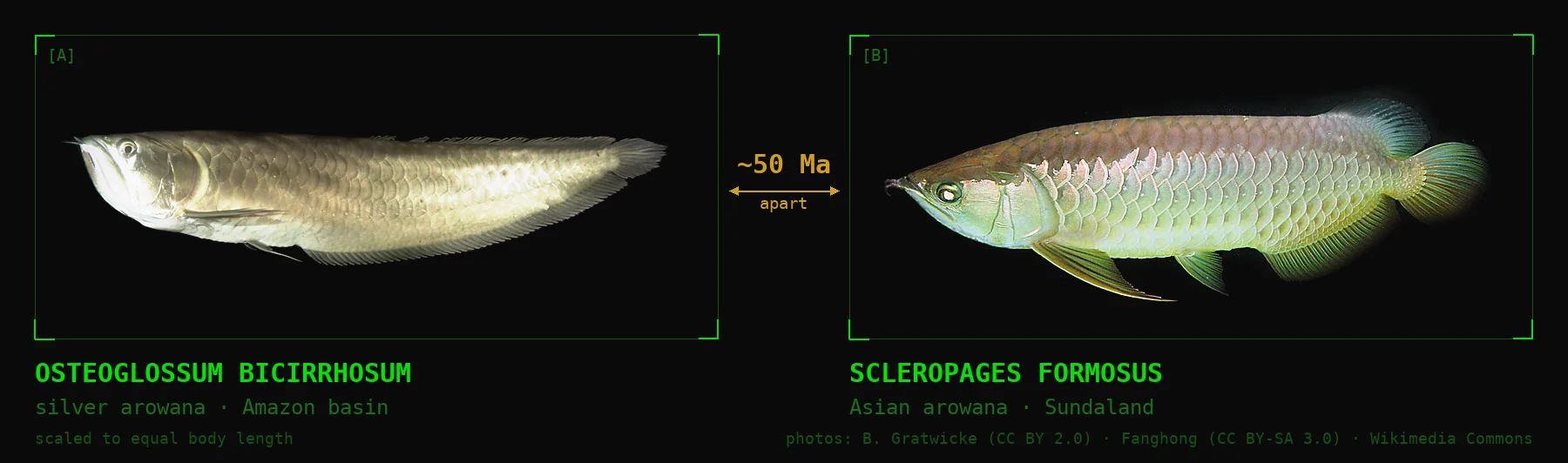


A marine fish with this range would not be a puzzle. Arowanas, though, are river fish. They live in still, warm, acidic water and have no known tolerance for the sea. Freshwater fish are the best witnesses to old geography because they cannot easily cross oceans. When related freshwater fish turn up on continents separated by thousands of kilometers of salt water, the usual assumption is that the land moved, not the fish.
The arowanas test that assumption hard, because their family tree has two branch points and each tells a different story.
The family tree #
The arowana family, Osteoglossidae, is one of the oldest lineages of living bony fish. It has two parts. The first holds the giant Arapaima of the Amazon and Heterotis niloticus, the “African arowana” of the Nile and West Africa. The second holds the true arowanas: Osteoglossum in South America, and Scleropages in Southeast Asia, Myanmar, New Guinea, and Australia.
Within the true arowanas, molecular clocks now give two dates:
| Split | Estimated age | Geography at the time |
|---|---|---|
| Osteoglossum (South America) vs. Scleropages | ~50 Ma (95% interval 47.8–55.0) | South America, Antarctica, and Australia still joined |
| Asian S. formosus vs. Australian Scleropages | ~35 Ma | Deep ocean between Australia and Southeast Asia |
Cioffi and colleagues produced both dates from more than a thousand genomic markers covering nearly every living species Cioffi et al. 2019. Lavoué’s analysis, which combined molecular, morphological, and fossil evidence, reached about the same 35-million-year age for the Asian–Australian split Lavoué 2016. A 2026 pangenome study places the South American split at 52.6 Ma Mu et al. 2026.
The first date is the one in the title. Antarctica explains it well. The second date is where the real mystery sits.
Split one: Antarctica as the last shared river country #
About 50 million years ago the southern continents were arranged very differently. Africa and India had long since left. South America, Antarctica, and Australia remained a single chain. Patagonia was connected to the Antarctic Peninsula across what is now the Drake Passage, and Tasmania was pressed against East Antarctica Australian Museum.
That Antarctica was not the ice sheet we know. The Early Eocene Climatic Optimum, roughly 52 to 50 million years ago, was the warmest stretch of the last 85 million years Bijl et al. 2013. Antarctica had temperate rainforest, rivers, and land animals. Fossils from Seymour Island, off the Antarctic Peninsula, include marsupials of South American type Goin et al. 1999, and related marsupials appear in both Peru and Queensland Sigé et al. 2009.
02 / The map
Gondwana's last southern chain, ~50 Ma
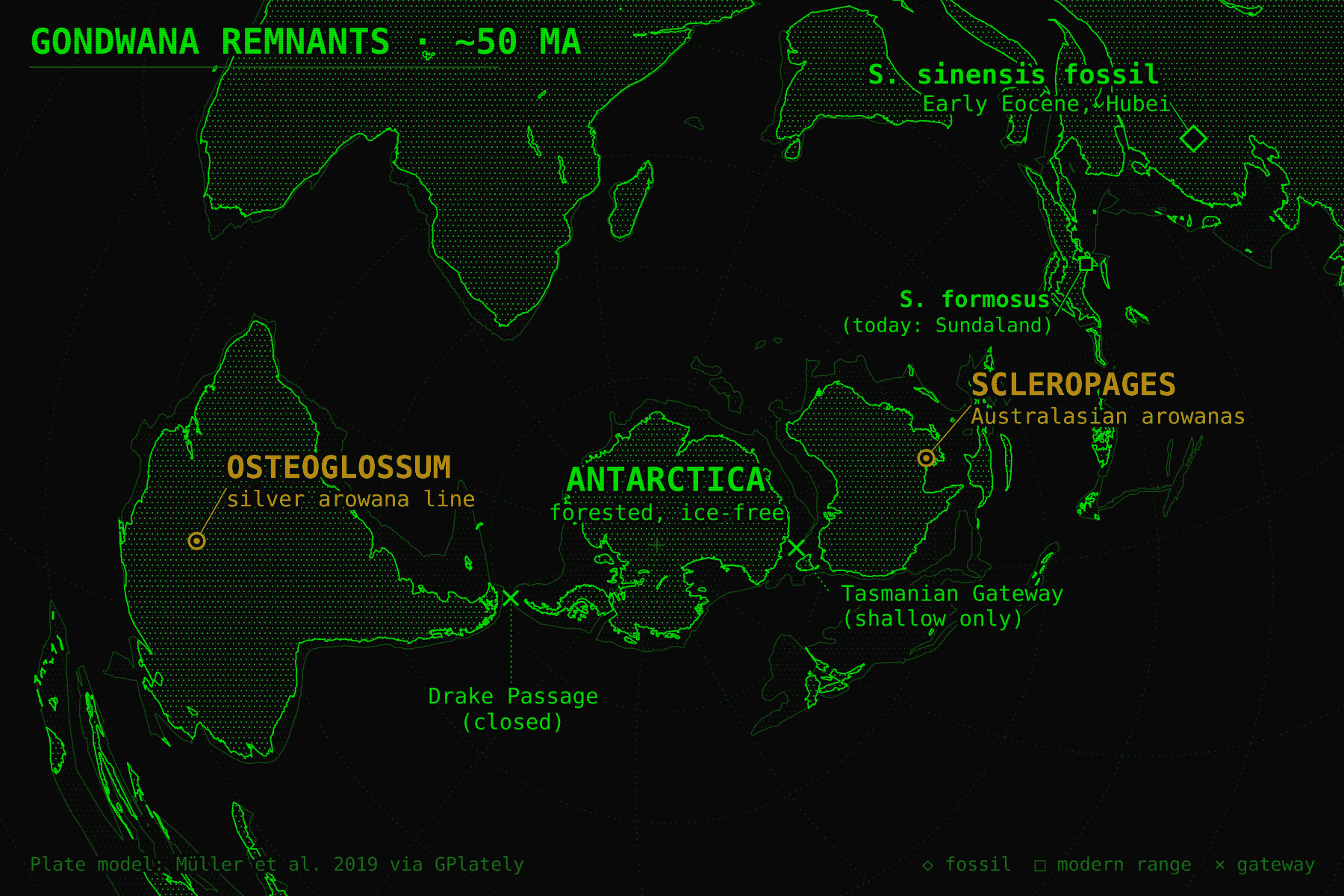
scripts/maps/arowana_gondwana_map.py.A freshwater fish living across that chain would need no ocean crossing. Its range could have run from the Amazon basin through Patagonia and Antarctica into Australia. That range could split and leave one lineage on each side.
The timing works in an interesting way. The 50-million-year date does not match the final separation of the continents. The Drake Passage and the deep Tasmanian Gateway did not open fully until about 41 to 34 million years ago. The date does match the end of the Eocene warm peak. Bijl and colleagues found that the Tasmanian Gateway first opened to shallow ocean flow about 49 to 50 million years ago, and that the new current began cooling the Antarctic coast Bijl et al. 2013. A warm-water fish spread across Antarctica would not have been split by a rift. It would have been split by cold, as the middle of its range became uninhabitable while the land was still connected.
This is the best answer to where the southern root sat. The last common ancestor of the Amazon arowana and the Australian saratoga most likely lived in a range that spanned Antarctica. No arowana fossil has been found there, and one probably won’t be, since Eocene Antarctic freshwater deposits are rare and mostly buried under ice. The geography, the clock, and the climate still point to the same place.
Split two: the Asian problem #
If the story ended in Australia it would be tidy. The Asian arowana is what spoils it.
The first attempt to explain it came from Kumazawa and Nishida in 2000. Their mitochondrial clock put the Asian–Australian split at about 138 million years. That is old enough for a piece of Gondwana to carry the fish north. They proposed that the Asian arowana’s ancestors rode India, or smaller blocks broken off Gondwana’s eastern edge, until those landmasses docked with Asia Kumazawa and Nishida 2000. The idea is not far-fetched in principle. India’s purple frog is a real surviving passenger of that voyage, with its nearest relatives in the Seychelles Biju and Bossuyt 2003.
The newer dates remove that option. If Scleropages split from Osteoglossum about 50 million years ago, the Asian and Australian branches inside Scleropages must be younger still, and Cioffi and Lavoué both put them at about 35 million years. India had separated from Australia and Antarctica more than 100 million years earlier. No landmass moving north at 35 million years ago could have carried a fish from Australia to Asia. There was open ocean between them, and the collision that later raised the islands of Wallacea had not yet begun.
A fossil makes this worse. In 2017 Zhang and Wilson described Scleropages sinensis, the first complete fossil skeletons of the genus, from Early Eocene lake deposits in Hunan and Hubei, central China Zhang and Wilson 2017. A Scleropages was living in mainland Asia at roughly the same time the clock says the genus was splitting from its South American relatives in the far south.
Two explanations remain.
1. The ancestors could survive in salt water. Capobianco and Friedman built a family tree combining living and fossil osteoglossids. They found marine species near the base of the family, coastal bonytongues from Eocene seas in Europe, North Africa, and elsewhere. They argue for a move from fresh water into the sea, followed by several independent returns to fresh water Capobianco and Friedman 2024. If early arowanas tolerated brackish or coastal water, the ocean between Australia and Asia was a barrier they could cross, even if their descendants can’t.
2. The family was already everywhere. Eocene osteoglossids are not confined to the southern continents. Phareodus occurs in the Green River lake beds of Wyoming and in Eocene deposits of Queensland. Other bonytongue fossils come from Europe, Asia, and Africa Hilton and Lavoué 2018. In that picture the living arowanas are not a Gondwanan family that stayed at home. They are the survivors of a family that once lived nearly worldwide, reduced to the tropical rivers where the lineage lasted.
These explanations are compatible, and the evidence supports combining them. A partly salt-tolerant, widely distributed family would produce exactly the pattern we see: a clean southern split near Antarctica, an Asian population that seems too old for its location, and an Asia–Australia divide that no land bridge explains.
So where was the root? #
The question has two answers, depending on which root you mean.
The root of the South American and Australasian arowanas was most likely a warm southern range spanning Antarctica about 50 million years ago. This is the strongest part of the story: the date, the continental arrangement, and the climate record agree, and the same route explains marsupials and side-necked turtles.
The Amazon arowana and the Australian saratoga split about 50 million years ago, while South America, Antarctica, and Australia were still joined, and as the first cooling of the Antarctic coast began.
The root of the arowana family as a whole was not confined to Gondwana. The marine fossils and the Eocene Scleropages in China point to ancestors that lived along coasts and in rivers across much of the world. The Asian arowana’s route to Sundaland is the least settled part of the story. It probably involved crossing salt water or surviving on an older Asian population. Rafting on India is not a viable explanation.
These are the possibilities, ranked by current evidence:
- A southern range across Antarctica. Best supported, but only for the Osteoglossum split.
- Marine or coastal dispersal by early arowanas. Best explanation for Asia, backed by the fossil marine bonytongues.
- A widespread Eocene family, with survivors left on separate continents. Consistent with Phareodus and S. sinensis, and likely combined with option 2.
- India as a Gondwanan raft. Historically important, but ruled out by the current dates.
Other animals with the same map #
Arowanas are one case among many where a Southern Hemisphere distribution invites the question of whether the continents did the work. The answers differ, and the useful comparison is simply whether each group’s dates are old enough for the breakup.
- Lungfishes have dates old enough. South American and African lungfishes remain one of the strongest cases for vicariance among freshwater fishes Capobianco and Friedman 2019.
- Cichlids are too young. They live in South America, Africa, Madagascar, and India in a pattern that looks like a Gondwana map, but fossils and genomic dates place their spread long after the continents separated, so they must have crossed salt water Friedman et al. 2013; Matschiner et al. 2020.
- Galaxiid fishes are old, but their distribution has been reworked by later dispersal. Their juveniles spend time at sea, which lets them cross gaps that pure freshwater fish cannot Waters et al. 2000.
- Side-necked turtles and marsupials fit the Antarctic route. Chelid turtles are split between South America and Australasia, and marsupial fossils on Seymour Island show Antarctica was the crossing between them Joyce et al. 2016; Goin et al. 1999.
The arowana belongs in two of these groups. Its southern split resembles the turtles and marsupials. Its Asian branch resembles the cichlids: a group whose map looks continental, but whose dates require crossing water.
This is the southern counterpart of the migrations across Beringia. That route was a northern land bridge that let animals walk into the Americas, and it survives in the fossil record the animals that made America. The Antarctic route is lost under ice. It is known mainly from the animals it once connected.
The arowanas in aquarium tanks around the world are the end of that history. A red dragon fish in a Singapore apartment and a silver arowana in a Manaus fish market last shared an ancestor in a warm river country that is now under two kilometers of ice.
Sources #
- Cioffi, Marcelo de Bello, et al. “Deciphering the Evolutionary History of Arowana Fishes (Teleostei, Osteoglossiformes, Osteoglossidae): Insight from Comparative Cytogenomics.” International Journal of Molecular Sciences 20 (2019): 4296.
- Lavoué, Sébastien. “Was Gondwanan breakup the cause of the intercontinental distribution of Osteoglossiformes? A time-calibrated phylogenetic test combining molecular, morphological, and paleontological evidence.” Molecular Phylogenetics and Evolution 99 (2016): 34–43.
- Mu, Xidong, et al. “Osteoglossid pangenome reveals ancient teleost evolution and population dynamics.” Zoological Research (2026).
- Kumazawa, Yoshinori, and Mutsumi Nishida. “Molecular Phylogeny of Osteoglossoids: A New Model for Gondwanian Origin and Plate Tectonic Transportation of the Asian Arowana.” Molecular Biology and Evolution 17 (2000): 1869–1878.
- Zhang, Jiang-Yong, and Mark V. H. Wilson. “First complete fossil Scleropages (Osteoglossomorpha).” Vertebrata PalAsiatica 55 (2017): 1–23.
- Capobianco, Antonietta, and Matt Friedman. “Fossils indicate marine dispersal in osteoglossid fishes, a classic example of continental vicariance.” Proceedings of the Royal Society B 291 (2024): 20241293.
- Hilton, Eric J., and Sébastien Lavoué. “A review of the systematic biology of fossil and living bony-tongue fishes, Osteoglossomorpha.” Neotropical Ichthyology 16 (2018): e180031.
- Bijl, Peter K., et al. “Eocene cooling linked to early flow across the Tasmanian Gateway.” Proceedings of the National Academy of Sciences 110 (2013): 9645–9650.
- Goin, Francisco J., et al. “New Discoveries of ‘Opossum-Like’ Marsupials from Antarctica (Seymour Island, Medial Eocene).” Journal of Mammalian Evolution 6 (1999): 335–365.
- Sigé, Bernard, et al. "Chulpasia and Thylacotinga, late Paleocene–earliest Eocene trans-Antarctic Gondwanan bunodont marsupials: new data from Australia." Geobios 42 (2009): 813–823.
- Capobianco, Antonietta, and Matt Friedman. “Vicariance and dispersal in southern hemisphere freshwater fish clades: a palaeontological perspective.” Biological Reviews 94 (2019): 662–699.
- Friedman, Matt, et al. “Molecular and fossil evidence place the origin of cichlid fishes long after Gondwanan rifting.” Proceedings of the Royal Society B 280 (2013): 20131733.
- Matschiner, Michael, et al. “The genomic timeline of cichlid fish diversification across continents.” Nature Communications 11 (2020): 5895.
- Waters, Jonathan M., et al. “Molecular phylogenetics and biogeography of galaxiid fishes (Osteichthyes: Galaxiidae): dispersal, vicariance, and the position of Lepidogalaxias salamandroides.” Systematic Biology 49 (2000): 777–795.
- Joyce, Walter G., et al. “A review of the fossil record of turtles of the clade Pan-Chelidae.” BMC Evolutionary Biology 16 (2016): 218.
- Biju, S. D., and Franky Bossuyt. “New frog family from India reveals an ancient biogeographical link with the Seychelles.” Nature 425 (2003): 711–714.
- FishBase. "Scleropages formosus, Asian bonytongue." Accessed September 22, 2026.
- FishBase. "Osteoglossum bicirrhosum, Arawana." Accessed September 22, 2026.
- Australian Museum. “The Eocene Epoch (56–33.9 million years ago).” Accessed September 22, 2026.
- Müller, R. Dietmar, et al. “A global plate model including lithospheric deformation along major rifts and orogens since the Triassic.” Tectonics 38 (2019): 1884–1907. Base data for the map in figure 2.
- Wikimedia Commons. “File:2016-12-11 Arawana.jpg.” Photograph by Brian Gratwicke, CC BY 2.0.
- Wikimedia Commons. “File:Honglongyu3.jpg.” Photograph by Fanghong, CC BY-SA 3.0.
Read other posts