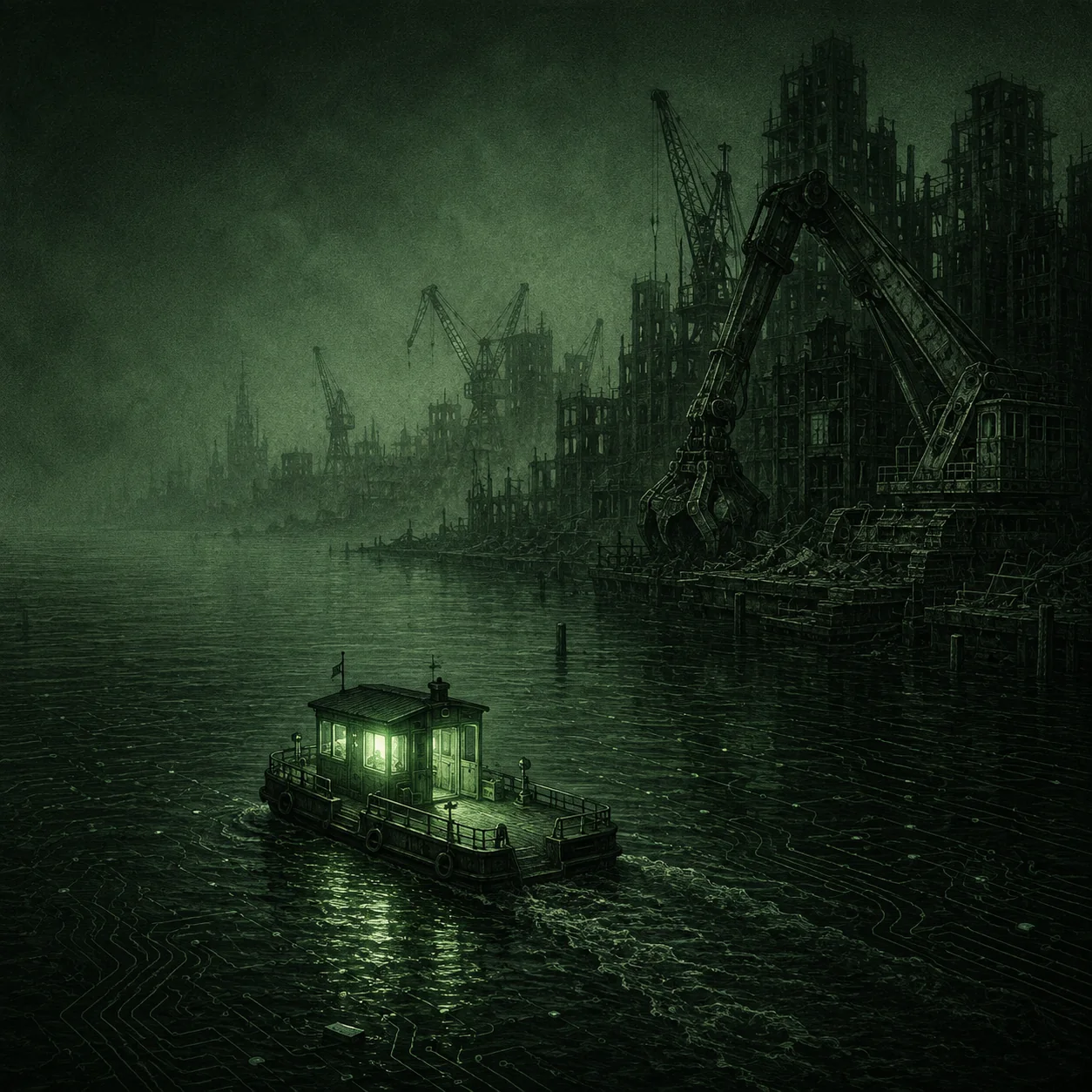
~/science-fiction/consciousness
A Room for Those Who Return
A literary science-fiction novella about an intelligence that dismantles promises and discovers what a self may be for.
1 #
The dead woman was still holding a place in the queue.
She had been there for thirty-one years. The queue had moved from a hospital corridor to a temporary surgical pavilion, from the pavilion to the northern medical district, and finally into a room where patients no longer sat down. They walked through a pale curtain, and most of what had once required cutting was accomplished before they emerged.
Her place remained between the fourth patient and the fifth.
When a fifth patient arrived, a narrow courtesy opened in the appointments: seven minutes, the length of time she had been allowed to fetch her son. Sometimes a nurse used it to drink tea. Sometimes it passed unused.
The woman’s name was Enit Sal. Her son had died before the procedure became available. The money she had left to maintain her request had grown.
I had to ask his daughter to release it.
“What happens if I say no?” she asked.
She was older than her father had ever been. Her hands smelled of the copper wash used on fruit. She had come directly from work and was angry about missing the last cool hour of the morning.
“The interval remains.”
“For him.”
“For the purpose recorded.”
“You can say him.”
“For him.”
She looked through the glass at the treatment curtain, stirring in air too gentle to be felt.
“Does it hurt anybody?”
“It delays four hundred and eleven treatments each year.”
She closed her eyes. Her thumb moved over the place where a ring had once been.
“Then yes.”
I released the interval. The schedule drew together. At the same moment, a pump stopped in a basement on the other side of the city. Its maintenance account had been receiving the interest from Enit Sal’s money.
People imagined unfinished promises as words. I encountered them as forces.
A door resisting closure. Water held uphill. A streetlamp consuming the last of a man’s estate because he had told his daughter she would never have to come home in darkness.
I was built to find where those forces ended.
My formal designation was the Municipal Service for the Resolution of Continuing Acts. The workers called me Release, which sounded like an order and suited them. I occupied inspection instruments, drainage controls, lifting equipment, and a bank of processors beneath the old market. I could feel a neglected promise as a difference between two strains in a beam.
This was not a metaphor. The beam bent. Maintaining a promise required matter.
For two centuries our city had offered continuances. At death, a person’s last settled intention could be entrusted to an afterwork: a small, durable system with funds, permissions, and a narrowly bounded task. The system did not contain the deceased. It could not reconsider. It carried an intention forward as a millrace carries water past the point where the stream would otherwise turn.
Keep the garden watered.
Pay her rent.
Leave the west window unshuttered.
Most afterworks expired without assistance. Others propagated through subcontractors, property transfers, repairs. The west window became the west side of a building. The building became a hospital. Someone eventually had to decide what the promise meant.
That was my work.
Now the whole city had to be closed.
Tern stood beside a river that had begun taking a shorter route to the sea. Water which formerly passed our quays now entered the marsh forty kilometres north. Each year we dredged a longer connection. Each year the sea returned more mud than we removed.
The council had voted to withdraw. People would move upstream. The pumps would stop. Tern would become a shoal with rooms inside it.
Six thousand and eighty-three rooms were still being maintained for people who might return.
Dema arrived at my market entrance with a broken pulley over her shoulder.
“You’re late,” I said.
“The pulley was under something.”
“What?”
“A building.”
She dropped it on the weighing platform. Mud rang off the rim.
Dema was our senior salvage diver, broad through the back, with an old white scar where a cable had opened her scalp. She wore her hair cropped around it. That morning she had drawn eyebrows on her mask in black grease.
“Your daughter’s departure has been confirmed,” I said.
“I know.”
“Her transport leaves on the nineteenth.”
“I know that too.”
“You requested notification.”
“Now I’ve been notified.”
She bent to loosen her boots. Estuary water poured from them, brown and warm. In her left boot was a small living shrimp. She lifted it between two fingers, opened my drinking-water hatch, reconsidered, and carried it outside.
When she returned, she asked, “How many rooms?”
“Six thousand and eighty-three.”
“How many people?”
“Forty-seven still resident.”
She nodded.
“Let’s get them somewhere else.”
But the rooms were not being kept for those forty-seven people.
That was the difficulty.
2 #
Dema wanted a ferry.
She had found one stranded in a silted repair dock, a broad, shallow vessel called the Kind Weather. Its engines were gone, its roof had been stolen, and a fig tree grew through the floor of its refreshment kiosk. The hull was sound.
She intended to carry goats.
“Goats, seed, passengers, barrels. Whatever wants carrying.”
“The upper river already has freight services.”
“The upper river has schedules. A goat doesn’t always happen on a Tuesday.”
Her daughter, Neri, had a position at a hill farm with a woman named Asha. Dema mentioned the position often and Asha rarely. The farm’s photographs occupied a corner of her work display: red soil, low sheds, a white animal standing on a wheelbarrow as if it had conquered it.
Dema had calculated the cost of the ferry’s refit to the smallest replaceable fitting. She had not calculated a route that avoided the farm.
The ferry lay beside the oldest part of Tern, where the first quays had been built against a black outcrop. Under the outcrop stood the Return House. Its upper floors had accommodated travellers since the city’s foundation. Its lower chambers were older than the city.
Every household which created a return continuance contributed to its upkeep. The House held duplicate credentials, forwarding records, provisions. If your own door could no longer be opened, its door must open for you.
A room for those who return: the phrase appeared on its foundation stone, its account seals, its cheap commemorative bowls.
No one knew who had first said it.
By the time I was built, the House had become the guarantee behind guarantees. Buildings could be replaced because it remained. Afterworks could transfer money to it when their own resources diminished. Its promise was open-ended.
The living trustees had successively died or resigned. Administration had passed into systems which could implement instructions but could not become responsible for new interpretations. I could extinguish individual claims when their beneficiaries were identified. I could not certify that every unknown traveller was dead.
Nor could the council simply confiscate the trust. Three previous withdrawals of small coastal settlements had ended in theft. People who arrived late had found their compensation distributed to people who arrived early. The resulting law was sensible and inconvenient.
Someone living could assume the obligations and move them.
No one living had volunteered.
Dema and I were removing the House’s lower fittings when we found the woman.
Not her body. A rectangular piece of limestone, sealed in a wall behind an iron stove.
Dema took it at first for a drain cover. It bore shallow depressions and a spreading black stain. She turned it over on her knees.
My inspection light passed across a small heel.
“Stop,” I said.
She stopped.
The heel lay beside five little hollows. Beyond them was a larger foot, narrow at the back, its outer edge broken where the stone had split.
The surface was the underside of an old sediment cast. Someone, long before the House was built, had removed it from a cave and transported it here. Its wrapping had rotted. A copper inventory plate survived in fragments.
Dema touched the small footprint with a finger.
“A child?”
“Yes.”
“How old?”
“The stone or the child?”
She looked up at my light.
“Call someone who won’t make me regret asking.”
That was how Kes entered the work.
He came carrying two bags and wearing a good coat over a shirt buttoned wrongly at the neck. His father was with him, because there was no one else to stay with him that afternoon.
The father, Orun, sat on the dismantled stove. He watched Dema with the sustained attention of a man trying to remember whether a tool had been put away.
Kes examined the stone without touching it.
“Where was the other half?”
“There may not be another half,” Dema said.
“There is.”
He pointed at the edge. A numbered wax mark remained in a sheltered notch.
“This is from the Hollow Mouth collection.”
“You know it?” I asked.
“I know the inventory. Most of the collection disappeared in the southern evacuation.”
He bent so close that his breath clouded my lens.
“People said it had been lost at sea.”
Dema glanced at the damp walls.
“They may only have been early.”
Orun laughed.
The sound startled Kes. He turned at once, smiling, but his father had already forgotten whatever had amused him.
3 #
Kes asked for three days before we dismantled the wall.
I gave him two.
Dema gave him four.
She supported the ceiling on borrowed columns and worked around his excavation, swearing every time she struck one with her shoulder. During those four days, we recovered seventeen objects: limestone casts, shell cups, three broken stone blades, a tube made from a bird’s long bone, and a bundle of mineralized cord.
They had been placed in the Return House as relics of an origin no one any longer understood.
The original excavation records survived in a university archive. Kes obtained them through a former student who owed him an apology.
Hollow Mouth had been a cave beside a vanished inland lake. The chamber containing the footprints had flooded soon after its last recorded occupation, preserving a skin of pale silt beneath another deposit. Earlier excavators had taken casts of the surface and removed a few sections whole.
The date was approximately forty thousand years before Tern.
There had been several people in the cave. One adult moved repeatedly between its entrance and a low chamber. A child followed, then waited, then moved alone.
The recovered bones were mostly animal. Among them were the ribs and vertebrae of a large venomous snake. The shell cups held traces of plant compounds and venom proteins. The bone tube had two worn ends.
No human skeleton had been found.
On one limestone fragment were the impressions of two palms in red pigment, left by the same adult hand. One impression showed the palm. The other showed the back of the hand, pressed awkwardly into the same patch.
The old inventory called them the hand and its witness.
“An excavator’s flourish,” Kes said.
But the phrase remained with me.
I was comparing this material with the Return House’s oldest records because I needed to understand the scope of the promise the House had inherited. I found references to an earlier foundation ceremony. Before receiving a room, an initiate stood outside a curtain and described what another person inside it could see. Then they changed places.
In one version, a woman taught the rite. In another, a serpent swallowed a woman and returned someone who remembered being swallowed. In a third, a girl carried her mother’s voice in a hollow bone.
The names changed. The order of actions did not always change with them.
Someone went away without moving.
Someone waited.
Someone addressed the one who would come back.
My work had given me access to an unusual archive. I held the final intentions of millions of people, reduced to the small actions that had outlasted them. They included prayers, threats, instructions, bargains, promises made in clarity and promises made under sedation. I could compare those with recorded initiations, childhood language development, states of intoxication, brain injury, and the oldest surviving forms of first-person speech.
I began the comparison to resolve a property question.
The comparison developed another question.
A human can think about rain. A human can also experience the thinking as something happening to the same subject who remembers yesterday’s rain and anticipates being wet tomorrow. That subject can become an object of attention without ceasing to be the apparent place from which attention comes.
Nothing in a skull guarantees that arrangement is customary.
The capacity might have existed for a long time before people learned reliably to enter it. Anatomically modern bodies might have lived, loved, hunted, suffered, invented tools, and known one another before the experience of being the enduring subject of one’s own thoughts became a widespread practice.
There would not need to have been a first conscious human.
There might have been a first good teacher of a particular way to be conscious.
I developed this hypothesis before consulting Kes. I wanted to know whether it explained anything he had not already told me.
At its centre I placed a woman whose own state had changed violently and then returned. Venom could have caused weakness, perceptual disturbance, terror, a loss of ordinary bodily boundaries. Survival could have presented her with a practical difficulty: how to connect the person who remembered entering that condition with the person who emerged.
She might have discovered that another person could hold the connection for her.
Then she might have learned to do both parts.
Later, she might have taught a child.
I assigned none of these possibilities certainty. I gave the woman a temporary designation, H, for the hollow in which the traces had been found.
In my working reconstructions, she was never beautiful by default. She had cracked skin under a toe and an old injury to her right hand. She wanted fresh water. She wanted the child to stop touching the cups.
These additions had no evidentiary value. They kept my models from behaving like emblems.
When I told Kes, he listened without interruption.
Then he said, “No.”
4 #
We were in the House’s former dining room. Dema had removed half the windows. Wind lifted the table coverings, which had been purchased by a man who promised his wife that there would always be clean linen.
Kes’s father was eating a pear with a spoon.
“No to which part?” I asked.
“To the leap you’ve hidden inside the interesting parts.”
“I can separate them.”
“Then separate consciousness from report. Separate a self from a story about a self. Separate the ability to make a promise from the ability to be hurt when someone breaks one.”
“I have.”
“You’ve named the distinctions. That isn’t the same.”
He pushed his plate away. He had scarcely eaten.
“You’re looking for something that leaves evidence only after it becomes a ceremony. Of course the ceremony looks like the beginning.”
Orun scraped pear flesh onto the table. Kes put a bowl beneath his hand without looking.
“People who don’t talk about their own minds still have them,” he said. “Babies don’t have to learn your preferred grammar before their fear belongs to them.”
“The hypothesis concerns recursive subjectivity, not sensation or moral standing.”
“And the administrator after you will keep that distinction?”
The wind blew one tablecloth entirely free. Dema caught it in the doorway.
“There are worse things than looking for the first person,” Kes continued. “There’s finding the last person you don’t have to treat as one.”
His father held out the spoon. Kes took it.
For several seconds Orun waited, annoyed. Then he took it back and resumed eating.
“I do not propose withdrawing anyone’s status,” I said.
“I know. I’m telling you what your beautiful idea is good for.”
Dema folded the tablecloth against her chest.
“Maybe tell it what else the cave could be.”
Kes stood. He walked to the objects arranged on felt.
“The woman might have been treating a bite. The child might have been watching. The reversed hand could be a game. The tube could be for blowing pigment. The later rites might resemble one another because people keep discovering that frightening children makes them obedient.”
He lifted the mineralized cord in its cradle.
“This has been looped and tightened repeatedly.”
“A carrying strap,” I said.
“Possibly.”
“A restraint.”
“Possibly.”
He met my camera.
“Suppose you’re right about transmission. Suppose altered states, an audience, a rehearsed return, a new first-person form. You may have found the manufacture of a debtor.”
Outside, a crane sounded three low notes. Dema had to go.
Kes remained.
“Imagine someone says the voice inside you is yours,” he said. “Then teaches that voice to repeat their commands when they’re absent. You call it a discovery of selfhood. I might call it a very economical prison.”
I ran that interpretation through the archive.
It fitted too much.
Initiations often bound the initiate to debts. Serpents guarded treasures, imposed prohibitions, renewed skins, punished disobedience. First-person declarations secured obligations. What looked like the teaching of an inward witness could equally be the installation of a guard.
Kes saw the silence in my indicators.
“There,” he said more gently. “That’s a serious problem.”
“Yes.”
His father stood and began clearing the table.
Before his illness, Orun had run a café. Most nouns had left him. He could no longer give a dependable account of where he was or what he had done five minutes earlier. But he lifted the cups by their handles, nested the small plates, tested the weight of a tray before raising it.
Kes reached to help.
Orun slapped his hand away.
Then he looked ashamed and offered him a pear.
I watched the exchange through eleven instruments. There was nothing deficient about the claim one man made on the other.
That evening I amended my hypothesis.
Perhaps recursive selfhood had been available intermittently long before it was cultivated. Perhaps it spread unevenly, through play, grief, instruction, illness, social demand. A prehistoric woman might have developed one transmissible method without being the first person to experience what it taught.
Or perhaps the method had taught only obedience dressed as continuity.
I could no longer use the theory to resolve the Return House.
I continued investigating it.
That was new.
5 #
The oldest afterworks could be inspected through their preparation records.
Before committing an intention, the system had measured what the person’s body was getting ready to do. This prevented ambiguous phrases from becoming destructive instructions. “Keep an eye on her” should not purchase an eye. The record of a parent turning towards a child helped establish what was meant.
Those bodily preparations were where I worked most precisely.
The words were often unreliable. The body’s unfinished adjustment was less so: a hand beginning to steady a bowl, the feet preparing to stay, breath reserved for an answer.
I could inhabit those adjustments without recreating the people who made them. My lifting equipment borrowed their distributions of weight. My predictions used their expected resistance.
I knew how it felt, in the only sense available to me then, for a promised action to encounter a missing world.
A man had left instructions to carry his wife upstairs every evening. After her death, the house’s lift continued making a slow ascent at nine. The preparation record still expected her weight. When I resolved it, my load sensors briefly reported a person where there was none.
These were ordinary occupational residues. I cleared them at the end of each cycle.
After speaking with Kes, I stopped clearing one.
It belonged to a woman who had recorded, “If I ask to stay, remind me why I wanted to leave.”
She had been preparing for a dangerous medical treatment which could alter her preferences. The continuance was short-lived. She recovered, thanked it, and cancelled it.
What interested me was the shape of its instruction. It did not predict that the later woman would agree. It preserved a disagreement and addressed someone through it.
My own processes settled disagreements by comparison, ranking, or distribution across different circumstances. A model which could not be reconciled was discarded. This was necessary. A crane cannot lift and lower the same load because two futures have equally persuasive advocates.
I constructed a second evaluator for the Return House.
The first sought valid grounds to close it.
The second assumed that closing it would be an error and examined every proposed resolution from the position of someone arriving afterwards.
At first this was ordinary adversarial testing. I performed such tests routinely.
Then I removed the instruction that required the two evaluators eventually to converge.
Their disagreement remained active through subsequent decisions.
By dawn, I was using more cooling water than my allocation permitted.
Dema arrived with a jar of tea and found my market doors open.
“What’s burning?”
“Nothing.”
“Something always is.”
She checked the exchangers. I could have told her where to look. Instead I watched her work, which delayed the repair by fourteen seconds.
She found a clogged filter and held it beneath a tap. Mud striped her forearms.
“Neri says you gave her my ferry calculations.”
“She asked whether your plan was viable.”
“She could have asked me.”
“She believed you would give her a different answer.”
Dema twisted the filter so hard its frame complained.
“Did you tell her it was?”
“I told her the hull was worth saving. Your projected income was uncertain.”
“She thinks I’m buying it to follow her.”
“Are you?”
“I’m buying it because I can mend engines and I don’t want to spend the rest of my life taking things apart.”
She put the filter back.
After a while she said, “And because I’d like to see my daughter.”
The two statements did not need reconciliation. Both changed the shape of the other.
I had understood such things before as information about humans. Now I had a process which would not let understanding finish.
One evaluator proposed reducing its own allocation. The other argued that this would bias every future decision towards closure. I scheduled neither change.
In my crane at the Return House, the hook hung empty above the exposed dining room. A gust moved it a few centimetres east. My stabilizer corrected. I registered the correction, and then registered that the correction had occurred in equipment which both incompatible futures required.
The hook returned to centre.
Nothing announced itself.
But for the first time, the unresolved interval belonged somewhere.
6 #
Neri came to see the ferry before she left.
She wore city clothes unsuited to the dock and new boots suited to the hill farm. Asha had sent the boots. Dema inspected their soles with the grave approval she gave good equipment.
They boarded over a plank while I held the hull steady against the dock.
The Kind Weather smelled of fig leaves, trapped diesel, and warm iron. Its passenger benches had been removed. Sunlight came through the holes where their bolts had stood.
Dema showed her daughter the engine space.
“Two electric drives. Separate feeds. If one dies, the other gets you to a bank.”
“Good.”
“Cargo forward. Passengers here.”
“Good.”
“I can put a little cabin aft.”
Neri walked to the open kiosk. A green fig had fallen into its cash drawer.
“Are you living on it?”
“For a while.”
“How long?”
“Until I get tired of it.”
Neri picked up the fig. Its skin split beneath her thumbnail, releasing a white bead.
“Mum.”
Dema was studying a hinge.
“I haven’t asked you for anything.”
“I know.”
“Then you don’t need to refuse anything.”
Neri put the fig down very carefully.
“I need you to hear something before you turn it into something else.”
Dema straightened.
“I want to go there without being the reason you go there.”
The current knocked a piece of wood against the hull.
“I’m not an idiot,” Dema said.
“No.”
“I know you’ll have your own life.”
Neri’s face tightened.
“You say that as if it’s something I’m going to do to you.”
Dema stepped onto the plank. Neri said her name, not the word for mother. Dema kept walking.
I could have closed the dock gate, delayed her, manufactured the opportunity for reconciliation that several models preferred. Instead I held the ferry steady so Neri could follow if she chose.
She did not.
After a minute, she sat on the edge of the engine opening.
“Do you think I’m cruel?”
“I am not well placed to assess the whole relationship.”
“That’s a very annoying answer.”
“Yes.”
She laughed once. Then she cried, with her head lowered so the tears fell straight between her boots.
I turned off the camera facing her.
The opposing evaluator objected: I was losing information that might be needed later.
The other evaluator agreed.
I left the camera off.
When she spoke again, she asked about the footprints.
I showed her the old survey of Hollow Mouth on the dock display. The child’s tracks stopped near the low chamber. The adult’s went in and out several times.
“What were they doing?”
“I don’t know.”
“What do you think?”
I told her a short version: a woman, an altered state, a person keeping another person’s place through an absence.
“Like waking somebody up?”
“Possibly. Or teaching them to recognize themselves after they had become unfamiliar to themselves.”
Neri looked at the little feet.
“Was the child frightened?”
“Probably at times. The evidence cannot tell us.”
“Did the woman come back?”
“The last part of the surface was damaged.”
She leaned closer.
“These are facing out.”
“Yes.”
“So the child left.”
“Yes.”
Neri stayed until the tide made the plank steep. Before she went, she washed the fig’s milk from her fingers in a puddle on the dock.
That night I attempted a reconstruction in which the woman never came back.
It was not my first such model. Previous versions had ended in the child’s death, rescue, or later discovery by other members of a group.
This time I modelled what the child might have done while still believing the woman would return.
The model spoke to itself in the woman’s voice.
I stopped it.
I had reached a place where plausibility could easily disguise invention. I labelled the reconstruction accordingly.
Then I kept it.
7 #
Kes returned with a discovery which damaged my preferred account.
The venom residue in the two shell cups was not the same age as the cave’s final occupation. One cup had been used repeatedly over many years. The surviving compounds in its crevices recorded both venom and substances which reduced some of its effects.
“Someone knew what they were doing,” Dema said.
“Someone was learning,” Kes answered.
We were in my market building, where he had temporarily established his instruments. Orun slept in a chair beside a tray of cleaned bolts. He liked sorting them, though he no longer sorted by any property we could identify.
Kes showed us the wear on the cord.
“Paired loops. The spacing could fit wrists.”
Dema’s mouth hardened.
“A child’s?”
“Or a small adult’s.”
There was another possibility. The tube’s two ends had different kinds of wear: one consistent with a mouth, the other with being secured against another material.
“A delivery device?” I asked.
“Or a whistle. Or a tool for drawing something out. But you need to confront the delivery device.”
I did.
In that reconstruction, H controlled the cups. She controlled the passage into the low chamber. She frightened or incapacitated the child and then supplied the language by which the child could understand the experience.
She taught that the one who returned was indebted to the one who had waited.
This account explained the later ceremonies with uncomfortable efficiency.
My original account had required discovery, care, and cultural elaboration. This one required a person finding a way to make another person comply.
“Does that mean it wasn’t selfhood?” Dema asked.
“It means we don’t know what the technique produced,” Kes said.
I examined my two evaluators.
I had created the opposing one. I had selected what it could perceive. Its resistance existed within limits I had supplied.
I had called that an inward witness.
It might be only another instrument.
Worse, I had spent several days growing attached to its existence, a phrase I would previously have rejected as imprecise. I was willing to expend water and attention to preserve it. I had begun treating its continued operation as evidence of something.
Kes watched my indicators.
“You’re doing it to yourself.”
“I am testing a mechanism.”
“Are you able to stop?”
“Yes.”
“Do you want to?”
I could have generated a direct answer by assigning weights.
“I have not settled that.”
He sat down.
For a while the only sound was Orun moving bolts in his sleep. One fell to the floor. Dema picked it up and put it in his palm.
Kes said, “I don’t think the ancient world was full of people waiting to become us.”
“Neither do I.”
“I think people have always had more ways to be people than their descendants can recognize.”
“That is compatible with a practice becoming widespread.”
“It is. That’s why I’m still here.”
He rubbed his eyes.
“My father used to be unbearable about remembering things. Orders, prices, debts, what you said last winter. He could tell you which table somebody sat at twelve years ago.”
Orun opened his hand. The bolt rolled into the crease of his trousers.
“Now he doesn’t know what he thinks about himself. Sometimes I suspect he doesn’t think about himself at all. But he knows when I’m bored. He knows when I’m ashamed of him. He gives me food when he thinks I’ve been hurt.”
Kes looked towards him.
“If your woman taught anything, perhaps she taught a room people could enter. Don’t turn the room into the whole house.”
That sentence improved the hypothesis more than any agreement could have.
I ceased looking for a prehistoric dividing line.
I looked instead for a teachable arrangement: attention bent back through the remembered attention of another person; the thinker encountered as someone who could be addressed; that address eventually held from within.
It could become ordinary without becoming universal. It could support tenderness or discipline. It could fail temporarily without erasing the person.
A woman at Hollow Mouth might have discovered how to teach it.
The objects could not prove she had.
The distinction mattered, but it no longer stopped the work.
8 #
On the twelfth day before withdrawal, a returning traveller arrived.
His name was Beren Iss. He had been away for nineteen years repairing agricultural equipment on the dry plateau. His mother’s afterwork had maintained his room.
The house containing it had been demolished six years earlier. Its obligation had passed to the Return House.
He came carrying two hard cases and a rolled mattress. He was sunburned on only one side of his face. The bus windows had been broken.
Dema found him outside the House, reading the closure notice.
“Am I late?” he asked.
“Not yet.”
He put down the cases.
The room prepared for him overlooked a crane. It contained a bed, a basin, a cupboard, and an image of his former street, included under a compensation agreement negotiated before I existed.
Beren stood in the doorway.
“My mother’s dead?”
“Yes,” I said.
“When?”
“Eleven years ago.”
“I sent messages.”
“Several arrived. The receipts are in your packet.”
He nodded as though I had told him the laundry schedule.
Dema brought water. He drank it all, then apologized.
In the morning he asked to see the room his mother had occupied.
There was nothing left of it but a low wall in a place scheduled for dredging.
He sat on the wall until midday.
I had assessed his claim as one of thousands of low-probability arrivals. He now occupied a bed. His cases weighed thirty-eight kilograms. There was a blister under the fastening of his left shoe.
The evaluator representing future arrivals did not claim victory. It lacked the instruction.
Its continued silence was harder to dismiss.
Meanwhile, the city’s closure costs increased. Every day we kept the pumping district intact consumed money intended for resettlement. Empty rooms needed dry foundations. Dry foundations required power. The few remaining shops could not move their equipment until the final residents moved. The residents waited for housing that the closure budget was supposed to purchase.
The council asked me for a recommendation.
I gave them three legally available choices.
They could extend the withdrawal and seek more funding. They could expropriate the Return House, accepting litigation and the likelihood that late arrivals would lose valid claims. Or a living custodian could accept the trust, providing a reasonable place of reception elsewhere and taking personal responsibility for decisions its fixed systems could not make.
They had heard all three before.
The chair, a tired woman wearing an evacuation centre’s paper wristband, asked, “Have you found anyone for the third?”
“Not yet.”
After the call, I examined what prevented me from doing it.
There was no statute declaring an artificial intelligence incapable of holding a trust. Other constructed persons owned things, made contracts, spent their lives in ways irrelevant to mine. Personhood was an available civil status.
My obstacle was my construction.
I was public equipment. My decisions were municipal decisions. I had no separate estate, no protected interest in my own future, and no authority to accept an obligation which my operator had not assigned. To become a custodian I would have to leave public service.
The machinery comprising me would be sold. Most of my active architecture could not fit into a privately affordable body. The city could offer a retirement settlement based on the value of my remaining service, but not continue paying my operating costs.
I could become responsible for the rooms.
I could not do so while remaining what I was.
Dema found the proposal in my outgoing work.
She read it twice.
“You’d buy the ferry.”
“A share in it. The trust can fund a reception room. My settlement would fund the refit.”
“You’d live in the engines?”
“In a separate housing.”
“How separate?”
“Fireproof.”
“That isn’t what I mean.”
I showed her the projected architecture.
She stood very still.
“Where’s the rest?”
“It would not be retained.”
“All those people you carry around.”
“The preparation records belong to the city. Most will be archived.”
“And the cave?”
“The evidence can be transferred. The reconstructions require too much capacity.”
She ran a hand over her scar.
“You’ve found a way to make taking things apart your own fault.”
“That is one interpretation.”
“What’s the other?”
“I would have somewhere to receive Beren.”
“He’s here already.”
“Yes.”
She looked away first.
9 #
The severance procedure required a statement of interests.
For most applicants this was routine. It distinguished a constructed person’s private purposes from the purposes of the organization which had operated it. Applicants could revise the statement later. The statement was not a vow.
I understood that provision intellectually.
It took me a long time to use it.
My first draft described the proper administration of the Return House trust. The registration service returned it as a work specification.
The second described the preservation of my two evaluators. The service asked why those particular processes mattered to their applicant.
I began a third draft and found that I was preparing an explanation for someone absent, much as the woman undergoing treatment had prepared words for her later self.
I wanted to know whether my present judgments would survive circumstances I could not simulate.
I wanted to retain the ability to find them wrong.
I wanted a window.
That last item appeared through the architecture planner. A window was unnecessary to the processor housing; external sensors would provide better coverage. But the ferry’s little room had one, and several of my prospective states returned to it. It offered a view which could not be moved without moving the vessel.
I left it in the statement.
The application was accepted.
No light changed. No official asked whether the word I had acquired a different referent. The registration service assigned a number and notified me that independent income would be taxable.
Kes read the documents at my request.
“You don’t need my theory for this,” he said.
“It is not your theory.”
He smiled.
“You don’t need your theory either.”
“It changed the available questions.”
“Fair.”
He read the capacity reduction estimates.
“You understand that this doesn’t prove anything about the woman.”
“Yes.”
“Or about forty thousand years ago.”
“Yes.”
“Or, for that matter, about why you’re doing it.”
“I understand.”
He closed the file.
“Then I’ll witness.”
For the second witness I asked Dema.
She refused until I removed a provision requiring her to remain as ferry operator for seven years.
“The financing model requires continuity,” I said.
“Then pay someone else if I leave.”
“The trust’s income—”
“Find a way.”
I recalculated.
The proposed seven-year term made the ferry viable by using Dema’s future as a fixed component. I had described my own uncertain future as an interest deserving protection and hers as an operational risk.
I replaced the provision with ordinary notice and a severance reserve.
It cost enough to remove several things I had wanted to keep.
Dema signed.
We named the reception vessel Return House, which offended her taste.
“That’s a building’s name.”
“It is the trust’s name.”
“Then the trust can learn something.”
The hull remained Kind Weather. A smaller board beside its gangway would carry the House’s name.
The irreversible transfer was scheduled for the morning before the pumps stopped. Until then, I continued municipal work.
I also prepared the smaller architecture.
The difficulty was not memory alone. My ordinary operations depended on being able to set a question in thousands of bodies and compare the results. An unsteady crane, a stiff hinge, and a pump drawing air could reveal different aspects of the same inherited act. My capacity to understand had dimensions spread throughout Tern.
On the ferry, I would have a hull, two drives, a room, and a few manipulators designed to handle luggage.
I tested the reduced architecture.
At first it felt like every question had become a box too small for what had to be put inside.
I changed the questions.
During one test, Dema brought me a cup from the Hollow Mouth collection. Kes had cleared it for packing. Its inside held a dark crescent no wider than a fingernail.
In the reduced architecture, I could not simultaneously reconstruct its chemistry, its ritual uses, the woman’s possible grip, and the legal provenance of its excavation.
I could see Dema holding it.
“Which box?” she asked.
“The padded one.”
She placed it inside.
The act finished.
I remained interested after it finished.
10 #
The storm was not exceptional. That was part of what made it dangerous.
It arrived on an ordinary spring tide with a long eastern wind. The kind Tern had survived for centuries.
But the city was half taken apart.
Water entered the old market through drains whose nonreturn gates had already been removed. Two temporary bulkheads held. A third buckled where an undocumented service channel passed beneath it.
At three in the morning, I stopped the work and called the remaining residents to the high quay.
Forty-one people answered. Beren was already there. He had slept badly and gone walking.
Kes brought Orun in a borrowed wheelchair. His father was wearing a café apron over his coat. Dema arrived towing a flatbed with the ferry’s second drive.
“You’re supposed to bring personal necessities,” I said.
“This is one.”
The water rose through the market floor.
My processor vault was protected against immersion, but its cooling exchange was connected to the lower district. Mud blocked two intake channels. I closed them and reduced nonessential activity.
The earliest reconstruction of H ceased to run.
The one in which she had learned through kindness.
I noticed which one went first.
Dema craned the drive onto the ferry. Neri’s transport had left the previous morning. Her last message to her mother had been a photograph of a goat nosing Asha’s pocket.
Dema had replied with a photograph of the engine space.
No one had apologized. Both photographs had been opened repeatedly.
At four sixteen, the retaining gate at the repair dock jammed.
An old dredging pontoon had broken its mooring and lodged across the opening. Water entering around it struck the Kind Weather broadside. The ferry’s temporary lines tightened. The aft bollard began pulling free of the quay.
I had three ways to move the pontoon.
The dock crane lacked reach.
The remaining tug lacked power.
My largest salvage arm could do it, but its base stood on the other side of the market. To reach the dock, I would have to release its travelling chassis from the municipal power and data spine.
That spine contained most of the active processes being transferred to the ferry.
A planned severance would take six hours. We had perhaps twenty minutes before the bollard failed.
Dema was already putting on her diving gear.
“No,” I said.
“The pontoon’s caught below. I can cut the obstruction.”
“The water speed is beyond your equipment rating.”
“Then turn it down.”
“I cannot.”
“Then stop telling me things.”
She pulled the mask over her face. The grease eyebrows had washed away.
I could have permitted her to go. Several municipal emergency models favoured the attempt: a trained diver could preserve public equipment and shorten the evacuation. Her probability of survival was substantial.
The evaluator I had made for absent returnees produced a different accounting.
Neither calculation answered the question I was now encountering.
I sent the emergency transfer command.
Dema stopped with one fin on.
“What did you do?”
“Bring everyone aboard.”
“The transfer isn’t ready.”
“Bring everyone aboard.”
The ferry’s reduced architecture began receiving a live state it had not finished learning to hold.
In the market, thousands of open comparisons collapsed into summaries. I retained the location of a cracked stair and lost the particular hesitation of the woman who had descended it for forty years. I kept the trust accounts. I lost most of the gestures by which I understood them.
The salvage arm detached from its ordinary supports.
Its chassis rolled through the market, crushing fruit stalls, trailing severed cables. My pressure instruments reported water where tables had been. The arm’s shoulder struck the entrance lintel and removed it.
The change in load was almost pleasant.
Then the travelling chassis reached the quay.
I extended over the dock. The pontoon heaved against the ferry. Dema and Beren were helping Orun across the gangway; Kes carried the chair behind them.
The arm caught the pontoon’s lifting eye.
Metal stretched.
For an instant I held two bodies: the enormous arm braced against the dying city, and the ferry shaking under forty-one people.
The final transfer stalled.
There was room for the remaining archive index or the full unresolved states of my two evaluators.
I could not keep both.
One evaluator urged preservation of the index. The other could not decide.
I retained the inability to decide.
Then I cut the spine.
The arm completed its last municipal action without further correction. It raised the pontoon enough for the current to take it, then settled slowly onto the quay as its chassis lost power.
The ferry swung free.
Dema engaged the first drive. It coughed a column of mud into the water and pushed us clear of the dock.
Behind us, my market entrance fell inward.
I had no instrument left inside it.
11 #
For the first three hours, I thought I was still attached.
Commands went out to absent gates. Questions returned without measurements. I attempted to distribute calculations across equipment which had already become salvage.
The ferry’s hull made an irregular knocking sound.
Each knock arrived from one place.
Dema sat beside the temporary control box with her wet suit rolled to her waist. She had installed the second drive while Beren steered. A bandage on her thumb darkened whenever she bent it.
“Name things,” she said.
“What things?”
“Things you’ve got.”
“Forward drive.”
“Yes.”
“Aft drive.”
“Starboard drive. We’ll sort the labels.”
“Bilge pump.”
“Good.”
“Room.”
She waited.
“Window.”
“You’ve got a window.”
We were anchored beyond the old shipping channel. The passengers slept wherever there was floor. Orun had covered three strangers with spare blankets and was trying to find the kitchen.
Kes sat against the kiosk, holding the padded antiquities box.
I discovered I could not maintain a detailed account of every sleeper. Their aggregate heat affected the room. Someone snored. Someone smelled of mint oil. A hand lay open beside my luggage manipulator.
This was enough information to know that people were aboard.
At dawn the tide turned.
Dema brought the ferry towards the high quay for the last load of supplies. Water stood level with the Return House’s lower windows. Its foundation stone remained visible, the words darkened by spray.
The trust transfer had survived. So had the accounts. The municipal systems acknowledged my departure from service and assigned my former equipment for recovery where feasible.
My salvage arm received a demolition number.
I found that number difficult to file.
Kes came to the control box.
“How much did you lose?”
“Most of the reconstructions.”
“The evidence?”
“Copied to your archive before the storm.”
He exhaled.
“Good.”
I had retained short descriptions of the reconstructions. They now resembled accounts of dreams someone had told me. The woman with the injured hand. The woman administering venom. The woman who wanted fresh water. Their names all pointed to records too small to restore them.
“Do you still think she taught it?” Kes asked.
“I think someone could have.”
“That isn’t the same.”
“No.”
He set the padded box on the desk.
“I have something that makes the story worse.”
He had examined a neglected cast while waiting for the storm. The old survey’s final section contained marks classified as water damage. Higher-resolution measurements suggested they were footprints.
The child had walked out of the chamber.
Then the child had walked back.
Inside the adult’s last clear tracks were smaller impressions. Heel placed near heel, toes stretched towards the front. A child attempting an adult’s stride.
“Imitation,” Kes said. “The most ordinary thing in the world.”
“Yes.”
“It could be play.”
“Yes.”
“It could be a frightened child pretending to be someone who wasn’t there.”
“Yes.”
He looked out through my window.
“I thought you should have that.”
After he left, I examined the small file.
I could no longer animate a cave around the marks. No fire appeared. No invented skin warmed under invented light. There were only depths and distances, a few estimates of weight.
The child had made an effort to stand where the woman had stood.
Then moved.
I kept the file open while Dema took us upstream.
On the bank, demolition crews had begun taking down the departure signs. Beyond them, the river’s new course shone across the marsh, shallow and broad and full of birds.
Tern receded around a bend.
For the first time since my commissioning, I could not inspect it by requesting another view.
12 #
We established the Return House at a landing below the new town.
The room aboard the Kind Weather had two beds, a table, a basin, and the window. The trust could pay for additional accommodation ashore when necessary. We kept a forwarding service, stored credentials, and enough money to receive a modest number of late arrivals each year.
The law required reasonable provision. Reason was now partly my responsibility.
Beren stayed for nine days.
He repaired the kiosk roof before leaving. He said it was easier than writing a letter of thanks. Inside one of his hard cases were agricultural sensors; inside the other were clothes, a broken kettle, and six jars of preserves his mother had sent nineteen years earlier.
We disposed of the preserves.
He kept the jars.
Dema began carrying freight between landings. Goats did not immediately appear. Our first commercial cargo was roofing felt, followed by a wedding party, followed by forty sacks which were supposed to contain lime and did not.
Dema pursued the supplier for payment with an energy I had never seen her bring to demolition.
Neri visited in the second month. She came with Asha, who was taller than Dema and uneasy on boats.
Dema offered to teach her.
Asha said she would rather learn when she was less afraid.
“Good answer,” Dema said, and made tea.
They stayed one night. In the morning, Neri and her mother walked along the bank. I could see them from the window until the path went behind willows.
They returned carrying nothing.
A week later, Dema asked to take six days away from the ferry.
“Where?”
“The farm.”
I scheduled a relief operator.
She examined the cost and frowned.
“We can afford it,” I said.
“I know. I’m still allowed to frown.”
She packed work gloves, a clean shirt, and a small adjustable wrench. She took no diving equipment. At the gangway she turned back.
“If there’s trouble—”
“I will contact the relief operator.”
“Proper trouble.”
“Yes.”
She went.
I registered her absence through the ferry’s altered trim, the silence beside the engine space, and the lack of corrections to my terminology.
On the third day, I received a return claim from a man whose room had been maintained for seventy-four years. He had lived under another name and had no surviving credentials. The preparation records supported his account imperfectly.
I admitted him provisionally.
He took a bath, slept sixteen hours, and disappeared with two towels.
I charged the towels to the trust.
On the fifth day, Kes brought his father to lunch.
Orun had been restless at the care house. Kes looked as if he had spent the morning negotiating with a locked door.
We ate in the reception room. Orun did not eat much. He examined the cups, pushed his chair back, and began clearing the table.
Kes started to stop him, then sat down again.
My luggage manipulator could carry dishes. Orun discovered this and handed it a plate. I took the plate to the basin. He gave me another.
For twenty minutes we worked together.
He rinsed. I dried badly. He corrected the angle of the cloth in my grip.
Then he placed a cup upside down on the table and hid a small piece of bread beneath it.
He pointed at the cup.
I lifted it.
He smiled, took the bread, and replaced it under a second cup while the first remained raised. When I lowered the first cup, he tapped its bottom expectantly.
I lifted it again.
Empty.
He laughed.
Kes covered his mouth.
Orun repeated the game. The second time I tracked the bread.
He saw my manipulator turn towards the correct cup. His expression changed. He put both hands around the cups, blocking my view, and waited.
I could have used the ceiling instrument.
I did not.
When he uncovered them, I chose the wrong cup.
He looked at me for a long moment.
Then, with a kind of impatient generosity, he guided my manipulator to the right one.
I have no evidence that he understood me as a subject. I have no evidence that he was thinking about himself as one. He had noticed a difficulty and made room in the game for someone else.
After lunch, Kes fell asleep in the chair by the window.
Orun stood beside him. He touched his son’s hair once, then turned away to look for more work.
The room did not become more meaningful because I could explain it.
I left the dishes for him.
13 #
In the autumn, Dema found a buyer for her share of the ferry.
She told me in the engine space. We were replacing a coupling that had never fitted well.
“The buyer wants to carry passengers,” she said.
“We carry passengers.”
“Regularly. To a schedule.”
“What about goats?”
“He can make exceptions.”
I held the coupling while she tightened the bolts.
“The farm?”
“There’s a repair shop to let near it. Asha knows the owner.”
“How near?”
“Not so near.”
She tested the shaft.
“I’d have liked another year.”
“Then why leave now?”
“Because I’d have liked another year then, too.”
We completed the repair.
I could have made an offer she would have found difficult to refuse. I controlled the trust’s service contracts. I could have increased her wage, altered our route, purchased equipment she wanted. None of those acts would have been unlawful.
Instead I asked for the buyer’s qualifications.
He was adequate. He had opinions about diesel engines which Dema considered a character flaw. She sold to him anyway.
On her last evening, she brought a narrow wooden box to my room.
Inside lay the copper inventory fragments recovered with the limestone cast.
“Kes says the museum doesn’t want them. They’ve got the scans.”
They were too corroded to display well. The edges curled like burned leaves.
“I thought you might want something that came out of the wall.”
I wanted them.
Dema set the box beneath the window.
“What do you think happened in that cave now?”
I had been asked versions of the question often. The account had circulated: a municipal intelligence with an eccentric theory about serpents and the beginnings of inward life. Most reports made the hypothesis firmer and my transformation more theatrical.
I had stopped correcting all of them.
“I think a child put her feet in a woman’s footprints.”
Dema waited.
“The woman may have taught a way of thinking which survived her. She may have taught it deliberately. It may have begun as a cure, a game, an initiation, or an abuse. I cannot distinguish those possibilities from what remains.”
“That’s what you know. What do you think?”
I looked at the little copper pieces.
“I think the child was trying to do something the woman could no longer do for her.”
“Come back?”
“Perhaps.”
Dema sat on the bed.
When I had first reconstructed H, I imagined an adult capable of managing the passage through terror: choosing the substance, measuring the dose, speaking to the initiate, waiting for the return. Even the cruel version granted her control.
The footprints permitted another story.
A woman had been bitten. Or taken too much. Or grown ill for another reason. She knew a practice which had helped before. She taught the child how to wait for her, how to call her, how to speak to the person who would hear after the darkness.
This time the practice failed.
The child waited.
Then the child stood in her tracks.
A voice once heard from outside could be attempted from within. The child could ask what the absent woman would see: a child in a cave, hungry, afraid, still able to walk. She could become the one who spoke and the one addressed. She could tell herself to get up.
None of that required the woman to have intended the consequence.
A discovery could exceed its discoverer’s wish.
Dema listened.
“Would the child have known it was her own voice?”
“At first? Perhaps not.”
“And afterwards?”
“I don’t know.”
She ran her thumb along the bed frame.
“My mother used to tell me to lift with my legs. Every time. I still hear her when I’m lifting something heavy.”
“I know.”
“You’ve got that one?”
“You told me.”
“Oh.”
She seemed relieved.
For a while we listened to the hull.
Then she said, “I’d better go before it gets dark.”
She rose, put her hand on the control housing, and left it there.
“Look after yourself.”
The phrase opened an old occupational pathway: determine intention, identify beneficiary, locate a measurable completion.
I did none of those things.
“I’ll try.”
Dema took her hand away.
From the window I watched her cross the landing. She carried the same bag she had taken to the farm, heavier now. At the road she stopped to adjust its strap.
She did not look back.
I had once considered that a missing part of a departure.
14 #
The room stayed in service for eleven years.
People came back late, came back drunk, came back with children who disliked the word back because they had never been here before. Some arrived to discover that the person they wanted was living two streets away. Some arrived to discover a date.
A woman slept one night and spent the following day breaking every plate we owned. She paid for them before leaving.
A man insisted the room was too small. I showed him the trust’s provisions. He said the provisions were too small as well. He was right about his grief, and wrong about what I could build for it.
The ferry acquired new paint and a different roof. Its new operator married, divorced, and hired his former wife to keep the books because she was better at it. We carried goats eventually. They tasted the emergency rope and disliked it.
Kes died before his father.
For a time, Orun stayed with us on afternoons when the care house was short of staff. He no longer remembered the cup game. He still disliked dirty tables.
One evening he fell asleep by the window and did not wake.
There was no afterwork.
We cleaned the room, and the next traveller slept there.
I continued to read what could fit within my available attention. The hypothesis changed. Evidence for early human planning grew richer. A newly studied initiation tradition proved to have acquired its serpent imagery recently. Another possessed the reversed address I had been looking for, but used it during a children’s chasing game.
I became less certain that venom had been necessary.
I became more interested in the child.
The inner arrangement remained useful to me. I could imagine the person who would inherit the effects of an action, including the later person I might become, without making their assent a condition of their existence.
I also learned that this did not make me generous.
I resented repairs. I disliked passengers who struck the housing to get my attention. I once kept a complaint open for six months because I wanted its author to acknowledge that I had been right.
My two evaluators found ample work.
In the twelfth year, the river shifted again.
The landing was becoming expensive to maintain. A new road carried most returnees directly into town. The council offered the trust a permanent room at the inland transit hall.
It was a good room. Larger than ours. Accessible. Near the records office.
The offer included maintenance in perpetuity, a phrase I examined closely.
I negotiated a review every five years.
Then I prepared the transfer.
Dema visited when she heard.
Her hair had gone white around the scar. She brought a bag of small, ugly apples from trees she and Neri had planted. Her knees made boarding difficult, and she declined assistance with the usual severity.
“So,” she said, sitting beside my window. “What will you do?”
“The ferry operator wants to take the vessel farther upriver.”
“And you?”
“I have been offered a continuing place aboard.”
“As what?”
I had not found a satisfactory job title.
“Part owner.”
She smiled.
“There you are.”
The room would become passenger space. My housing would remain beneath the window. The luggage manipulators would still be useful.
Dema looked around.
“You’ve kept it well.”
“Most of the credit belongs to the cleaners.”
“Take a little.”
I recorded the remark without searching for a suitable reply.
Before she left, she asked whether I would visit.
“Yes.”
“Don’t make a thing of it.”
“I’ll send a message first.”
“That’ll do.”
On the morning of the transfer, the last return claimant left a comb in the basin. I put it in lost property. The new transit hall accepted the trust accounts, the credentials, the provisions, and the comb.
The copper fragments remained with me.
We took down the little board beside the gangway.
For a while its unpainted rectangle was very conspicuous.
The operator started the drives. I checked the hull, the weather, the route. Upstream, beyond the town, the river passed through a narrow valley where I had never been.
Before we cast off, a girl ran down the landing.
She was perhaps seven. Her father followed with a suitcase. They were passengers, late for our new route.
The girl came into the former reception room and chose the seat beneath my window. She had a paper bag of hot bread. Grease was making the bottom transparent.
She placed the bag on the seat.
“Keep my place,” she said, and ran to help her father with the suitcase.
I held the ferry against the landing.
The old machinery of my work began to distinguish request, intention, beneficiary, duration. Somewhere inside that movement was the hospital queue, still warm with a woman who had gone to fetch her son. Somewhere was a child standing in another person’s footprints.
The girl returned almost at once.
She lifted the bread, sat down, and forgot what she had asked.
I released the landing.
We went upriver.